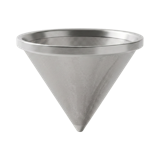
The ROK W1 is a two-part pour-over filter from the London brand ROK: a cone that sits on a base. The base is the whole idea — an inverted cone rises from it into the middle of the brewer, so when you push the tip of a paper filter inwards over it the cross-section stops being a V and becomes a W. A steel ring supplied in the box presses the paper down around that peak until it seats.
What the shape changes is the depth of the coffee. In a cone the bed is deep at the tip and shallow at the rim, and all the water funnels toward one hole, so the grounds near the exit see far more flow than the ones up the wall. The W1 replaces that with a ring of coffee at roughly constant depth and a drainage channel that runs all the way around the central peak instead of a single outlet. ROK's claim for it is "twice as even pressure distribution as traditional V shaped filters", and the practical pitch that follows is that the pour stops mattering: no gooseneck, no scales, any kettle. In the cup that reads as a clean, sweet brew closer to a flat bottom than to a cone — one reviewer calls it the halfway point between the two.
On materials, take ROK at their word and no further: the specification reads "Biodegradable Bamboo composite & Glass composite". Neither part is the raw material its name suggests. The cone is a glass composite, not glass — ROK describes the same family elsewhere in their range as a glass-filled polymer — and the base is a bamboo composite, bamboo fibre held together by a binder. That is also why it is not dishwasher safe, which ROK attributes to the biodegradable nature of the composite. The warranty is ten years, and one owner reports the cone cracking on repeated travel and being replaced without argument.
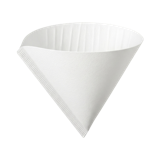
It takes standard #2 (02) cone papers — Hario V60 and Cafec both fit, and the box ships with ten. Flat-bottom papers do not. Capacity is two cups, about 250 ml in the chamber, so a 500 ml brew is poured in stages as it drains. There is no valve: it is straight percolation.
Three honest caveats from the people who use it. The geometry is not new — a V60 with a LilyDrip or a Canadiano insert does the same job, and forum readers said so the week it launched. The fold is the real skill: inverting the paper tip without tearing it is fiddly the first few times, and more than one owner tore the paper on the first attempt. And the bamboo composite has been questioned twice in public, once on a UK forum citing research on bamboo products at brewing temperatures and once by a customer on ROK's own product page, who linked the UK Food Standards Agency's advice against bamboo-plastic composites for food and drink. ROK answered on the record: bamboo composites generally use melamine as a binder, some melamine resins may release formaldehyde at higher temperatures, and they say they tested extensively and selected a variant they are confident in. Worth knowing before you buy; the judgement is yours.
Starting recipe: 15 g of coffee to 250 g of water (about 1:16.7), water just off the boil, a medium to medium-coarse grind, a short pour to wet the bed, a pause, then a second pour to the total.