Making the Majority Ingredient Visible
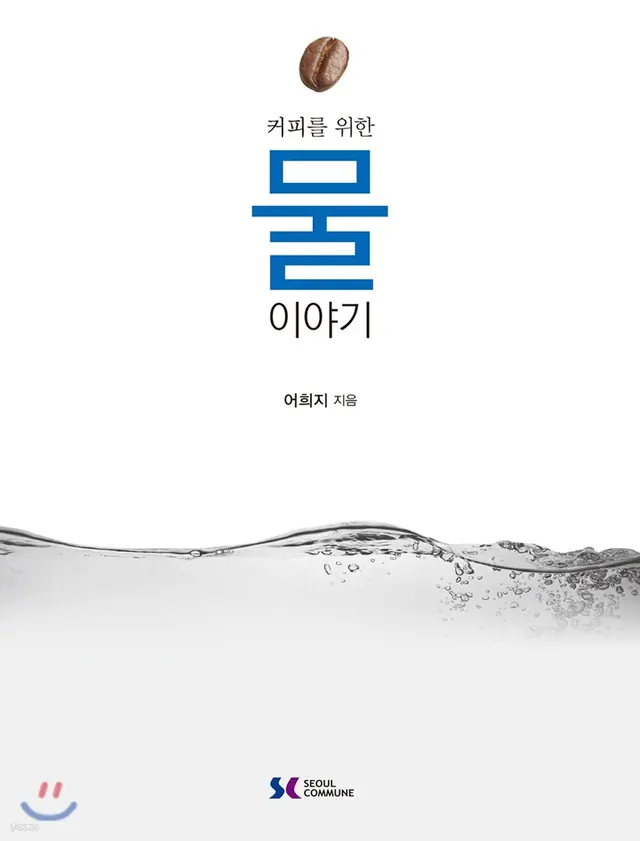
커피를 위한 물 이야기 can be translated as A Story of Water for Coffee. 어희지 begins with a common disproportion: the beverage consists mostly of water, yet many handbooks devote pages to the bean and grind while dismissing water with a generic recommendation. This 2017 Korean book makes that invisible background its protagonist.
The detailed contents on YES24 verify six chapters. It first reviews brewing concepts; then explains basic water science, classifies types of water, studies its role in coffee, presents standards and measurement, and closes with practice. Bookstore 12 reproduces the publisher’s description and confirms the ambition to connect science, sensory evaluation, and café use.
It is not merely a book of mineral recipes. Its value lies in organizing distinct questions: what water contains, how it is measured, how it behaves during extraction, how it changes perception, and which treatment is viable. The risk of such a broad map is moving from general chemistry to sensory recommendation without always making the strength of the evidence clear.
Brewing Before Discussing Water
The first chapter defines brewing, extraction, and percolation, and reviews variables such as grinding, ratio, temperature, and turbulence. It also addresses the relationship between brewing and cupping. This opening prevents every difference in the cup from being assigned to water. If two tests change dose, flow rate, or temperature at the same time, the result cannot isolate mineral composition.
The contents mention the history of technical standards and the idea of “optimal yield.” Such tools serve to describe concentration and extraction, but by themselves they do not dictate liking. A beverage within a range may be unattractive to one person; another outside it may suit their preference. Water participates both in transporting compounds and in the solution’s own flavor, so diagnosis requires measurement and tasting.
The decision to place these foundations at the beginning is sound. A water formulation only makes sense alongside a repeatable protocol. Readers need to keep coffee, grinder, dose, ratio, temperature, pour, and time constant if they want to attribute a difference to calcium, magnesium, sodium, or alkalinity.
From Molecule to Label
The second chapter covers the formation of water, its molecular structure, physical and chemical properties, natural cycle, states, and contaminants. It then addresses total dissolved solids, hardness, and the pH scale. The third distinguishes surface water, groundwater, rainwater, tap water, purified water, mineral water, bottled water, and water regulated for consumption.
These distinctions are essential because “mineral water” does not denote one composition. Two bottles can have similar TDS and very different ionic proportions. TDS estimates a sum of dissolved materials from conductivity; it does not identify each ion. Hardness primarily expresses multivalent cations, usually calcium and magnesium. pH describes hydrogen activity at a particular moment. Alkalinity measures the capacity to neutralize acid, often dominated by bicarbonate. They are not synonyms.
The book devotes separate sections to hardness and pH, then addresses alkalinity in the context of coffee. A contemporary reading must maintain that separation even when a practical rule groups them together. Water can have high hardness and relatively low alkalinity, or the reverse. It can also show a similar initial pH and respond differently on contact with coffee acids.
What Ions Do During Extraction
The fourth chapter asks about compounds in the bean, cellular structure, solubility, extraction, and mass balance. It then presents “binding reactions” between water and coffee components and examines calcium, magnesium, sodium, carbonate, sulfate, and chloride. This is the bridge between water analysis and the cup.
A 2014 article in the Journal of Agricultural and Food Chemistry modeled the interaction of common cations with flavor compounds and argued that magnesium and calcium could influence the extraction of acids and other molecules. That work was influential, but its computational component is not equivalent to universal tasting and does not demonstrate that “more magnesium” always produces better coffee.
A 2024 study in npj Science of Food examined six cations and combined extraction measurements with sensory evaluation. It found that ionic identity and concentration can alter both what is extracted and what is perceived, and that the effects cannot be reduced to total hardness. This later evidence supports the book’s decision to devote specific sections to each mineral.
It also complicates simple rules. The same ion can change extraction, contribute its own taste to the solution, and alter the balance with acidity or bitterness. Concentration matters; a conclusion observed in one matrix should not be extrapolated to every origin, roast, or recipe. Formulation is a multivariable problem.
Alkalinity Is Not a Detail
Alkalinity receives attention because it buffers acids entering from the coffee. If it is very high, a bright beverage may taste flat; if it is very low, acidity may be weakly buffered. This explanation is more precise than attributing everything to initial pH. Two waters with the same pH can hold very different bicarbonate reserves.
The contents connect carbonate with mass balance and extraction. Two planes should be separated: the quantity of material that moves from the solid into the beverage, and the way the resulting solution is perceived. Partially neutralizing acids can alter flavor without changing measured total yield in the same proportion. Conversely, changing a cation can alter extraction and also add its own gustatory effect.
Responsible practice records alkalinity and hardness with units and method. Expressions such as “ppm as CaCO3” are calculation equivalents, not a claim that the water literally contains that mass of calcium carbonate. The book helps introduce the vocabulary; readers should verify how each instrument expresses its result.
Standards, Measurement, and Treatment
The fifth chapter studies water standards for coffee, supply quality in Korea, treatment systems, and metrics. The contents list TDS, hardness, pH, and alkalinity meters. The sixth moves to applications: filters, cupping water, espresso water, and filter-coffee water.
A professional standard is an operational starting point, not a natural boundary between good and bad flavor. It must also account for equipment: hardness and alkalinity affect deposits, corrosion, and machine stability, not only the cup. A café may need to balance sensory preference, equipment protection, supply consistency, and cost.
Classifying treatments also demands care. A carbon filter can reduce odors and some compounds, but not necessarily hardness. Ion exchange replaces some species with others. Reverse osmosis broadly reduces dissolved material and usually requires remineralization or blending. Boiling does not turn every water into a suitable formulation. “Filtered” describes an incomplete process if the medium used is unknown.
Later Sensory Evidence
Research published since the book confirms that preference cannot be derived from one number. A study of sodium, extraction, and perception found responses dependent on concentration and brewing conditions. Sodium is not simply desirable or undesirable: it can participate in extraction and modulate flavors, with a threshold beyond which its own presence matters.
Another experiment on brewing waters observed physicochemical and sensory differences among compositions. As in all such studies, the number of coffees, recipes, and panelists limits generalization. Together, they support the method of comparing waters under a stable protocol, not one mineral recipe for every coffee.
There is also a 2017 Korean article about hardness, TDS, and coffee characteristics by 어희지 and collaborators. It is relevant to understanding the author’s technical context, but it is not an independent validation of her book. It should be read as related output from the same researcher.
Reception and Limits
YES24 shows customer ratings, and both stores reproduce editorial presentation copy. No broad independent critical review or sufficient evidence for measuring professional adoption was located. The dossier does not turn commercial ratings into consensus.
The promotional description states that water changes flavor and that the book offers theory and practice. The general claim is supported by the literature, but every specific recipe or range requires its own validation. The volume appeared before several experiments that better separated ionic identity, concentration, and preference. Its framework is compatible with that research; it should not retroactively receive conclusions that it could not cite in 2017.
Another limitation is geographical. The sections on Korean regulation, supply, and measurement do not transfer automatically to Spain, Latin America, or any other network. Parameter names and chemical principles can be compared; legal limits, disinfectants, seasonal profiles, and reporting units must be verified locally.
Edition and Access
YES24 and Bookstore 12 identify ISBN 9791185060156, author 어희지, publisher 서울꼬뮨, and publication on June 9, 2017. YES24 records 207 pages. The listings do not unambiguously document the binding, so Gota uses the generic format “print” and does not infer paperback from the dimensions.
No commercial English edition has been verified. A Story of Water for Coffee is a Gota editorial translation; the documented edition is in Korean. That language barrier does not diminish the importance of its central question: saying “good water” is not enough. Composition, buffering capacity, measurement, treatment, the coffee’s response, and the drinker’s preference must be distinguished.