What Kind of Book It Is
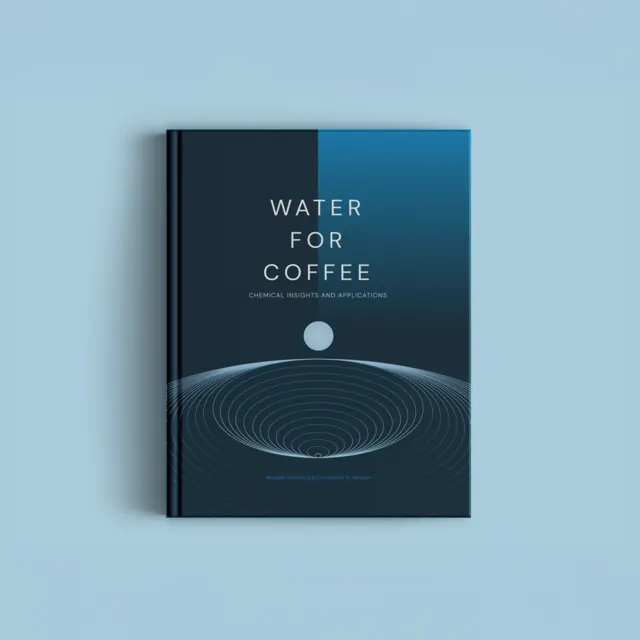
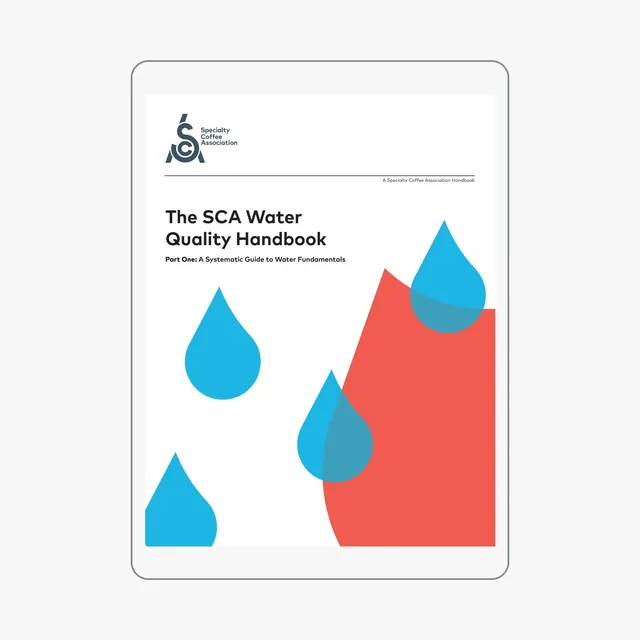
The 2018 SCA Water Quality Handbook is an institutional technical handbook about water for coffee. Marco Wellinger, Samo Smrke, and Chahan Yeretzian approach the subject through chemistry and operational needs: describing what water contains, understanding how that composition may participate in extraction, choosing or evaluating a treatment, and preventing a solution for the cup from becoming a problem for the installation.
The ZHAW Digital Collection classifies it as a book, identifies all three authors, dates publication to 2018, and names the Specialty Coffee Association as publisher. Its keywords, “Water Quality” and “Coffee Flavor,” condense the bridge it attempts to build. The SCA currently sells it as a digital download. It is therefore neither an isolated standard nor a domestic guide to recipes made with salts: it is a professional document connecting beverage quality, measurement, and treatment.
That framing matters because “good water” can mean different things. For a cupper, it may mean water that allows acidity, sweetness, and aromas to express themselves. For someone maintaining an espresso machine, it may mean a composition that limits scale or corrosion. For someone managing several shops, it may mean a reproducible condition. The three goals are related, but they do not always coincide.
Verifiable Content and a Cautious Account of Its Structure
The public pages consulted provide neither a complete table of contents nor an authorized preview of the text. We therefore do not attribute specific chapters, tables, limits, or recipes that cannot be verified. The title, authorship, keywords, and institutional character do allow four defensible axes to be defined: water composition, its relationship to flavor, quality assessment, and treatment decisions.
The SCA coffee standards page helps place the handbook within a tradition of specifications for brewing and evaluating coffee. A specification defines an operating range or a shared language; it does not demonstrate that every coffee reaches its sensory maximum at one single point. The handbook is best read as an explanation of the variables that make a specification useful and of the trade-offs that emerge when treating real water.
This requires separating quantities that are often confused. Total dissolved solids summarize concentration, not identity. Hardness and alkalinity are not synonyms. Conductivity permits comparison, but by itself it does not say which ions produce the reading. Water softened by exchange may have little calcium and magnesium hardness while also containing more sodium. Without that distinction, two waters with the same figure may behave differently in the beverage and in the machine.
Mineral Composition and Extraction
The 2014 study The Role of Dissolved Cations in Coffee Extraction, whose authors include Christopher Hendon, Lesley Colonna-Dashwood, and Maxwell Colonna-Dashwood, modeled the interaction of sodium, calcium, and magnesium with selected coffee compounds. It found different binding energies, with stronger interactions for magnesium than for sodium in the model. The article made ionic identity a central question in the contemporary discussion of water.
It was not, however, a broad sensory comparison of coffees brewed in cafés. Computational chemistry studies molecular relationships under defined assumptions; by itself, it does not reproduce grinding, flow, roast, concentration, temperature, and perception. Even its authors warn that no single composition guarantees a flavorful extraction for every coffee. The handbook is useful when it helps interpret mechanisms, not when a table is turned into dogma.
Subsequent research has added qualifications. A 2024 experimental study examined calcium and magnesium and quantified organic acids. At concentrations typical of drinking water, it observed limited effects; differences were more visible at much higher concentrations. The similarity between adding salts before and after brewing led the researchers to consider that part of the interaction might occur in the beverage or during perception, rather than exclusively through an increase in extracted material.
The two studies are not incompatible because they ask different questions. One models affinities; the other measures analytes in an experimental protocol. Together, they prevent water from being reduced to the formula “more magnesium, more extraction” and support a more restrained practice: hold coffee and recipe constant, change one composition under controlled conditions, measure, and taste blind.
Alkalinity, Sodium, and Sensory Outcome
Alkalinity describes the capacity to neutralize acids and shapes how a beverage expresses acidity. It is not equivalent to pH or hardness. Two waters with similar pH can respond differently to coffee if their alkaline reserve differs. A treatment that reduces scale can also alter this balance, so a technical decision ultimately reaches the cup.
A 2024 study of sodium and sensory cleanness compared waters and added sodium citrate to brewing water. Under its conditions, increased sodium raised the recorded saltiness and reduced the impression of cleanness. This is direct evidence that an ion can matter at low concentrations, but the panel consisted of six people and “cleanness” depended on the protocol. It establishes neither a universal limit for all water nor that any presence of sodium ruins coffee.
The operational lesson is that the name of a treatment is not enough. Reverse osmosis, carbon, ion exchange, blending, and remineralization solve different problems and require characterization of the incoming water. Effectiveness also changes with flow rate, temperature, media exhaustion, and maintenance. Copying equipment installed in another city without comparing analyses can produce an expensive solution to a different problem.
Machine, Maintenance, and Trade-Offs
Water circulates through boilers, pipes, valves, and hot surfaces. Carbonate hardness can encourage deposits; highly aggressive compositions may increase corrosion risk. The best cup in an isolated test is not automatically the best policy for a business that must operate every day. Equipment, temperature, volume, and the maintenance program all belong to the decision.
Here the handbook has an advantage over works focused only on recipes: it forces the reader to state the complete objective. Is the purpose to protect an espresso machine, stabilize a batch brew, correct odors, compare shops, or design a cupping water? Each answer changes the required measurements. It also changes the acceptable cost, complexity, and failure risk.
No guide replaces local analysis or the manufacturer’s instructions. A municipal report, hardness and alkalinity titrations, a conductivity meter, and a laboratory do not say exactly the same thing. Salts used to formulate water demand precision and food-safe materials. This dossier does not reproduce doses or limits from the handbook because the open sources do not allow them to be verified and because applying them out of context would be imprudent.
Edition and Access
ISBN 9780999580738 has a valid check digit. ZHAW records it in hyphenated form as 978-0-9995807-3-8, published in 2018 by Speciality Coffee Association. The spelling difference between “Speciality” in the record and “Specialty” in the institution’s current name does not indicate two publishers or two editions.
The SCA store displays a paid digital product and states that its products are downloads. It gives no public page count and does not make it possible to determine from the listing whether the current file has received silent corrections. The catalog therefore retains a single digital manifestation, uses only the year, and assigns no pagination. To cite a specific claim or table, the purchased file must be consulted and its own version recorded.