What kind of book it is
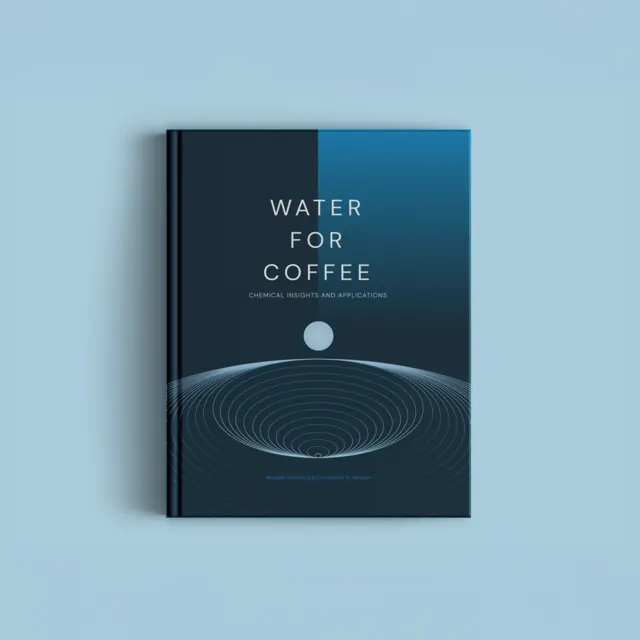
Water for Coffee is a specialized manual on water chemistry applied to coffee. It is not a collection of mineral recipes, a filter-buying guide, or a general introduction to brewing. Its central question comes before all of these: what water actually contains and how that composition can change extraction, perception, and equipment operation.
The second-edition description published by Maxwell Dashwood mentions chemistry and some physics, and attributes to Maxwell Colonna-Dashwood and chemist Christopher H. Hendon the aim of providing tools to anticipate how a water and a coffee will interact. Eight Ounce confirms that scope and explicitly identifies it as the second edition. This is a promise of understanding and practical prediction, not a guarantee that one formula will produce the same flavor with every bean, roast, or method.
That distinction is essential. Two waters with the same total dissolved solids reading may contain different ions. Hardness and alkalinity are not synonyms either: the former usually expresses the equivalent presence of calcium and magnesium, while the latter describes acid-neutralizing capacity. A conductivity meter can be useful for observing changes, but it cannot by itself identify which salts produce the reading. The book matters because it shifts the discussion from “high or low mineralization” to composition, balance, and purpose.
What can be verified about the contents
No complete authorized table of contents for the second edition has been located. This dossier therefore does not attribute chapters, diagrams, recipes, or specific studies that the available listings do not allow us to verify. The descriptions agree on four subjects: water composition, its effect on acidity and body, its relationship with extraction, and consequences for roasting and brewing. They also agree that the book combines chemical explanation with tools for application.
The Fresh Cup review reveals the architecture of the 2015 first edition, but it should not be transferred automatically to the 2025 revision. That volume began with fundamentals of chemistry and physics, explained the properties of water and dissolved minerals, and then moved to measurement, filtration, specifications, and café case studies. The review emphasized that a TDS reading does not reveal mineral identity. That idea remains in the new promotion; the exact sequence, wording, and examples may have changed.
The second edition appeared ten years after the first. In 2018, Daily Coffee News reported that the authors were working on revised content, new infographics, and possible translations. That report documents a revision process, not its final result. It does not establish which graphics survived, which recommendations were withdrawn, or how much text is new.
Hardness, alkalinity, and ionic identity
The book's most durable pedagogical contribution is separating quantities that commercial language mixes together. “Soft water” may mean low hardness, but an ion-exchange softener can replace calcium and magnesium with sodium without reducing all solids in the same way. Water with high alkalinity can buffer some perceived acidity even if its hardness is not extreme. Chlorides, sulfates, and bicarbonates accompany the cations and are also part of the system.
Hendon, Lesley Colonna-Dashwood, and Maxwell Colonna-Dashwood's 2014 article, The Role of Dissolved Cations in Coffee Extraction, used computational chemistry to compare the binding energies of sodium, calcium, and magnesium with several coffee compounds. The model found stronger interactions for magnesium and weaker ones for sodium. The authors nevertheless warned that there is no single composition capable of producing a flavorful extraction with every coffee, and that bicarbonate, roast, and the balance of compounds alter the result.
That paper is an intellectual foundation of the work, but it was not a double-blind tasting and did not measure a complete cup. It modeled selected molecules and thermodynamic relationships. Turning its binding energies into a direct sensory rule would go further than the experiment. The book is strongest when it teaches what to measure and compare, rather than when a reader extracts a universal “best water” from it.
What later science requires us to qualify
A 2024 experimental study of calcium, magnesium, and the extraction of organic acids added salts before and after brewing and analyzed acids using GC-MS and NMR. At concentrations typical of drinking water, it found limited variation; differences were clearer at concentrations ten times higher. The similarity between additions before and after brewing led the authors to propose that, for the acids studied, some relevant interactions might occur in the beverage or in perception, rather than because the water necessarily extracts much more material.
The finding does not “refute” all of the 2014 computational chemistry. It studies particular analytes, particular salts, and a different protocol. It does prevent the idea that more magnesium automatically extracts more acids from being presented as a macroscopic law already demonstrated for the cup. Its authors specifically call for more sensory evaluation and more analysis of less soluble compounds.
Another 2024 paper examined sodium and the impression of cleanness. It compared waters, measured ions, and added sodium citrate to brewing water. Under those conditions, recorded saltiness increased and the “cleanness” score decreased. This is direct evidence that small amounts of an ion can matter sensorially, but the panel consisted of six volunteers and cleanness was an attribute defined within that protocol. It does not authorize a universal maximum or the assumption that sodium always worsens every beverage.
Together, these studies change the kind of certainty that is reasonable. Water composition does deserve attention; TDS alone is insufficient; exact mechanisms and sensory thresholds remain open. Measuring before and after, keeping the coffee and recipe constant, and tasting blind is more defensible than adopting a table as truth independent of context.
Reception and influence
The professional reception located pertains primarily to the first edition. Fresh Cup valued it as practical education for scientists and enthusiasts, but warned that its technical pages were not light reading. Daily Coffee News described a notable effect in 2018 on the attention professionals and consumers paid to water. It also connected the knowledge produced by the book with the later development of filtration products, although that commercial relationship does not demonstrate the efficacy of any particular device.
No extensive independent critical review of the second edition has been found. The Maxwell Dashwood, Scott Rao, Eight Ounce, and other distributor pages describe the product; they do not evaluate it. It would be misleading simply to transfer praise from 2016 to a text revised ten years later. Historical influence can be attributed to the work; the comparative quality of this version requires its own critical reading.
Practical and scientific limits
Water has at least two functions that can come into tension: producing a desired beverage and protecting equipment. A composition attractive in a tasting may increase scale risk; treatment designed for a boiler may change sodium, alkalinity, or flavor. Method matters too. Espresso operates with concentration, pressure, heat, and metal surfaces different from immersion or paper filtration. “Optimal” always needs the rest of the sentence: for which coffee, which machine, which maintenance regime, and which sensory goal.
The book does not replace local analysis either. Reports from a water utility, a hardness and alkalinity titration, and a laboratory analysis answer different questions. A salt recipe prepared with demineralized water requires careful measurement and consideration of food safety; it should not be copied from an editorial summary. This dossier does not reproduce quantities because the open sources consulted do not allow them to be verified in the second edition.
Edition and access
The cataloged edition bears ISBN 9781399980449, whose check digit is valid. Eight Ounce documents 156 pages, hardcover, English, a 2025 copyright, and publication by Maxwell Dashwood in Great Britain. Someware confirms the same data. The author's listing announced “autumn/winter 2025,” without a day.
Distribution crossed the turn of the year. Some stores listed the ISBN as a 2026 new release or preorder. This may reflect receipt of stock rather than a different edition: title, authors, ISBN, and physical characteristics match. Gota retains 2025 as the year of copyright and publication declared in the book and does not invent an exact date.
No translations or other print edition have been added because no distinct ISBNs were found with two specific sources. For a technical reader, this second edition is an invitation to formulate the water problem more precisely. Its safest lesson is not a formula: it is to stop confusing a total figure with composition and to test every recommendation against the coffee, method, equipment, and tasting.