What kind of book it is
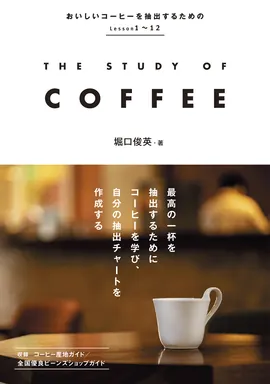
THE STUDY OF COFFEE is a 2020 Japanese manual connecting green-coffee quality, roasting, brewing, and sensory evaluation. Its author, 堀口俊英, founded Horiguchi Coffee and returned to academic study after decades of professional activity. The work incorporates some of his university data and proposes ending not with a universal recipe but with an extraction chart adapted to the reader.
The 新星出版社 listing defines that aim precisely: explain how green-coffee quality produces good flavor, present part of the chemical support obtained in graduate study, and teach readers to express and evaluate the beverage through physicochemical figures. That combination justifies treating it as a practical scientific reference, but the book as a whole is not a peer-reviewed article.
The English title may suggest an international treatise, although the text and its editorial context are Japanese. No commercial translation into another language has been verified. “The Study of Coffee” is the editorial title of this dossier, not evidence of a separate English-language edition.
Twelve verified lessons
The complete structure appears in the publisher's launch material and can be cross-checked against reviews that work through the volume. The twelve lessons progress from green coffee to personal evaluation. The first covers the relationship between bean quality and flavor; the second introduces chemical data; the third asks about the function of roasting. Lessons four through nine form the brewing core: fundamentals, different drippers, diversification of pour-over, the author's method, variation factors, and construction of a personal chart.
The final three address sensory language, evaluation, and blends. An appendix gathers a guide to producing countries, bean purchasing, and seminars from the author's institute. The CoffeeSwamp review reproduces that sequence and highlights the use of data from his time at Tokyo University of Agriculture.
The architecture matters because it does not separate brewing from the material being brewed. A TDS value or extraction percentage does not by itself describe green quality, roast development, defect, or preference. The book attempts to place these measurements within a chain and end in tasting. That ambition is broader than teaching readers to pour water over a dripper.
Doses, formulas, and the boundaries of its chart are not reproduced here. Open reviews summarize procedures, but they are not an adequate source for copying parameters precisely. Moreover, presenting an isolated value without the coffee, instrument, and method that produce it would contradict the book's own comparative approach.
From craft to research
The author's trajectory explains the project. The publisher presents him as a doctor of environmental studies, head of the 堀口珈琲研究所, and a figure in Japanese coffee associations. His doctoral thesis, deposited by Tokyo University of Agriculture, studied correlations between physicochemical and sensory evaluation to construct specialty-coffee criteria. The repository confirms the degree, the 2019 date, and access to the work.
Part of that research appeared in 2019 as a paper on organic acids, lipids, acid value, and quality. It compared commercial and specialty samples from Kenya, Guatemala, and Colombia. It measured pH, titratable acidity, citric and acetic acids, lipids, and acid value, and related those data to sensory scores.
Coffees classified as specialty scored above 80 points and showed differences in several measurements. The article proposed acid value as a possible indicator and related acids and lipids to acidity and body. This is relevant evidence for the scientific origin of the book. It does not demonstrate that a single value identifies quality in every coffee: the samples also differed in selection, storage, transport, and packaging, and the design covered three countries and specific lots.
That caution changes how the word “objective” should be read. Measuring pH, Brix, TDS, or yield can make a comparison more explicit. The choice of which attribute deserves a high score and which cup is preferred still incorporates a protocol and human judgment.
Building a personal chart
The goal of a personal chart distinguishes the book from a closed standard. A brewing chart relates concentration, yield, ratio, and sensory observation. It can help repeat a result and record where different profiles appear. Its usefulness increases when coffee, water, grinder, dripper, and temperature are documented.
Later science reinforces the idea of personalization. The new Coffee Brewing Control Chart of 2023 integrated tens of thousands of descriptive measurements and more than three thousand liking ratings. It found two consumer groups with different preference zones and replaced the simple notion of an “ideal” box with surfaces of attributes and liking.
It is not the same chart as Horiguchi's and does not validate its boundaries. The research used drip coffee and a mostly young population in Northern California. It does support a compatible principle: strength and extraction describe a beverage, while the desirable point also depends on profile and person. Building a personal chart is more defensible than obeying a single zone without tasting.
Measurement must also acknowledge error. Refractometers and conversions from Brix to TDS depend on calibration, temperature, sample filtration, and the mathematical model. Calculated yield inherits errors in mass and water retention. A number with decimals is not automatically truer than a well-designed tasting.
Temperature, dripper, and coupled variables
The central lessons cover fundamentals and dripper diversity. This plurality avoids treating pour-over as a single device: geometry, channels, filter, and holes change resistance and flow. The pouring gesture also changes water level, agitation, and temperature. Comparison requires holding more than the nominal recipe constant.
A 2020 sensory study illustrates the problem. It brewed at 87, 90, and 93 °C but adjusted grind and flow to reach the same combinations of TDS and yield. With those compensations, temperature had a small sensory effect. The conclusion is not that the kettle is irrelevant. It is that temperature acts within a system and that two brews can reach similar results by different paths.
For the book's reader, the practical consequence is to record the outcome as well as the input. Saying “I used 90 °C” does not report strength, time, yield, or flavor. Saying “this dripper is faster” does not separate filter, grind, coffee, and pouring. A personal chart can be useful precisely because it forces conditions, measurement, and perception to be connected.
Expressing and evaluating flavor
Lessons ten and eleven separate language from evaluation. Describing citrus, floral, roasted, or body is not the same as deciding quality. A descriptor attempts to communicate a perception; a score applies a criterion. The work seeks to support both with measurements, but no chemical measurement by itself reproduces the complete experience of aroma, taste, and texture.
Horiguchi's article provides an example of useful but limited correlation. It found associations between pH and sensory acidity, and between lipids and body in some samples. A correlation across six groups cannot automatically diagnose another cup. Roast, preparation, serving temperature, and panel training can change perception. The very fact that specialty and commercial lots followed different logistics chains introduces competing explanations.
The most productive lesson is not to replace the palate with a laboratory. It is to make each question the other. If two cups receive different descriptions, a measurement can help investigate why; if a figure changes and the panel detects no difference, the change may not be sensorially relevant under those conditions.
Reception and limits
The open reception located comes from specialist readers, not academic journals. Every Coffee places it between a light introduction and a dense scientific text and considers it appropriate for an intermediate level. CoffeeSwamp values the freshness of the data, depth, and professional character. These are favorable accounts, but not an independent audit of methods or conclusions.
The volume's breadth imposes limits. In 256 pages it covers green coffee, chemistry, roasting, numerous drippers, extraction, sensory work, blending, and producing countries. None receives the detail of a monograph. The author's research adds substance, but also proximity: the book interprets work in which he participated. Published data, company experience, and pedagogical recommendation should be distinguished.
Nor is it a complete social or economic history. The country guide helps with buying and orientation, but it cannot represent labor relations, price, climate, and power structures in every origin. Those questions require current local sources.
Edition and access
ISBN-13 9784405093966 has a valid check digit. 新星出版社 records release on October 30, 2020, 256 pages, and A5 format; Maruzen Junkudo confirms title, author, publisher, ISBN, and date. Some stores show the 29th, probably as commercial availability, but there is no reason to replace the official date.
The publisher also offers electronic access from its page, but the cataloged record is the print edition and no other ISBN has been added without two sources of its own. The binding is not labeled hardcover or paperback either: A5 describes size, not cover.
THE STUDY OF COFFEE may be especially useful for someone who already brews regularly and wants to relate green coffee, roasting, measurement, and tasting. It does not deliver a universal numerical truth. It offers something more defensible: a method for building personal evidence, provided the correlations remain attached to the samples and conditions that produced them.