What Can Be Said About the Book
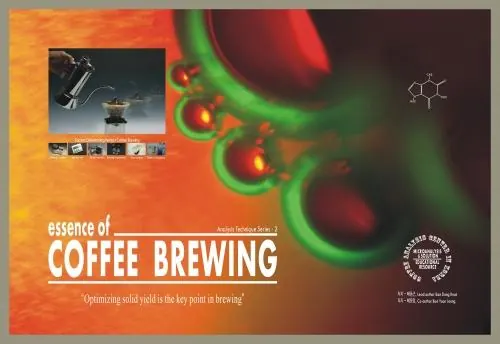
에센스 오브 커피 브루잉 is a Korean technical handbook by 배동근 and 배윤정, published in 2015. The Kyobo listing records ISBN 9788996743934, 311 pages, and an October 1 publication date. BookPrice independently confirms the title, ISBN, and date, and associates the work with 커피분석센터. It is a substantial bibliographic object, not a pamphlet or a translation of an English-language handbook.
Gota’s catalog places it here because of its focus on brewing analysis, extraction, measurement, and process control. That description must be read with documentary caution: the public listings do not provide enough of an authorized preview to reconstruct the entire table of contents, recipes, or tables. This dossier explains the technical field the book occupies and separates verified information from the external science used to contextualize it.
Its inclusion is also bibliographically important. Much of the international conversation about extraction circulates in English, while South Korea developed its own training, publishing, and professional practice. The absence of a commercial translation does not diminish a work’s existence or local relevance. The interface’s six localized versions of the title and summary are navigation aids; they do not claim that the book is available in those languages.
A Work Within a Training Series
Kyobo presents the 2015 volume as a 311-page work. The same retailer later records 에센스 오브 커피 브루잉 주니어 1, published in 2018 under a different ISBN with 86 pages, within a series described as extraction material and a practical guide. The existence of the junior volume helps identify a training line, but it does not authorize transferring its contents, teaching format, or material to the main handbook.
The relationship between the two titles suggests different levels and uses: a broad reference book and shorter later materials. “Junior” does not mean a second edition or a translation. The catalog therefore neither merges them nor adds ISBN 9788996743958 as another manifestation of the same text. They are different bibliographic products.
Without verifiable access to the main volume’s complete contents, its structure is described by function rather than through invented chapters. Analytical training in brewing must connect raw material, grinding, ratio, water, temperature, contact, filtration, measurement, and sensory evaluation. Identifying these as the field’s axes does not mean that we know the exact order or the figures used by the authors. Citing a recipe, equation, or page requires consulting the physical copy.
Measurement Does Not Decide for the Palate
Measurement supports repeatability. Weighing coffee and water preserves a ratio; timing helps comparisons; observing temperature and grind narrows the range of changes; measuring dissolved solids makes it possible to estimate strength and, with dose and beverage data, calculate an approximate extraction yield. No figure, however, contains sensory preference by itself.
The 2020 scientific review of coffee extraction organizes a field in which mass transfer, solubility, particle size, temperature, hydrodynamics, and method interact. That complexity supports the idea of process control. It also prevents any one variable from being treated as an independent dial. Grinding finer changes surface area, but in percolation it may also alter resistance and flow; increasing time does not affect all compounds equally; a final concentration reading does not describe uniformity within the bed.
The most robust use of a technical handbook is to construct comparisons. Establish a starting condition, deliberately change one variable, record the result, and taste. Measurement reduces ambiguity, but the cup still requires interpretation. Two beverages with similar yield may differ in extraction distribution, compounds, and preference.
Grinding and Particle-Size Distribution
Speaking of “grind size” as a single number simplifies a population of particles. Every grinder produces a distribution containing fragments of different sizes. Shape, bean brittleness, burr design, alignment, and setting affect that distribution; the method then converts those differences into available surface area, resistance, or sediment.
A 2023 French press experiment compared conventional heterogeneous grinds with more homogeneous sieved fractions. Under its conditions, the conventional grinds extracted more solids, bioactive compounds, and volatiles than several isolated fractions. A uniform fine fraction did not automatically produce the maximum result for every measure.
This is not a recommendation to seek inconsistency. The study used immersion and does not reproduce a gravity filter, moka pot, or espresso. It does show why analysis must consider distribution and method rather than only a fine or coarse label. A handbook centered on control is valuable precisely when it teaches readers to relate grinding to the complete system.
Methods Produce Different Profiles
A 2023 comparison of V60, AeroPress, French Press, and Pure Brew used the same coffee and analyzed volatile compounds and sensory attributes. The methods could be distinguished. Under those conditions, paper and metal systems were associated with different profiles, a result consistent with differences in filtration, contact, and extraction dynamics.
The study does not establish a universal ranking. It used a particular coffee, set of recipes, and panel. A different origin, roast, water, paper, grind, or concentration can change perception. Its methodological contribution to reading Essence of Coffee Brewing is that devices are not interchangeable vessels and that comparisons need to control more than the method’s name.
This also affects professional standardization. A recipe can be a useful training procedure and still require adjustment when the lot changes. Repeatability means being able to distinguish the effect of a change; it does not mean freezing the outcome. Controlling a process means keeping its conditions visible and knowing which decision to modify.
Reception and Documentary Limits
No substantial independent critical review of the book was located in the accessible sources. Kyobo is a commercial listing; BookPrice aggregates metadata and price comparisons; the junior volume demonstrates editorial continuity, not reception. There is no basis for calling it a canonical text, a bestseller, or a national standard.
The lack of international reviews may be related to language and distribution, but that is a hypothesis, not a fact. What can be verified is that the edition exists, has 311 pages, circulated commercially, and generated a later line of training material. The dossier does not replace direct reading and does not claim to evaluate the prose, the accuracy of every table, or the quality of the illustrations without access to the text.
The date must also be considered. Extraction science, refractometers, grinders, and competition methods have evolved since 2015. A procedure may retain pedagogical value while still requiring comparison with current instruments, standards, and literature. The scientific review cited here is independent context; it does not prove that the book anticipated its findings or that every recommendation agrees with them.
Edition and Recommended Use
ISBN 9788996743934 has a valid check digit. Kyobo identifies a 311-page Korean edition, and BookPrice confirms the bibliographic record. The catalog uses hardcover according to the commercial listing and retains 커피분석센터 as publisher. It does not add page counts to nonexistent editions or create manifestations in English, Spanish, Japanese, Portuguese, or German.
It is an especially relevant reference for readers of Korean, trainers, and libraries seeking to broaden the geography of their technical collection. For readers who do not know the language, this record serves to identify the work correctly, not to promise access to its content. Its place in the catalog rests on a simple idea: the history of analytical brewing does not belong to a single language, and documenting it requires recognizing sources that Western indexes often omit.