From the Bean to Twenty Methods
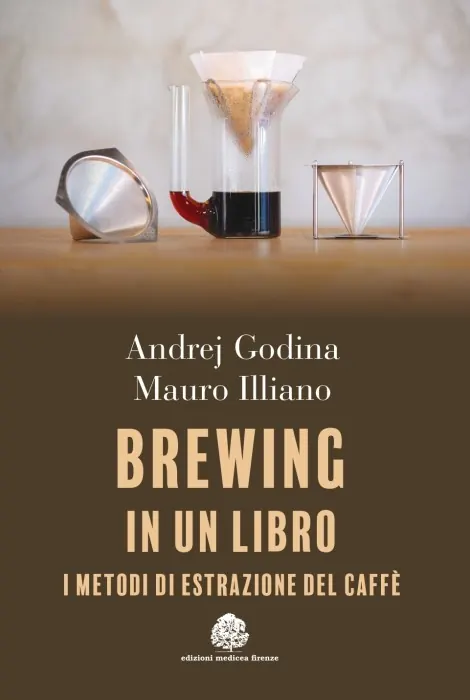
Brewing in un libro. I metodi di estrazione del caffè is an Italian handbook by Andrej Godina and Mauro Illiano. Edizioni Medicea, the publisher, records 160 pages, ISBN 9788898015818, and a sewn paperback binding. Comunicaffè documented its presentation at Sigep on March 12, 2022, and published an extensive table of contents and a French Press reference sheet.
The title promises brewing, but the book does not begin with pouring. It covers history, botany, cultivation, processing, sustainability, roasting, storage, tasting, water, and grinding before reaching parameters and methods. This architecture attempts to prevent a recipe from being isolated from its raw material. The result is presented as a foundation and intermediate handbook associated with the Coffee Skills Program, not as peer-reviewed research.
The breadth is deliberate. To understand why a cup changes, readers must know what coffee they received, how it was roasted and stored, which water and particles they are working with, and how the method organizes contact. Within 160 pages, each section must necessarily function as an introduction. The work provides continuity and vocabulary; it does not replace a specialized monograph on every subject.
The Documented Structure
Comunicaffè reproduces a sufficiently detailed table of contents to describe the work without conjecture. The opening sections cover the coffee world, consuming countries, coffee waves, specialty coffee in Italy, the botany of arabica and canephora, processes, the market, sustainability, and roasting. Then come transformations of the bean, a curve for brewing, color, oils, gases, shelf life, resting, and freezer storage.
The sensory section introduces flavore, a form for filter methods, and a simplified version. The water section addresses composition, measurement, effects on extraction, SCA charts, and filtration and softening systems. Grinding includes particle-size distribution and sieves. The fundamental parameters include ratio, grinding, temperature, turbulence, time, paper, metal, cloth, blooming, strength, extraction, the refractometer, and bypass.
The methods are grouped by percolation, immersion, pressure, cold water, and absence of filtration. The reference sheets cover French Press, two uses of AeroPress, V60, siphon, Chemex, Kalita, moka, Neapolitan pot, Clever, electric machine, cold drip, immersion cold brew, ibrik, and other devices. The closing section adds cleaning, maintenance, commercial communication, and practical questions.
The authors began with recorded tutorials and added QR codes. This audiovisual component complements the reference sheet, but it also introduces a dependency: a URL or platform can change while the physical book remains. The public description does not make it possible to verify the future availability of each resource.
Recipe, Strength, and Extraction
The French Press sheet published by Comunicaffè shows how the handbook works: it identifies the system, filter, particle size, ratio, temperature, time, and steps. That transparency supports repetition. It does not turn the values into a universal optimum. The coffee, grinder, geometry, volume, and sensory aim belong to that specific procedure.
The 2020 scientific review describes extraction as mass transfer shaped by solubility, particle size, temperature, time, and hydrodynamics. One parameter can affect others. In percolation, grinding finer changes surface area and resistance; in immersion, flow through the bed does not dominate in the same way. A handbook is right to state variables, but readers must avoid turning complex relationships into simple arrows.
Strength and extraction yield answer different questions. Strength describes concentration in the beverage; extraction yield estimates the fraction of dry mass that entered the liquid. Two cups can have the same strength but arise from different doses or yields. Nor does a yield figure decide preference or, by itself, detect uneven extraction.
The refractometer is useful when sampling, temperature, and cleaning are consistent. Its reading does not identify compounds or replace tasting. The final section’s question about whether every beverage should always be measured therefore has pedagogical value: measurement is useful when it reduces uncertainty or enables learning, not as a mandatory ritual.
Paper, Metal, Immersion, and Percolation
Classification by mechanism supports comparison. Paper, metal, and cloth retain particles and oils differently; immersion and percolation distribute contact in different ways; pressure or vacuum changes the dynamics. The recipe must correspond to that system.
A 2023 comparison used V60, AeroPress, French Press, and Pure Brew with the same coffee. Volatile analyses and the panel distinguished the methods, and paper and metal were associated with different profiles under those conditions. The result supports the book’s decision to present separate sheets. It does not demonstrate that the filter alone explains every difference or permit the methods to be ranked from best to worst.
Grinding adds another layer. A 2023 French press study compared conventional distributions with sieved fractions. Real, heterogeneous grinds extracted more of several components than some homogeneous fractions. This does not invalidate control of particle size distribution; it shows that one central number does not summarize fines, boulders, and particle shape.
Water and Roast Within the System
The water chapter introduces composition and treatment, an appropriate decision because the liquid is reactive and also circulates through equipment. The 2014 article on dissolved cations modeled different interactions of sodium, calcium, and magnesium with selected compounds. It provides a basis for not reducing water to TDS.
That computational study does not establish a universal sensory recipe. Alkalinity, anions, roast, method, and the mixture of compounds alter the cup. Control charts are tools for communication and diagnosis, not maps on which every preference has one correct coordinate.
Roasting for brewing calls for similar caution. Color, development, solubility, and rest are related, but a colorimeter does not narrate the complete thermal history. The book’s reference sheet provides variables for discussion; a roaster must test them against their own equipment and coffee.
Reception and Conflicts of Interest
The reception located is mainly sectoral. Comunicaffè reported the launch and reproduced statements, a table of contents, and a reference sheet. It is a valuable and specific source, but not an independent critical review: the article thanks companies that supported the tutorials and presents the handbook in promotional terms. Edizioni Medicea is the seller.
No extensive academic or critical assessments comparing its explanations with other handbooks were found. Nor is there a public basis for asserting sales, general curricular adoption, or influence outside Italy. Collaborations with manufacturers can provide equipment and experience; they should also remain visible so that readers can distinguish material support from neutral evidence.
The 2022 date is less limiting than for earlier works, but devices, standards, and knowledge continue to change. The studies cited here contextualize mechanisms and limits; they do not “prove” the book or validate each of its twenty recipes.
Who It Serves and Which Edition Exists
The volume is useful for Italian students, baristas, and enthusiasts seeking a continuous course from raw material to service. The combination of reference sheets, a broad table of contents, and tutorials supports training. An advanced reader can use it as a map, but will need specialized sources for modeling, water, sensory science, or maintenance.
ISBN 9788898015818 has a valid check digit. The publisher and coverage agree on 160 pages, authors, and launch price; the publisher specifies 17 × 24 cm and a sewn paperback. Because no public editorial date more precise than the March presentation exists, the catalog retains 2022. No commercial translations with their own ISBN were located.
Read within those limits, its contribution is clear: it makes visible that brewing coffee is not the repetition of a gesture, but the coordination of raw material, water, grinding, energy, time, filtration, measurement, and tasting.