What kind of book it is
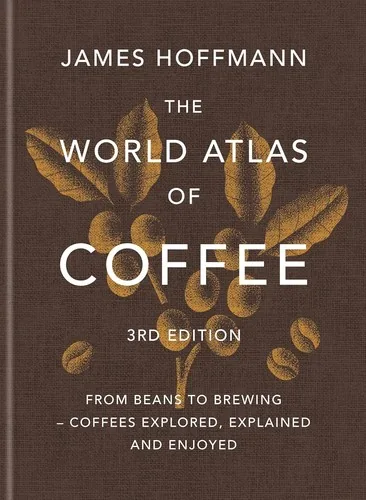
The World Atlas of Coffee is a large-format visual introduction to the coffee chain and its production geography. James Hoffmann combines fundamentals about the plant, harvesting, processing, and trade with a second scale extending from roasting and brewing to country profiles. The result is neither an atlas in the strictly cartographic sense nor an academic monograph: it is an illustrated reference work that attempts to translate a complex sector for non-specialist readers and professionals in training.
The structure of the first edition can be verified in the WorldCat record and library catalogs. It begins with arabica and robusta, the tree, fruit, varieties, harvesting, processing, and trade; continues with roasting, buying, tasting, grinding, water, brewing, espresso, and home roasting; and then surveys origins in Africa, Asia, and the Americas. Geography occupies much of the volume, but it comes after an explanation of why provenance does not act alone.
That architecture is its main editorial virtue. A country is not reduced to a flavor note. History, internal regions, species, variety, altitude, harvest, processing, trade, and roasting can change what reaches the cup. The atlas offers a vocabulary for beginning to ask about those layers. Its limitation is the same as that of every global synthesis: a page or spread cannot represent all the agricultural, political, and cultural diversity of a territory.
Three English editions that are not interchangeable
The 2014 North American edition, ISBN 9781770854703, was published by Firefly Books. Library Journal identifies it as a 256-page work with photographs, maps, and an index. Its review values the journey from plant, harvesting, processing, and trade to a tour of Africa, Asia, and the Americas, and recommends it for collections related to agriculture, business, and nutrition.
The second British edition, ISBN 9781784724290, appeared on October 4, 2018. The Hachette listing confirms hardcover and Mitchell Beazley; commercial records agree on 272 pages. In an interview with The Coffee Compass, Hoffmann explained that he updated statistics, expanded the history, and added six countries: Haiti, the Democratic Republic of the Congo, Uganda, China, Thailand, and the Philippines. He also acknowledged the difficulty of closing information in a dynamic industry.
The third edition, ISBN 9781784729868, was released on October 9, 2025. Hachette documents 288 pages, hardcover, and new chapters on decaffeination and release immersion brewers, as well as Australia, Japan, and Puerto Rico as origins of interest. These are changes declared for this edition; they should not be projected onto copies from 2014 or 2018.
Ebook ISBN 9781784725716 accompanies the second edition and has the same on-sale date. The specific Hachette listing documents the format and ISBN. Some platforms assign it 272 pages, while others give locations or screen counts. Gota does not transfer fixed pagination to it because a reflowable file does not necessarily retain the physical extent of the hardcover.
Verified translations
The first cataloged Korean translation, 커피 아틀라스, ISBN 9788993461268, was published by 아이비라인. The Seoul Metropolitan Library records 2015, 256 pages, translation by 김민준 and 정병호, and supervision by 김병기. Kyobo shows a reprint listing dated August 15, 2016, and identifies December 21, 2015, as the first printing. The catalog retains that initial date; it does not turn the reprint into another edition.
The Korean revision, ISBN 9791192066141, was released on November 21, 2022. Kyobo confirms hardcover and 274 pages, while BookPrice corroborates ISBN, date, title, and extent. Its table of contents corresponds to the framework of the second English edition. The two additional pages compared with the English 272 belong to Korean layout, not a demonstrated expansion of content.
The first German edition, Der Kaffeeatlas, ISBN 9783833845321, appears in the Stadtbücherei Nürtingen as a Hallwag edition published in Munich in 2015, 256 pages, translated by Reinhard Ferstl. Wein.plus confirms ISBN, hardcover, and extent. Amazon gives September 1, but the two independent sources selected for the record clearly support the year, not the day; 2015 is retained to avoid precision from a single commercial source.
The revised German edition, ISBN 9783965842977, was published on April 8, 2023. ZS Verlag declares hardcover, 272 pages, and the second edition of the work; Schulthess confirms German, binding, extent, and translation by Lisa Heilig. The bibliographic listing's “first edition” for that ISBN and the promotion's “second edition” of the atlas are not contradictory: it is the first printing of that revised translation and corresponds to the second English content.
Place, processing, and the problem of “terroir”
The atlas uses origin as an organizing principle, but flavor does not come from a national border. A 2022 review of coffee terroir proposes that species, variety, environment, management, harvesting, and postharvest practices contribute together. It also insists on standardizing roasting, grinding, and tasting when comparing provenances. Without that control, a difference attributed to place may be due to processing or how the sample was prepared.
A 2023 study of 46 arabica lots analyzed volatile compounds in green and roasted coffee. It was able to discriminate effects of origin, processing, and roasting, but roast level was the strongest factor in roasted coffees and process classification was less robust. This result supports the idea that origin leaves signals while preventing a country profile from being read as a fixed sensory destiny.
The book's maps are therefore historical and productive orientations. Within Ethiopia, Colombia, or Indonesia there are heterogeneous altitudes, varieties, microclimates, commercial structures, and postharvest practices. A country description helps begin; it does not authorize blind identification of a cup or turning a frequent descriptor into a national essence.
An atlas that ages with the climate
Perennial agriculture makes the date of each edition especially visible. A global model published in PLOS One in 2022 combined soil, topography, and climate with fourteen models and three scenarios for 2050. It projected reductions greater than 50 percent in areas of highest arabica suitability, although it also projected regional shifts and gains. This is a model of biophysical suitability, not an exact prediction of cultivated hectares, production, or future quality.
That limitation matters. Price, policies, irrigation, shade, varieties, disease, and adaptive capacity can change what is ultimately grown. Nor will every region respond in the same way. The study demonstrates that a map from 2014 or 2018 is not a permanent photograph; it does not allow anyone to declare that an origin will disappear on a specific date.
The third edition updates countries and techniques, but it too will become dated. This is not an accidental flaw: it is a property of the genre. A responsible atlas should be read with its date visible and supplemented by agricultural statistics, local research, and the voices of current producers.
Reception: accessibility versus critical apparatus
Library Journal praised the coverage and field photography in 2014. The second edition received praise for breadth and accessibility, and Hoffmann himself said that he was trying to close the distance between a growing industry and people who did not master its language. This capacity for orientation explains why it works as both a coffee-table book and an introductory manual.
The most specific criticism comes from the New York Botanical Garden library. Its 2019 review valued the interest, updated statistics, and new countries but noted that the volume does not include references and that some historical images are not clearly credited. It concluded that the book was attractive and informative, but not by itself a source of sufficient scientific value.
That judgment defines its use well. The atlas can point toward a region, process, or question. When a claim concerns colonial history, economics, agronomy, or sensory causality, it is necessary to continue to a primary or academic source. Images and narrative confidence do not replace notes, methodology, or bibliography.
Limits and who may find it useful
It is especially useful for someone who needs a general map before moving into specialist texts. A barista can relate a bag to country and process; an enthusiast can understand why variety, harvest, roast, water, and method form a chain; an educator can use its maps as an entry point. The third edition offers the most recent snapshot of the work, but a reader of publishing history may prefer to compare all three.
It is not a sufficient basis for agronomic decisions, climate forecasts, historical verification, or ethical purchasing. Nor can it represent producers and communities by itself. The category “coffee from a country” summarizes information at the cost of erasing internal differences. Its greatest value appears when the summary generates a better question, not when it is confused with the last word.
All eight retained editions have a valid ISBN-13 and two specific sources. Other translations seen in secondary markets were not added because that double evidence was lacking. The atlas remains one of the most effective visual introductions to the world of coffee. A rigorous reading requires holding two ideas together: place matters, and no place by itself explains everything that ends up in a cup.