Understanding in order to taste better
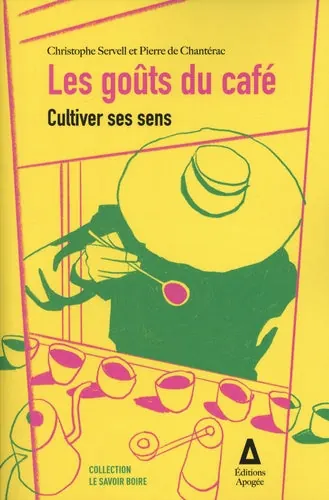
Les goûts du café : Cultiver ses sens proposes changing the mental image of coffee before teaching a technique. Apogée, the publisher, summarizes its purpose in a direct sequence: update what quality coffee means, explain the stages that make it possible, recognize its theoretical and sensory signs, and dismantle received ideas. Its authors, Pierre de Chanterac and Christophe Servell, write from the French specialty coffee world and from the company Terres de Café.
The documented edition has 192 pages, a 14 by 21 centimeter paperback format, and ISBN 9782843988004. Apogée dates it March 6, 2024, while the Terres de Café page announces a release on April 16, 2025. A specific bookseller catalog, Le Bleuet, identifies the same work and ISBN. The difference in dates is not resolved by the sources; this dossier retains the publisher's date and makes the discrepancy visible.
Apogée publishes the complete contents, author profiles, and a short press section. That documentation makes it possible to reconstruct the proposition, not to verify every argument. When structure or exercises are discussed here, the dossier describes what the contents announce; when theses about taste or industry are assessed, it distinguishes the authors' position from independent evidence.
From territory to cup in two parts
The first part explains how coffee flavors are constructed. The opening chapter connects sourcing, history, vocabulary, carbon, carbonization, and standardization. The second develops terroir as an interaction of nature and culture: geography, climate, species, varieties, and decisions. It includes producer testimonies. The third covers harvesting, fermentation, drying, resting, sorting, transport, and roasting.
This sequence avoids a common error: attributing everything perceived to the barista or a final recipe. The cup results from plant material, environment, agricultural work, microbiology, drying, logistics, thermal transformation, and extraction. By including transport and carbon footprint, the book also suggests that value does not reside in flavor alone.
The second part moves from construction to observation. It asks what good coffee is, presents cupping, defects, stimuli, and sensory mechanics, then analyzes body, aftertaste, descriptors, aromatic notes, balance, and synergy. Two chapters turn theory into exercises: a home cupping with coffee selection and levels of attention, and a practice outside cupping, in a restaurant, café, or home, that incorporates extraction problems.
The final chapters ask about “the best coffee in the world” and propose ways to increase competence: plurality of palates, the importance of words, hygiene to isolate biases, side-by-side comparison, and exercises. The structure concludes that experience is built through comparison, not by collecting claims about origin.
The strength and risk of a polemical thesis
The promotional text sets hundreds of possible aromas against three common descriptions: bitter, sweet, or strong. It blames an almost hegemonic industrial supply for closing access to more delicate perception and establishing a burnt, bitter model. This thesis gives the book direction and urgency. It invites readers to verify that coffee does not have a single flavor and that dark roasting is not a natural essence.
But it must also be read as a position. The figure “nine out of ten French people” appears on the publisher's page without a visible methodological reference. It cannot be treated as an audited national statistic. Nor does all industrial coffee share one profile, and not all specialty coffee is automatically balanced. The contrast works as a pedagogical argument; assessing markets would require samples and data.
There is also a direct relationship between the authors and the commercial object. Servell founded Terres de Café; De Chanterac works there and holds Q Grader certification and brewing awards. That experience provides access to producers, roasting, buying, and training. At the same time, the company sells coffees defined precisely by the category the book defends. This is not a reason to dismiss the work, but it is a reason to make its perspective visible and avoid presenting its idea of quality as neutral.
The contents appear aware of part of this tension when they discuss the plurality of palates, biases, and comparison. The decisive point will be whether “good” remains open to description and preference or is identified with the authors' aesthetic catalog. The public pages do not allow that question to be resolved.
Vocabulary, reference, and comparison
The book insists on using less vague words. That aim aligns with the WCR Sensory Lexicon, which defines 110 flavor, aroma, and texture attributes and provides references for measuring intensity. A descriptor becomes more communicable when it does not depend solely on each taster's private memory.
The contemporary wheel was organized through a documented process. The study by Spencer and colleagues used 72 participants, sorting of 99 terms, hierarchical clustering, and multidimensional scaling. The article argues that the wheel helps reproducible description, but it also acknowledges interpretive decisions and the evolving nature of the lexicon.
This comparison favors the book's practical proposition. Tasting two coffees side by side reduces the burden of remembering an isolated sample; controlling context and biases improves comparison; naming body or aftertaste separately forces attention onto different dimensions. Using a shared vocabulary, however, does not turn “better” into an objective conclusion. Description can be agreed even when liking does not coincide.
Home cupping therefore has an educational rather than certifying function. Without strict control of roast, grind, water, temperature, time, and order, it does not reproduce a laboratory. It can still teach readers to keep some variables constant and discover differences. The value lies in designing an honest comparison, not in assigning commercial scores from the kitchen.
In relation to the Coffee Value Assessment
The SCA Coffee Value Assessment offers the most useful current framework for questioning the idea of “good coffee.” It separates physical assessment, sensory description, affective impression, and extrinsic information. Origin and process may contribute value, but they are not introduced covertly into the description of the cup; the evaluator's liking is recorded, but not disguised as an objective attribute.
Les goûts du café covers those four territories: physical defects, body and aromas, judgments about goodness, and accounts of territory or transformation. Its narrative approach makes it possible to connect them and show a complete chain. The risk is merging them again into a single hierarchy. Reading it alongside the CVA helps readers ask in every passage whether a sensation is being described, a preference expressed, a practice reported, or an ethical judgment made.
The extrinsic dimension is especially relevant to the chapters on carbon, connection with producers, and humanistic agriculture. Such information can matter even when two coffees prove sensorially similar. Conversely, an appealing story does not by itself demonstrate a floral note. Separating planes does not diminish value; it reveals where value comes from.
Terroir, process, and causality
The contents devote considerable space to terroir and fermentation. This is an understandable decision: it brings agriculture and labor back into a beverage that urban consumption receives already roasted. “Terroir,” however, can easily become a total explanation. Climate, variety, management, maturity, process, drying, storage, roasting, water, and extraction interact. A perceived note rarely authorizes identification of a single cause.
Producer testimonies provide situated experience, not controlled experiments. The chapters may be excellent maps of variables and still require primary literature to demonstrate mechanisms. The same is true of fermentation: naming a process does not guarantee a profile or improvement; conditions, microbiology, and control are necessary.
The book appears to avoid part of that simplification by placing “nature and culture” together and following the chain through roasting. That formulation recognizes human decisions. Readers should retain it when they encounter commercial narratives that attribute everything to soil or altitude.
Reception, limits, and usefulness
The Apogée page shows zero reader opinions and links an April 2025 interview with the authors themselves under “press.” That conversation may clarify intentions, but it is not independent criticism. Terres de Café provides a commercial presentation and professional profiles. The sources consulted yielded no extensive external review comparing the work with sensory or agricultural literature.
This lack of documented reception should not be confused with a lack of merit. It simply means that the available assessment rests on contents, synopsis, and comparative institutional sources. It is also impossible to verify how extensively the book cites evidence, how it defines “objective,” which controls it prescribes for its exercises, or what evidence supports its market claims.
The work seems suited to consumers and early-career professionals who want to connect agriculture, process, and cup without beginning with a technical treatise. Its two exercises offer a concrete path from reading to comparison. Advanced buyers, roasters, or trainers will need to supplement the chapters with SCA protocols, the WCR lexicon, and specialized studies.
Its best contribution is not dictating which coffee is best. It shows that taste is cultivated by isolating variables, comparing, and learning words, while recognizing the chain that made the drink possible. Its best reading keeps open a question that the title seems to settle: when are we discussing a property of the cup, when our preference, and when the world we wish to sustain by choosing it?