What kind of book it is
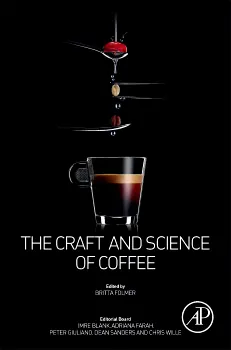
The Craft and Science of Coffee is a collective reference on the complete coffee chain. It is not a recipe manual, an experimental monograph, or a neutral encyclopedia written from a single institution. Its editor, Britta Folmer, brought together chapters by academic and professional specialists to connect knowledge that often remains separate: genetics, agronomy, sustainability, trade, roasting, extraction, sensory analysis, and consumption. The ScienceDirect presentation defines that conversation between research and experience as precisely the volume's project.
Its most valuable consequence is also its principal limit. Readers can follow a decision from the farm to the cup and recognize that “quality” changes meaning depending on whether a geneticist, producer, buyer, chemist, or consumer is speaking. But twenty chapters written by different teams do not share one method or the same level of evidence. A chemical explanation, a literature synthesis, a field case, and a professional recommendation can coexist in the book without thereby becoming equivalent forms of proof.
Twenty chapters and a verifiable architecture
The complete publisher's contents make it possible to describe the structure precisely. Chapters 1 through 3 address the coffee plant's genetic diversity and origin, cultivation for quality, and postharvest processing. Chapters 4 through 6 separate environmental, social, and economic sustainability. Chapter 7 introduces experience and experimentation; chapter 8, tasting and grading; chapter 9, trade, transactions, markets, and finance; and chapter 10, decaffeination.
The most directly technical core occupies chapters 11 through 18: roasting, roasting chemistry, grinding, flavor protection and freshness, brewing, water for extraction, crema, and sensory assessment. The final two chapters change scale: one studies tastes, rituals, and waves of consumption; the other, sociability, performance, and health. This is not a reconstruction based on advertising: the Mercer University Library catalog also reproduces the chapter titles and contributors.
The sequence makes an important editorial statement without needing to formulate a law: no cup begins at the grinder. Green coffee composition, agricultural and postharvest decisions, storage, the energy applied during roasting, and water composition delimit what can later be extracted and perceived. The book works best as a map of relationships rather than a collection of definitive answers.
Science, craft, and industry
The Elsevier record credits Folmer as editor and links her at the time to Nestlé Nespresso. Industrial collaboration provides access to specialists, processes, and questions of scale that rarely appear together in an independent manual. It also requires transparency: the volume was driven from within a company with specific interests in production, capsule systems, and consumption. That does not invalidate its chapters, but it helps explain which questions are prioritized and why the text explicitly seeks to reconcile science and practice.
The Mercer University Library also records Imre Blank as an editor, while Elsevier's commercial cover highlights only Britta Folmer. Gota's dossier retains the primary responsibility in the working catalog and does not expand authorship without inspecting the copy's legal page. This is a small difference, but it illustrates a useful rule: a bibliographic record may describe responsibilities in more detail than a commercial cover.
What it contributes to roasting and extraction
The chapters on roasting and chemistry make it possible to distinguish physical transformation from aroma formation. The bean loses water and mass and changes in volume, porosity, and color while numerous reactions generate and degrade compounds. The volume's usefulness lies in bringing those layers together, not in reducing them to one “correct” curve. An independent study by Baggenstoss and colleagues on time, temperature, and aroma formation tracked sixteen compounds in a commercial drum and fluidized-bed systems. At the same final color, high-temperature, short-time paths were not equivalent to low-temperature, long-time paths; when the same bean temperature history was reproduced, the kinetics were similar across equipment.
That result supports attention to thermal history, but it does not show that a recipe can be transferred between any roasters. The experiments used specific equipment, coffees, and endpoint criteria. Nor does color by itself summarize flavor. Later research comprising eight sensory studies found that color and time influence the profile, with color as the stronger predictor and development time as a relevant temporal component. The associations do not turn a development percentage into a universal law; they show that color, time, raw material, and sensory assessment must be compared together.
The extraction section extends that logic. A study of nine common methods measured solids, acidity, caffeine, chlorogenic acids, headspace compounds, and sensory attributes. Espressos showed greater concentration, while longer preparations tended to extract a greater total amount per cup. There were correlations between solids and body, or headspace intensity and aromatic intensity. Defined recipes and devices were compared, however; it cannot be concluded that one family of methods is always superior or that a correlation alone identifies the perceptual mechanism.
Reception and actual usefulness
The Oil Slick Coffee review values its breadth, number of contributors, and journey from seed to consumer. It is useful professional reception, not an academic review of the whole. No extensive scientific critique was found that audits all twenty chapters with a shared criterion. Individual chapters and their authors do circulate academically, but citing one part does not automatically validate all the others.
The book is especially useful for readers who already know one stage and need to understand adjacent ones. A roaster can situate density or postharvest process before interpreting a curve; a barista can see why water and freshness alter what can be extracted; a buyer can connect grading, price, and sustainability. For absolute beginners, its density and changes of voice may be less useful than a linear introduction.
What has aged and how to read it
Published around the turn of 2016 to 2017, the volume represents a snapshot of the literature available then. Coffee genetics, fermentation research, extraction models, roasting instrumentation, and sensory standards have advanced since that date. The debate around living incomes, value distribution, the climate crisis, and the limits of certifications has also grown. The sustainability chapters should not be used as an automatic summary of 2026.
The best reading treats each chapter as a dated gateway. Readers should check its bibliography, identify whether a claim comes from an experiment, review, or professional experience, and seek later work when a decision has operational consequences. The book does not eliminate the need for specialization; it makes clear which specialty must be consulted.
Edition and discrepancies
The selected edition has ISBN 9780128035207. Booktopia and Kyobo agree on a first edition, hardcover, 556 pages, and a January 4, 2017 date. The Elsevier shop also shows “1st Edition” but dates publication December 16, 2016. Google Books and certain catalogs describe the ebook ISBN 9780128035580 and may count xxv + 529 pages or 556 digital pages.
The difference may reflect copyright date, publisher release, and distribution, and pagination may vary between preliminaries, content, and the digital file. Without examining the colophons, one explanation should not be chosen. Gota specifically identifies the print manifestation supported by two independent records and retains the discrepancy in the edition note. That caution is more informative than a single date presented with false exactness.