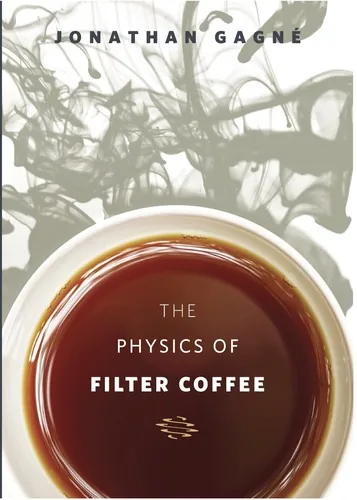
What kind of book it is
The Physics of Filter Coffee is a single-author technical monograph, not a collective academic manual or a recipe collection. Jonathan Gagné takes tools from physics, chemistry, data analysis, and engineering and uses them to build a mental model of filter brewing. The Scott Rao Coffee Books presentation lists percolation, extraction, grinding, water chemistry, kettle design, turbulence, fines, paper filters, and dripper geometry. That breadth explains both the book's appeal and the caution with which it should be read.
Its stated purpose is not to decide which dripper is best or prescribe a universal recipe. The Barista Magazine review quotes Gagné's intention to provide a mental toolkit for understanding brewing and exploring it more effectively. The reader receives equations, diagrams, observations, and procedures, but the main lesson is learning to connect a visible signal, such as a declining flow rate, a stalled bed, or an astringent cup, with possible mechanisms.
That difference matters. A recipe book tries to reduce decisions; this book increases the number of things the reader can observe. It does not promise that every problem has a single cause. It proposes a vocabulary for formulating hypotheses and testing them with greater discipline.
Eleven chapters, from extraction to data
The table of contents recovered by KaffeBox organizes the volume into eleven chapters. The first four establish the foundation: extraction, water, grinding, and percolation. The next three examine components of the brewing system: filters, kettles and agitation, and drippers. These are followed by freshness; roasting, terroir, varieties, and processing; technique and practical applications; and instruments and data. A glossary precedes the chapters, while the closing material includes mathematical variables, calculations, references, and an index.
This sequence avoids treating pouring as an isolated gesture. Before discussing a recipe, the reader must distinguish concentration from extraction yield, understand that water transports and dissolves substances, recognize that grinding produces a distribution of particles, and consider the coffee bed as a porous medium. Only then does it make sense to discuss how much to agitate, how dripper shape influences brewing, or what information total time provides.
The final section returns theory to practice. The book includes brewing methods, consistency habits, and tools for recording or measuring the process. It thereby avoids a common problem in technical popularization: presenting an interesting mechanism without explaining what observation would make it useful in a kitchen or at a bar.
The coffee bed as a flow system
Percolation is the book's conceptual center. Water does not pass through a uniform set of identical particles. It circulates through voids of different sizes, encounters regions with different resistance, and changes composition as it extracts soluble material. Darcy's law provides an initial relationship among flow rate, pressure, permeability, and geometry, but an actual brew adds irregular particles, gas, fines movement, thermal changes, and a filter that can also change its resistance.
The scientific literature helps establish the model's scope. A 2019 study in PLOS ONE compared one-dimensional models with computational fluid dynamics and experimental data. It found that a truncated-cone geometry could generate substantial local variations in flow and extraction. The result supports the attention Gagné gives to geometry and uniformity, but it also shows why a simplified equation cannot by itself describe everything happening inside a dripper.
This way of thinking changes how a cup is interpreted. An apparently correct average yield may conceal particles or regions extracted in very different ways. Likewise, a long brew time does not identify overextraction by itself: it may indicate a resistant bed, a partially clogged filter, or flow distributed through only a few paths. The book is more valuable when it teaches readers to separate these possibilities than when a particular recommendation is memorized as a rule.
Grinding, fines, filters, and bypass
Grinding occupies considerable space because a single number on a dial does not describe what a grinder produces. Size distribution, particle shape, and, disproportionately for flow, the fraction of fines all matter. These small particles can increase bed resistance and reach the pores of the paper. Agitation can improve contact between water and coffee, but it can also encourage movement that ultimately reduces the effective filtration area.
Here it is important to preserve the distinction between a demonstrated mechanism and a plausible hypothesis. In his article The Physics of Fines Migration, Gagné uses findings from granular physics to propose ways in which vibration and geometry might reorganize particles. The author himself warns that the presence of water, drag, and buoyancy complicates their application to coffee. The text is a reasoned exploration, not a direct demonstration of every movement inside a V60.
Later research provides partial support. A 2024 paper in Scientific Reports added sieved fines to espresso beds and observed lower permeability, lower flow, and longer times. It confirms that the proportion of fines may be more informative than an average size, but it does not measure migration in gravity filtration and does not allow its magnitudes to be transferred to every dripper.
The same caution applies to bypass, the water that avoids part of the bed. Gagné incorporates it into his four rules of percolation alongside clogging, flow uniformity, and adapting the ratio to the grind. He explicitly presents them as principles he considers important, not universal obligations. Their usefulness lies in showing design tradeoffs: reducing bypass may concentrate flow through less paper surface; increasing agitation may improve contact while also increasing clogging risk.
Measuring without confusing measurement and taste
The book gives a prominent role to scales, refractometers, temperature, particle distribution, and brew records. Measurement makes comparison and detection of deviations possible, but no number replaces sensory evaluation. Concentration and yield indicate how much material reached the beverage on average; they do not identify which compounds were extracted, how extraction was distributed, or whether the result is enjoyable.
Temperature offers a good example. It clearly changes viscosity and extraction rate, but that does not mean a particular number produces a sensory profile by itself. A 2020 experiment with drip coffee compared 87, 90, and 93 °C while holding concentration and yield constant through adjustments to grind and time. Sensory differences were small; the variables that best explained the profile were concentration and extraction. This does not make temperature irrelevant: it demonstrates that temperature acts within a system of coupled variables.
Water requires a similar reading. The relevant chapter distinguishes hardness from alkalinity and offers tools for formulating brewing water. The well-known 2014 study on dissolved cations provides a mechanism for understanding how magnesium, calcium, and sodium interact differently with coffee compounds. However, it relies primarily on chemical calculations and does not establish an optimal sensory recipe for every coffee. The book's merit lies in enabling readers to understand and control these dimensions, not in turning one composition into dogma.
Published science, original experimentation, and hypotheses
Gagné works from an unusual position. He has scientific training and applies programming, statistics, and experimentation to brewing problems, but the book as a whole is not a peer-reviewed article. It brings together scientific literature, models imported from other fields, original data, sensory experience, and design proposals. These layers do not carry the same degree of evidence.
The text is strongest when it makes a model's assumptions visible and teaches readers to look for deviations. It loses force if every recommendation is interpreted as an established conclusion. Comparison with later research helps prevent that. Recent studies of fines support their importance for permeability; microtomography and flow simulations published in 2023 also show that bed microstructure can be heterogeneous and that, under espresso pressures, regimes appear that exceed a simple linear description. These advances are compatible with the book's exploratory attitude, but they mark where its simplifications end.
Scale also matters. A mechanism observed in espresso, capsules, or dry granular beds can guide a hypothesis about filter brewing but cannot prove it. The volume is most rigorous when read as a bridge to its sources and as a record of Gagné's knowledge around 2021, not as the final word on extraction science.
Who may find it useful
This work is suitable for baristas, roasters, equipment designers, and enthusiasts who already brew with some consistency and want to understand why a change produces different results. It does not require university training in physics, but it does require patience to follow concepts, graphs, and relationships among variables. Readers seeking a quick recipe will find usable procedures; those who benefit most will be willing to record data, change only one condition at a time, and revise their hypotheses when the cup contradicts the model.
It is not the best general introduction to coffee: it devotes little attention to history, trade, or social context and assumes an intense interest in brewing. Nor does it replace sensory training. Its specific contribution is to make processes often explained through vague intuitions legible and to show that a stable technique depends on grinding, water, geometry, flow, temperature, filtration, and measurement at the same time.
Read with that discipline, The Physics of Filter Coffee occupies a distinctive place. It does not turn coffee into a solved equation. It teaches readers to observe a brew as an imperfect experiment, distinguish data from explanations, and improve a model without confusing it with reality.
Edition and access
The Kyobo Book Centre record identifies ISBN 9780578246086, the English language, and January 2021. Eight Ounce Coffee attributes the edition to Scott Rao Coffee Books. Contributor documents the hardcover binding.
Commercial sources disagree on length: Blommers lists 249 pages and Kofio lists 251. The difference may arise from how preliminary or final pages are counted, but no primary source confirming this has been found. Gota therefore does not set a page count. A formal edition number in the colophon has not been verified either.
At least one Korean translation published by Coffee Libre exists and is documented in the catalog as an independent commercial edition. The Spanish explanation on this page does not imply that a published Spanish edition exists: it localizes the work for the reader, while the editions block retains only verified commercial manifestations.