What kind of book it is
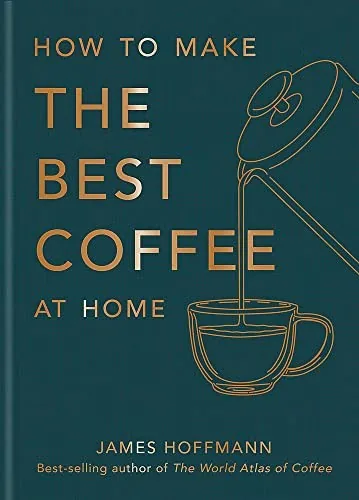
How to Make the Best Coffee at Home is a general home manual, not a chemistry treatise or a coffee encyclopedia. In 224 pages, James Hoffmann assembles a sequence that begins before the kettle is switched on: buying and storing beans, choosing tools, learning to taste, understanding extraction, brewing with several devices, working cold, and finally entering the world of espresso and milk.
The Hachette synopsis makes an ambitious promise: consistently making excellent coffee at home and explaining which equipment is worthwhile, how to grind, how to use the main devices, and how to distinguish drinks from cortado to latte. The title speaks of the “best” coffee, but the book does not require a universally superior cup to exist. Its practical proposal is more modest and more useful: improve the ability to repeat, compare, and correct a beverage according to the available coffee, equipment, and taste.
That position explains the tone. Hoffmann arrives as a World Barista Champion, cofounder of Square Mile Coffee Roasters, and audiovisual educator, but he writes for a kitchen, not a competition round. The Barista Magazine review records his intention to share the things that helped him brew better. Enjoyment remains the purpose; measurement serves learning rather than turning a preference into obedience.
Six parts, from the bag to espresso
The structure can be reconstructed safely at the level of its six parts. Barista Magazine describes each one, and the table of contents of the Korean edition confirms their order. The first, “How to Buy Great Coffee,” covers selection, freshness, storage, roast, and reading the notes on a bag. The second, “The Essentials for Great Coffee,” reduces basic equipment to water, a scale, grinder, kettle, storage, and the chosen method.
The third part covers tasting. It proposes training the palate, comparing flavors, and learning to communicate observations. The fourth is the brewing core: it introduces grinding, extraction, and temperature before moving through V60, AeroPress, moka, and other systems. The fifth separates iced coffee from cold brew. The sixth, the longest according to the review, addresses espresso ratios and temperature, machine purchasing, preparation, steaming, and milk drinks.
This architecture turns the volume into a progressive course. The recipe is not isolated from the raw material or instrument. Before asking for a grind change, the reader has had to consider which coffee was bought, how it was stored, what water is used, and which flavor is to be changed. Before discussing an espresso machine, the book distinguishes the result expected from it. Consistency is presented as the consequence of connected decisions, not of a miraculous accessory.
No authorized view is available that would allow every subsection, quantity, time, or temperature from the original to be reproduced. This dossier therefore describes the documented structure and subjects but does not reconstruct recipes. A review can confirm that the book teaches V60 or moka; it is not enough to attribute an exact dose or claim that a recipe remains identical in every translation.
Buying well before correcting the recipe
Beginning with purchasing has an important consequence: it defines what technique can fix. Roast level, age, and storage condition the possible range of flavors. Reading a bag helps anticipate style, although a tasting note is not a guarantee that every person will recognize the same descriptor with their water and method.
The guide tries to avoid two extremes. One is buying only by prestigious words without connecting them to real preferences. The other is treating freshness as a magical date after which every coffee becomes unusable. Readers gain more by comparing bags, observing how they change, and recording what they like than by memorizing a universal calendar. Storage does not stop aging either; it can only reduce exposure to oxygen, moisture, heat, and handling.
This section also has a conscious-consumption dimension that Barista Magazine values explicitly. Knowing what one buys and what information the package offers improves the ability to choose. Its scope, however, remains mainly domestic and sensory. A guide to brewing better does not replace analysis of the price paid to the producer, labor relations, climate adaptation, or the limitations of sustainability labels.
Equipment as a set of functions
The list of essentials is short for an industry that often sells improvement through accumulation. Each tool should solve an identifiable problem. The scale preserves ratios; the grinder makes it possible to change particle distribution; the kettle heats and, in some methods, controls pouring; the container attempts to slow deterioration. None produces quality independently.
Water deserves particular care because “suitable” does not describe a single composition. Hardness, alkalinity, and specific ions can change extraction and perception. A 2024 study of sodium compared waters and added salts to the extraction water; it found greater saltiness and a lower impression of cleanness as sodium increased. This supports paying attention to water, not a universal recipe. The sensory panel had six people, the coffee and brewer were specific, and “cleanness” was an attribute defined within that protocol.
The most transferable recommendation is functional: use potable water without unpleasant odors and stable enough to allow comparison. If the water changes, a grind correction may be responding to two causes at once. Formulating water or measuring minerals may be useful for someone seeking advanced control, but it is not a moral requirement for brewing a satisfying cup at home.
Tasting to decide what to change
Separating tasting from brewing prevents diagnosis from becoming a memorized list of defects. Hoffmann proposes training through comparison and building language to communicate sensations. The value lies not in reproducing the exact words printed by the roaster, but in noticing repeatable differences: more or less bitterness, a different acidity, greater weight in the mouth, or an aroma that disappears as the cup cools.
This approach protects the reader from false precision. Two people can agree that two cups differ and prefer opposite results. “Better” incorporates taste, context, and habit; it is not a single laboratory variable. A more repeatable brew allows better questions, but a TDS reading or total time does not decide which cup ought to be liked.
Tasting also connects the rest of the book. Without a sensory observation, adjusting the grinder is turning a dial without a criterion. With one, the reader can change a single variable, repeat, and judge whether the result moved closer to the goal. That elementary experimental discipline is one of the manual's most durable components.
Grinding, extraction, and filter methods
The central part teaches several devices because each organizes contact, flow, and filtration differently. A comparison published in 2023 brewed the same coffee by V60, AeroPress, French press, and Pure Brew. Volatile profiles distinguished the methods, and the panel found sensory differences; systems with paper showed a greater proportion of certain compounds associated with caramel and flowers, while metal filters were associated with fruitier and more roasted profiles under those conditions.
The result supports treating V60, AeroPress, and press as non-interchangeable recipes. It does not demonstrate that one is better. The study used one Kenyan coffee, specific configurations, and an expert panel; different raw material, paper, or grind can change the order. The book's value lies in offering a starting point for each device and teaching adjustment, not in fixing a definitive ranking.
Grinding shows why a simple rule needs qualification. Fine and coarse are not uniform substances: a grinder produces a distribution. In a 2023 French press experiment, conventional heterogeneous grinds extracted more solids, bioactive compounds, and volatiles than several homogeneous sieved fractions; the uniform fine fraction was not automatically superior. This does not recommend an inconsistent grinder. It demonstrates that surface area, diffusion, and particle composition interact, even when water does not pass through a bed under gravity.
In percolation, changing the grind also changes resistance and transit time. A flavor therefore cannot always be attributed to one variable. The most defensible home procedure remains keeping dose, water, and gesture constant, changing one condition, and tasting again. The book works better as a framework for that iteration than as a table of automatic answers.
Cold does not mean a single beverage
Giving iced coffee and cold brew their own part avoids confusing two processes. A hot beverage cooled over ice and a long immersion at low temperature may both reach the table cold, but they did not undergo the same extraction. They may also differ in concentration and dilution, so comparing only serving temperature mixes several causes.
A UC Davis sensory study published in 2022 attempted to separate those factors. It worked with three origins, three roasts, and three brewing temperatures; brought beverages to equilibrium, adjusted all to 2 percent dissolved solids, and served them at 4 °C. In that design, hot brews were more bitter, sour, and rubbery, while cold brews were more floral. Strong interactions with origin and roast also appeared.
The useful conclusion is not that every cold brew is sweet or floral. It is that extraction temperature can change the profile even when strength and serving are controlled, but its effect depends on the coffee. The book's separation is pedagogically sound as long as every recipe is read as the beginning of a comparison rather than a chemical definition of the category.
Espresso: coupled variables under pressure
The length of the final chapter reflects the difficulty of espresso. Dose, beverage yield, grinding, distribution, temperature, pressure, flow, and coffee condition interact within seconds. Buying a machine solves only the capacity to apply hot water under pressure; the grinder and bed preparation directly condition the flow encountered by the machine.
Research published after the book helps specify that system. A 2023 kinetics study varied flow, grinding, and temperature and analyzed successive beverage fractions. Under its conditions, flow had the strongest effect of those variables on the masses of compounds in the cup, with stronger interactions at fine grinding and high temperature. Changes due to total extracted mass were greater overall. A final ratio alone does not tell how each component reached the cup.
A 2024 paper on fines added controlled quantities of particles smaller than 100 micrometers. More fines reduced permeability and flow and lengthened extraction. It also showed that a single median size poorly describes a bimodal distribution. The sensory analysis in that study was only guidance from one taster, not a double-blind preference test; its strength lies in physical measurement of flow.
These results support the book's attention to the grinder and adjustment, but prevent “finer extracts more” from being read as a line without reversal. A finer grind increases surface area and can simultaneously restrict flow, encourage unevenness, and change time. Adjusting espresso means managing tradeoffs in a particular system.
Milk, aroma, and consumption context
Steaming and espresso drinks appear as distinct skills because adding milk changes more than ratio and texture. It also changes temperature, intensity, and aroma perception. A 2015 study measured retronasal odorants with three trained panelists. Most did not change significantly, but some compounds decreased with milk and the aromatic quality described as coffee was reduced.
This is a limited mechanistic observation, not validation of the book's steaming techniques. Milk, its fat and protein, temperature, and air incorporation can vary. It serves as a reminder that a latte is not simply an enlarged espresso: the recipe must preserve enough aromatic identity and build a texture suited to the intended result.
Nor does the guide turn method into health advice. A classic investigation of cafestol and kahweol found high quantities of these diterpenes in boiled and Turkish coffee, intermediate quantities in espresso, and negligible quantities in drip-filtered and instant coffee among the samples studied. Paper can matter beyond visual clarity. This context supplements a practical guide, but it does not permit individual consumption prescriptions without considering total dose, health, and broader clinical evidence.
Reception, redundancy, and depth
Professional reviews were highly favorable. Barista Magazine presented it as a guide for enthusiasts and professionals and valued its role in forming more conscious consumers. Drinkhacker gave it a high rating and highlighted its breadth, relaxed tone, and usefulness at different levels. Both readings agree that Hoffmann makes an extensive subject accessible without treating the beginner condescendingly.
Reader reception introduces an important limit. In a CoffeeSnobs thread, one person considered it repetitive in relation to the explanatory videos and The World Atlas of Coffee; another replied that they specifically preferred having a written reference, and another considered it especially useful for someone moving from capsules to a machine with more control. This is anecdotal evidence, but it clearly identifies the editorial tradeoff.
Someone who has followed Hoffmann's channel for years may recognize arguments, recipes, and priorities. The book does not compete with video by necessarily offering more detail; it organizes them into a stable, consultable progression that is less dependent on finding one piece among many publications. For a beginner, that structure is value. For an advanced reader, it may feel like compression.
Breadth also imposes scientific limits. Buying, storage, water, tasting, multiple methods, cold coffee, espresso, and milk cannot receive equivalent depth in 224 pages. The manual communicates professional experience and technical principles, but as a whole it is not peer-reviewed work. The studies cited here do not “prove the book”: they use particular coffees, grinders, waters, machines, and panels. They serve to support general mechanisms, qualify simplifications, and show where a recommendation still depends on context.
Who may find it useful
It is an especially suitable entry for someone who wants to leave improvisation behind without turning the kitchen into a laboratory. It helps with choosing a first grinder or method, understanding why weighing makes repetition easier, and building an adjustment routine. It can also serve a barista in training as a map of subjects before moving to specialized manuals on water, espresso, sensory analysis, or percolation physics.
The advanced reader will obtain less new information if already familiar with Hoffmann's audiovisual work. They can use it as a reasoned index, quick reference, and document of home practices disseminated around 2022. Anyone seeking social history, chain economics, deep agronomy, or a systematic research review will need other works.
Its most durable lesson is not a number. It is the order of the questions: buy coffee compatible with one's taste, store it carefully, use tools that solve real problems, brew repeatably, taste, and change one variable intentionally. That method does not guarantee “the best coffee” in the singular. It does make it more likely that the next cup will explain something about the previous one.
Editions and access
The principal cataloged edition is hardcover ISBN 9781784727246. Hachette UK records format and on-sale date of September 15, 2022; Waterstones confirms 224 pages, date, language, and Octopus Publishing Group. The cover and other records identify Mitchell Beazley, an imprint of the group. These publisher formulations do not demonstrate different works.
Ebook ISBN 9781784727819 appeared the same day. Octopus Books and Bokus agree on ISBN, digital format, language, publisher, and date. We do not assign it the print edition's 224 pages because a reflowable file does not necessarily preserve fixed pagination. ISBN 9781784728427, which may appear alongside them, belongs to the downloadable audiobook according to Hachette, not a US print edition.
The Korean translation 베스트 커피 앳 홈, ISBN 9791192066301, was published by 디자인이음 on December 1, 2023. Kyobo identifies it as a 226-page hardcover, while BookPrice confirms ISBN, date, extent, and translation by 조진경. The Spanish edition El mejor café en casa, ISBN 9788419043184, appears in Casa del Libro as a 274-page hardcover from Cinco Tintas, translated by Montserrat Asensio and published on June 6, 2023; Antártica corroborates title, publisher, and ISBN.
The German edition Der perfekte Kaffee für zu Hause, ISBN 9783965843202, was published by ZS Verlag on October 7, 2023. The publisher records hardcover and 224 pages, and Buch-KA confirms those details and attributes the translation to Lisa Heilig. The official URL slug ends in a different shortened sequence, but the ISBN displayed within the listing is 9783965843202 and agrees with independent catalogs.