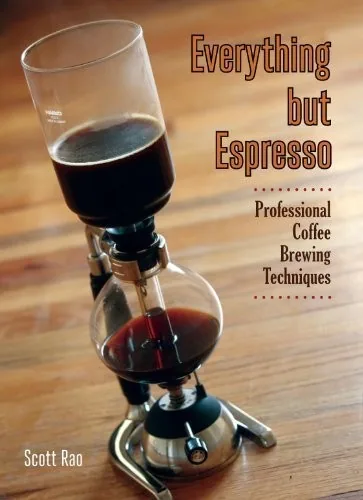
What kind of book it is
Everything But Espresso: Professional Coffee Brewing Techniques is a short professional manual on making coffee outside the espresso machine. It does not attempt to cover cultivation, trade, or roasting with the breadth of a general work. Nor is it an academic treatise. Scott Rao brings together extraction principles, bar procedures, and diagnostic criteria so that a result can be repeated and corrected rather than depending on a choreography learned by heart.
The official book page divides it into three parts. The first explains extraction, measurement, and changing flavor through brewing parameters. The second applies that framework to automatic drip, manual pour-over, press, and vacuum brewing. The third covers water chemistry and bean storage. Prima Coffee adds immersion, siphon, and Clever to its description of the methods, along with photographs and step-by-step guides.
That order is the volume's thesis. Before choosing a device, one must know what is to be controlled; before imitating a recipe, one must distinguish concentration, extraction, and uniformity. Methods appear afterward as different configurations of the same problem. In 2010, presenting filter coffee with that degree of systematization was an important intervention.
A manual written from the bar
Rao does not write as a university researcher. His professional biography locates the origin of his books in years of operating coffee shops and a desire for baristas and roasters to work in a more educated and systematic way. A 2014 interview adds that, before his first book, he consulted literature in a university library because he considered the resources available for learning the trade inadequate.
That position brings both a strength and a limitation. The strength is that every explanation pursues an operational decision: weigh, observe, measure, change a variable, and compare. The limitation is that accumulated experience, technical literature, and personal hypothesis share one authoritative voice. A recommendation can be excellent without constituting a physical law; a frequent result in a coffee shop is not equivalent to a controlled experiment.
The genre itself helps explain this. It is under one hundred pages, in color, and oriented toward use. Prima presents it as both a reference text and an instructional guide, accessible to enthusiasts as well. There is no space to demonstrate every mechanism or examine all the conditions under which it holds. Its achievement is not closing the science of brewing but offering a working system far more precise than “pour until it looks right.”
Separating strength, extraction, and preference
One of its most durable pedagogical contributions is separating the strength of a beverage from how much material has been extracted from the coffee. Concentration, or TDS, expresses the proportion of dissolved solids in the cup. Extraction yield estimates what fraction of the coffee's dry mass entered the beverage. A cup can be strong and underextracted, or weak after extracting a high fraction. Confusing these axes prevents diagnosis of whether ratio, grind, time, or flow should be changed.
The book arrived as refractometers and calculation software were beginning to enter specialty bars. Measurement made it possible to record a result, compare shifts, and check whether a correction moved the beverage in the expected direction. It did not turn flavor into a number. Years later, Rao insisted that extraction and sensory quality do not have a linear relationship: a coffee may taste better at 17 percent, lose interest at 19 percent, and reach another maximum at 21 percent. The Sprudge profile documents that later combination of refractometry and tasting.
Recent science preserves the usefulness of the axes and rejects a single ideal zone. The new Coffee Brewing Control Chart published in 2023 integrates descriptive studies and 3,186 consumer ratings. It found two preference groups with different responses to concentration and extraction. Its authors replace the universal notion of “ideal” with maps of sensory attributes and liking zones for different audiences.
This revision does not make the book's central move obsolete. Measuring TDS, extraction, and ratio still allows a brew to be described. What has aged is the temptation to treat the classic box on the chart as a mandatory sensory destination. The figure records an average property of the beverage; it does not know which coffee was used, which compounds reached the cup, or what the drinker prefers.
Uniformity and the bed after pouring
The manual's second axis is uniformity. Rao asks readers to attend to water distribution, bed geometry, and grounds that finish “high and dry,” stuck to the filter above the slurry. The intuition is clear: if some coffee stops receiving water early while other regions concentrate flow, the average yield may conceal very different local extractions.
Contemporary reception shows that this proposal was not accepted as dogma. In July 2010, the author of at odds with unevenness called the book an essential purchase and supported its emphasis on ratio, consistency, and uniform extraction, but considered diagnosis from final bed shape and some geometrical inferences debatable. The reviewer brewed V60, Chemex, Melitta, and Donut with and without agitation, dried samples from the top and bottom, and extracted them again to compare remaining solids. The observations suggested that agitation could improve or worsen uniformity depending on the device. The author warned that nearly all conditions were n=1 and not statistically conclusive.
That caution matters. A flat or domed bed can be the consequence of a flow, but its final appearance cannot by itself reconstruct what happened throughout the brew. Agitation improves mixing and can return particles to suspension; it can also move fines, change filter resistance, or open preferential paths. The correct gesture depends on the system.
Later research supports the general problem with stronger tools. A 2019 study in PLOS ONE compared one-dimensional models, computational fluid dynamics, and experimental data. In a truncated-cone geometry, it found substantial local variations in velocity and extraction even when output concentration resembled that of a cylindrical bed. This confirms that a cup average can conceal heterogeneity. It does not demonstrate that a particular visible shape guarantees uniformity or validate every pouring technique in the book.
Different methods, different tradeoffs
The volume's second part avoids treating all devices as interchangeable vessels. Automatic drip distributes water over a bed; manual pour-over adds the operator as flow controller; a press keeps coffee and water together during immersion; vacuum brewing combines immersion, heat, filtration, and a drawdown phase. Transport, separation of particles and oils, texture, and sensitivity to grinding or flow errors all change.
This comparative approach remains more useful than seeking a winner. Paper and metal, for example, alter more than clarity: they retain different amounts of material and produce different mouthfeels. In the book, Rao framed an opposition between clarity and body that he still defended in 2023, although his revision on the amount of fines acknowledges a more complex landscape. Too few fines may leave large voids and uneven flows; too many may clog regions and encourage channels. The assumption that every reduction in fines always improves filter brewing is too simple.
The map of devices has changed as well. In that same revision, Rao notes that Vac Pot, Clover, and Eva Solo were relevant in 2010, while today he would remove some from his diagram and add AeroPress and more recent devices. The book retains historical value precisely because it records the problems and tools that occupied professional brewing at that moment. It should not be forced to function as an updated 2026 catalog.
The distinction between percolation and immersion has also been refined. In a revision published by Rao in 2017, he challenged conventional calculations that did not properly account for solids-laden liquid retained among the grounds. A 2021 experimental immersion model independently reached a related caution: retained liquid can cause drying of grounds to underestimate actual yield. Under its equilibrium conditions, ratio strongly controlled TDS, while grind and temperature between 80 and 99 °C had little effect on final yield. This is a result for complete immersion, not a rule that can simply be transferred to V60 or siphon.
Water, temperature, and storage
By reserving its third part for water and storage, the book prevents brewing from being reduced to the dripper. Water is the solvent and also the majority of the beverage. Hardness, alkalinity, ions, and foreign compounds can alter flavor, interaction with acids, and equipment operation. Roasted coffee, meanwhile, loses volatiles and is exposed to oxidation; a consistent recipe does not compensate for poorly stored raw material.
The chemistry available today recommends more precision than a global water TDS figure. A 2024 paper on calcium and magnesium added salts before and after brewing and analyzed organic acids by GC-MS and NMR. At typical concentrations it found limited changes and similar results with additions before or after, suggesting that extraction of those acids did not depend on the cations as earlier models had proposed. Minerals may still change perception or interact in the beverage. The study does not conclude that water is irrelevant; it shows that the mechanism is less direct than a simple rule allows.
Temperature offers an equivalent lesson. A 2020 sensory experiment brewed drip coffee at 87, 90, and 93 °C, adjusting grind and time to keep TDS and extraction equal. Under that control, the sensory profile changed little with temperature; concentration and yield explained more. This does not mean heat can be ignored: it changes extraction rate and must be compensated by other variables. It means that attributing flavor to temperature in isolation confuses cause and outcome.
For storage, recent evidence strengthens the book's priority and specifies its mechanisms. A 2022 study of opened packages tracked volatile compounds, oxygen, and carbon dioxide with four closure methods. All coffees lost freshness, but an integrated closure preserved it better than transferring beans to a container, using tape, or using a clip. Exposure to air during each handling mattered as much as the “airtight” label. Practical recommendations must be updated for the package and usage pattern, but protection from oxygen, moisture, heat, and unnecessary opening remains well founded.
Reception, influence, and limits
The influence of Everything But Espresso is best seen in the adoption of its way of thinking rather than in a particular recipe. In 2012, Modernist Cuisine placed it alongside The Professional Barista’s Handbook among the best technical coffee books and compared Rao's explanatory ability to Harold McGee's for cooks: explaining why something happens and what can be controlled. In 2015, Sprudge used the book as the starting point for a generation that moved from vague visual rules to scales, refractometers, and discussion of extraction.
That influence has a reverse side. A quantified method can become a numerical ritual. Hospitality can disappear while a barista pursues a tenth of a TDS point; one area of the chart can receive authority unsupported by sensory data; an attractive bed can be mistaken for proof of good flavor. The book is most fertile when its numbers serve comparison and its rules generate hypotheses. It is less reliable when a recommendation situated in 2010 is recited as universal physics.
Nor does it cover the whole contemporary coffee question. It is not a social history, a guide to buying beans, or a discussion of sustainability. Its scientific apparatus is that of a professional synthesizing literature and experience, not a systematic review. Today's reader has access to flow models, sensory studies, and chemical analyses that did not exist while it was being written. These should be used to expand or correct the framework, not to deny the advance it represented.
Who may find it useful
This book is suitable for baristas, quality managers, and enthusiasts who already brew coffee and want to diagnose it more systematically. Its brevity makes it easy to return to a technique, compare methods, and turn an observation into a test. It is also a useful historical work for understanding how early-2010s specialty coffee professionalized filter brewing around mass, ratio, extraction, and consistency.
It is not the best single reference for someone who needs the current state of the science. It should be accompanied by later research on preferences, hydrodynamics, fines, water, and freshness. Nor is it necessary to buy every instrument to benefit from it: a scale, a reasonably stable grinder, notes, and comparative tasting are enough to adopt its main discipline.
Its most durable lesson is not a recipe. It is the obligation to distinguish what has been measured from what has been inferred, deliberately change one variable, and accept that flavor can contradict a figure. Read in this way, Everything But Espresso remains an influential manual: not because it solved every non-espresso method, but because it helped formulate them as problems that could be observed, repeated, and discussed.
Edition and access
The edition cataloged in Gota uses ISBN 9781450708708. Open Library, Amazon, and contemporary reception support 2010 as the year of publication; the July review explicitly calls it a new book. Prima Coffee identifies 70 pages and hardcover binding.
Sources are not entirely uniform. Eight Ounce Coffee records the same ISBN with 68 pages and a copyright line extending to 2014. Google Books shows 70 pages and a 2014 publication date. Without the copyright page or colophon from distinct copies, it cannot be determined whether these variants reflect unnumbered pages, a reprint, or simple catalog differences. Gota therefore retains 2010, does not set an extent, and does not declare a second edition.
No commercial Spanish edition has been verified. The title Todo menos espresso and the Spanish explanation are Gota editorial localizations; the documented edition remains the English one. The author's official listing continues to offer the book in print, while Google Books records no available ebook.