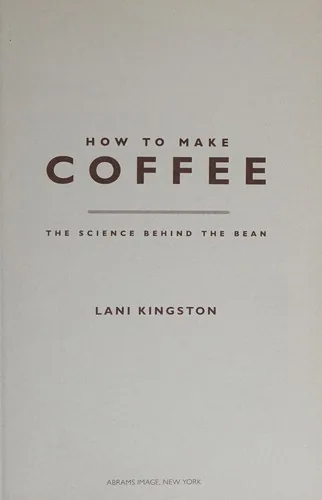
What kind of book it is
How to Make Coffee: The Science Behind the Bean is a visual introduction to brewing that tries to explain the mechanism before presenting the gesture. Lani Kingston covers biology, chemistry, roasting, grinding, extraction, technology, and home brewing methods in 160 pages. That length demands selection: the book offers a coherent map for beginners, not an exhaustive review of every discipline.
The Abrams listing promises to demystify physics and chemistry from bean selection through technique. Its audience may be an enthusiast who wants to move beyond isolated instructions or a barista at the beginning of training. The key is the connection between those two ends: knowing that grind or temperature matters and observing how it manifests in a particular method.
Kingston explained in a later interview that the subject could have produced a book ten times longer. She selected the principles a person needs to understand a good cup and consulted coffee professionals, scientists at Kew Gardens, and baristas. That statement clarifies her editorial method, but it does not turn the volume into peer-reviewed research.
Six chapters from plant to cup
The Internet Archive record preserves the architecture: “The Bean,” “The Chemistry,” “Roast & Grind,” “Brewing, Extraction & Balance,” “Coffee & Technology,” and “How to Make Coffee,” followed by an epilogue, bibliography, resources, and index. Sandra Pond's illustrations explain anatomy, equipment, and sequences without turning every page into a technical table.
The first section introduces the plant, species, cultivation, fruit, and processing. The second covers caffeine, decaffeination, and components involved in flavor, aroma, and milk behavior. The third follows the bean's thermal transformation and its fracture during grinding. The fourth brings together solubility, concentration, yield, ratio, water, and temperature. The fifth places those variables within the evolution of coffee makers and devices.
The final chapter moves into instructions. The reviews and contents document Turkish coffee, cowboy-style brewing, automatic filter and manual pour-over, percolator, siphon, moka pot, espresso, French press, AeroPress, and cold brew, as well as drinks made with espresso and milk. That breadth has an advantage: readers can compare what changes among immersion, percolation, pressure, and low-temperature methods. It also has a cost: no technique receives the space of a specialized manual.
Applicable science, not a complete laboratory
The book's teaching depends on distinguishing related variables. Strength, or TDS, expresses concentration; extraction yield estimates the fraction removed from the dry coffee. A beverage can be concentrated without having extracted the same proportion as another. Grinding changes surface area and, depending on the device, resistance to flow. Temperature affects rate, but shares responsibility for the result with time, water, agitation, and geometry.
A 2021 kinetic study investigated temperatures from 4 to 93°C and different particle sizes. It identified a rapid surface phase and a slower internal phase; increasing temperature and reducing particle size accelerated extraction and raised yield under its conditions. The result supports the guide's causal framework, although it does not provide a single optimal combination for every method.
Another full-immersion study revealed an important distinction. Between 80 and 99°C, raising the temperature accelerated the approach to equilibrium, but did not substantially change the protocol's final TDS or yield. That does not make temperature irrelevant: actual brewing ends before equilibrium, and the sensory profile can change even when the figures are similar. It does prevent a range such as 91–96°C from becoming a law independent of time, coffee, and purpose.
Cold brew, caffeine, and easy claims
The book includes cold brew from a time before it occupied its current commercial position. Cold preparation illustrates well that lower temperature can be offset by more time, but “cold” does not define a universal composition. A 2020 study compared hot and cold coffee across three roast levels. In its protocol, cold brew had lower TDS, lower titratable acidity, and fewer browning compounds; results varied with roast. Titratable acidity, pH, and perceived acidity are not synonyms either.
Caffeine invites similar simplifications. Saying that one roast contains “more” depends on whether the comparison uses bean mass, volume, density, yield, or recipe. A 2024 study examined thirty combinations of coffee, roast, and brewing time. Under identical conditions it found less caffeine in dark roasts, but a different relationship emerged when equal yields were compared. Porosity, degradation, mass, and extraction compete; a rule based on color is insufficient.
Chemistry does not authorize clinical promises either. The BMJ umbrella review found that consumption was associated with more favorable than harmful outcomes across numerous endpoints, but much of the evidence was observational. It identified circumstances requiring caution, including pregnancy, and the need for trials to establish causality. An accessible explanation of caffeine or antioxidants must not become medical advice.
Reception
Accessible reviews have valued the balance between clarity and density. TheBookbag emphasized that readers without scientific training could follow the diagrams, roasting, grinding, and extraction diagnosis. It also observed that someone using an automatic machine has fewer practical variables to manipulate, so part of the reading remains general knowledge.
The James' Coffee Blog review appreciated the coverage of extraction, TDS, liberica, and technology, while warning that the chemistry chapter could intimidate part of the beginner audience. That tension confirms that the volume occupies a middle ground: it wants to be more precise than a recipe book, but must condense scientific language to avoid losing first-time readers.
The sources consulted contain no independent recipe-by-recipe validation or academic reception of the book. Reviews demonstrate perceived usefulness and value as a reference. They do not prove that every explanation still reflects current consensus or that its procedures outperform later alternatives.
Discrepancies and edition control
The principal edition is clearly delimited. Abrams and Microcosm identify ISBN 9781419715846, hardcover format, 160 pages, the Abrams Image imprint, and April 14, 2015. The cataloged copy adds a bibliography on pages 155–156 and an index.
There is a 2017 Ivy Press edition with ISBN 9781782405184. It retains the title and advertised length, but it is a different manifestation. Its date, imprint, and ISBN are not used to complete the Abrams edition. Nor is it assumed, without comparing copies, that corrections or production changes are identical.
Limits and present-day use
The first limit is temporal. Since 2015, literature on particle distribution, kinetics, water, cold brew, and sensory preference has expanded, and new devices and practices have appeared. The book continues to explain fundamental questions, but its ranges should be tested with the coffee, grinder, and water at hand.
The second is one of scale. One hundred and sixty pages cannot develop botany, processing, chemistry, roasting, espresso, and milk with equal rigor. Regional or roast categories provide orientation; they do not predict a cup by themselves. Illustrated instructions reduce execution errors; they do not eliminate equipment tolerances or differences in palate.
The third is epistemological. A TDS figure improves repeatability, but does not determine pleasure. A plausible mechanism helps decide what to change, but does not prove that a recipe is universal. A favorable review evaluates reading and use, not an experiment. Read with those distinctions, How to Make Coffee retains its best function: giving a curious person enough vocabulary to stop obeying recipes blindly and begin making reasoned adjustments.