Science in the form of questions
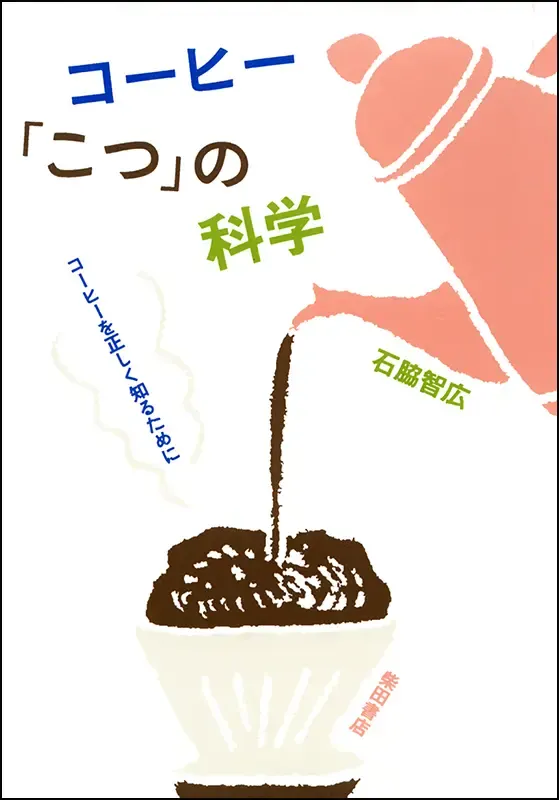
The title コーヒー「こつ」の科学 plays with the idea of practical coffee “tips” or keys. Its subtitle promises correct knowledge, but Tomohiro Ishiwaki's method does not consist of replacing one traditional authority with another. The publisher 柴田書店 presents 87 questions about claims as common as pouring in circles, associating dark roasts with less caffeine, or interpreting the expansion of the coffee bed as direct proof of freshness. Each answer attempts to separate mechanism, observation, and preference.
The format is decisive. It does not require readers to finish a linear treatise before resolving a particular doubt; they can enter through one question and discover which concepts are needed to answer it. Humorous illustrations and definitions lower the barrier created by the word “science.” According to the biography supplied by the publisher, Ishiwaki writes from a career in engineering, quality control, and industrial research. That position allows him to connect the laboratory with real problems faced by roasters or consumers.
The proposal is not to demonstrate that the knowledge of a coffeehouse master lacks value. It seeks to discover why a practice may work, under what conditions it stops working, and which part belongs to taste. That attitude is more enduring than many of the specific answers.
The architecture of the 87 answers
The 紀伊國屋書店 table of contents groups the questions into five sections. The first offers foundations: what the so-called coffee bean is, how the plant grows, where it comes from, where it is cultivated, and what transformations separate the fruit from the beverage. The second addresses composition: caffeine, bitterness, acidity, sugars, roasting reactions, aroma, chlorogenic acids, aging, and water.
The third section is closest to the home user. It examines buying, utensils, principles of extraction, paper filter, cloth, press, siphon, coffee maker, espresso, and cold coffee. It then moves to grinding and storage. The fourth follows the activity of a roastery: green coffee handling, preservation, machine types, heat transfer, changes during roasting, blends, and packaging. The fifth broadens the focus to cultivation, organic certification, processing, international circulation, prices, importing, and varieties.
That sequence makes the entire chain visible without forcing the author to pretend that every question belongs to a single theory. It also creates fragmentation. Someone seeking a continuous explanation of extraction or thermodynamics will have to reconstruct it from several answers. That is a reasonable cost for a work designed for consultation and discovery.
Dismantling rules without manufacturing new ones
The principal virtue is its demand for precision in everyday language. Saying that a beverage is “strong” may refer to concentration, bitterness, dark roast, or overall impression; each meaning would call for a different test. Similarly, asking whether mineral water makes better coffee has no universal answer without specifying its composition, the coffee, the method, and the criterion for “better.”
The 柴田書店 presentation emphasizes that science can reveal both the rationale behind an artisanal practice and the lack of foundation behind an industrial convention. That symmetry is important: it does not treat tradition as superstition by default or technology as automatic truth. It invites readers to observe variables and recognize uncertainty.
A review from a Japanese coffee shop highlights precisely the density beneath an approachable appearance and lists questions customers frequently ask. That reception helps identify the audience for whom the book works: readers who do not yet know how to organize their doubts and professionals who need to explain mechanisms without resorting to empty formulas.
Practice, preference, and evidence
The book can improve practice without delivering a closed protocol. Understanding that grinding increases available surface area, that particle distribution affects transfer, or that roasted coffee continues to release gas makes it possible to design better tests. Moving from the general mechanism to a recipe, however, requires measuring the particular equipment and raw material.
Plausible explanations must also be distinguished from sufficient evidence. A popular answer compresses debates and may use knowledge available in 2008 without presenting every study, sample size, or disagreement. The current reader should preserve the reasoning while verifying values sensitive to new data.
In particular, “rich” or “delicious” is not a single chemical variable. Composition and extraction influence perception, but preference depends on experience, context, and culture. Science can describe and compare; it does not by itself decree what people should enjoy.
Which parts need updating
Roasting is a clear example. A 2022 academic review integrates later work on physical changes, chemical reactions, and sensory effects. It confirms many general mechanisms, but expands the detail and makes the interactions among raw material, time, temperature, and equipment more visible. The 2008 answers are an entry point, not a current synthesis of the entire discipline.
Health questions require still greater caution. The BMJ umbrella review found that consumption was associated with more favorable than harmful outcomes in the available observational literature, but stressed the limitations on establishing causality. No statement in the book about caffeine or health benefits should be turned into individual medical advice.
Production, certifications, and trade have changed too. The final section helps readers understand the structure of the chain, but figures, rules, and categories from 2008 may have expired. The same critical discipline the author applies to myths should be applied to his own edition.
A science situated in industry
Ishiwaki worked in industrial roasting, quality, and research. That context provides direct knowledge of green coffee intake, manufacturing, blending, packaging, and shelf life. It also directs attention toward the problems a company needs to control. The volume does not claim to be an ethnography of producers or a political analysis of prices; when it approaches those topics, it does so to explain how coffee reaches Japan.
Recognizing that position avoids two errors. The first would be dismissing the book because it comes from industry, as though process experience produced no knowledge. The second would be treating it as a neutral and complete perspective. Its best pages teach readers precisely to ask who measures, for what purpose, and under what conditions.
The brevity of each answer encourages conversation and internal training. A team can select a question, formulate a hypothesis, and test it in tasting. In this way, the book stops being a collection of curiosities and becomes a trigger for small-scale controlled experiments.
Who it serves and how to use it
It is a good first reference for Japanese-reading enthusiasts, baristas, sales staff, and roasters in training. It is particularly useful when someone knows the rules but not their reasons. It does not replace a modern sensory-analysis manual, a review of roasting chemistry, or a detailed quality-control protocol.
The most productive reading keeps three columns: what the answer claims, what evidence or mechanism it proposes, and what test would allow it to be checked with the coffee available. When the result depends on taste, it should be recorded as preference rather than disguised as law.
Its importance does not lie in the 87 answers being the final word. It lies in teaching an intellectually demanding habit: formulate the question well, distrust monocausal explanations, and accept that a rigorous answer sometimes ends with a carefully delimited “it depends.” For a book of tips, that is a remarkably anti-tip conclusion.