A problem of professional language
When Ted R. Lingle began this manual, experienced tasters could recognize differences but could not always describe them using terms stable across companies. Tim Castle explained that problem in a presentation published in April 1986: words such as “acidy,” “fruity,” or “winey” circulated with different definitions, and the industry lacked a systematic view of taste, smell, and touch.
The Coffee Cupper's Handbook attempted to resolve it through classification and procedure. Lingle combined botany, chemistry, physical chemistry, organoleptic evaluation, and semantics. His goal was not merely to enrich commercial prose; he wanted two professionals to be able to observe a sample, record perceptions, and discuss differences within a shared structure.
That project appeared when the Specialty Coffee Association of America was young. The manual helped turn skills transmitted through informal apprenticeship into training material. Its later influence does not prove that all its categories are correct today, but it explains why so many words, diagrams, and habits of modern cupping have a recognizable genealogy in its pages.
The selected fourth edition
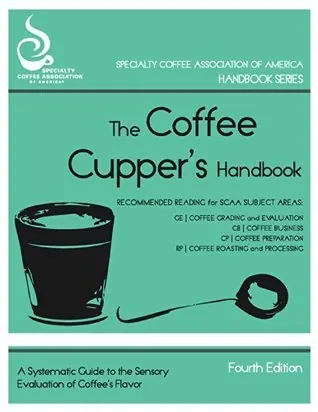
Gota's record uses the 2011 fourth edition because the first lacks a verifiable ISBN-13 in the starting inventory. ISBN Search identifies the title, Ted R. Lingle, fourth edition, paperback binding, Specialty Coffee Association of America, year 2011, ISBN-10 1882552008, and ISBN-13 9781882552009. Eborn Books confirms the edition, year, and ISBN-10; the UW-Madison Libraries catalog records the same volume.
The original date requires care. The fourth-edition text states that first publication occurred in 1985. Castle's review from April 1986 still describes it as a working document submitted to the Coffee Development Group and not formally published. Different histories therefore cite 1985 or 1986. The discrepancy may reflect drafting, internal circulation, and public release; there is not enough basis to erase either date.
The fourth edition presents itself as work accumulated by numerous professionals over more than a decade. It is not identical to the initial manuscript: it incorporates forms, protocols, training, and scales that reflect the later institutionalization of tasting.
Four sections and three senses
The view of the fourth edition's contents shows an introduction to the natural origin of flavor and sensory evaluation, followed by four sections. The first divides experience into olfaction, taste, and mouthfeel. For aroma, it classifies components by their source and constructs a profile or bouquet. For taste, it organizes basic tastes and combinations associated with coffee. For oral sensation, it distinguishes oils, sediment, colloids, body, and strength.
The second section catalogs taints and defects by stage: harvesting and drying, storage and aging, roasting and caramelization, roasting and loss of freshness, preservation after brewing, and external contamination, including water. The third formalizes the cupping method: sample preparation, evaluation, learning, forms, tools, and visual aids. The fourth addresses scaling of attributes, ranges, scores, diagrams, and SCAA forms.
The appendices add prescreening questionnaires, taste- and aroma-recognition tests, and a glossary. The organization expresses the book's ambition: to begin with how a person perceives, connect deviations with stages in the process, and end with a recordable practice.
Aroma, taste, and mouthfeel as grammar
The division into three senses was pedagogically powerful. It forces readers not to call every undifferentiated impression “flavor.” Volatiles reach olfaction through the orthonasal and retronasal routes; dissolved substances contribute to taste; materials and physical properties participate in oral sensation. That separation makes more precise questions possible.
Lingle classifies aromas into groups associated with processes in the living bean, browning reactions, and pyrolysis. He then develops families such as floral, fruity, herbal, nutty, caramel, or chocolate. The structure anticipated later visual tools. Its usefulness lies in guiding attention and conversation, not in establishing an exclusive correspondence between every word and one molecule.
One of its scientific limits appears here. Pathways of aroma formation are complex, many compounds contribute simultaneously, and perception depends on thresholds, matrix, and interaction. Some of the manual's chemical attributions and categories simplify sharply. The present-day reader should preserve the sensory grammar while comparing the molecular explanations with later research.
Defects as the bean's history
The section on taints and defects turns tasting into diagnosis. A note does not appear in isolation: it may point toward harvesting, fermentation, drying, storage, roasting, water, or beverage maintenance. That orientation helped connect evaluation with quality control throughout the chain.
The classification also reflects the commercial vocabulary of its period. Some terms vary across regions or have acquired stricter definitions. Attributing a descriptor to a cause without other evidence can be risky: several processes generate similar impressions, and the same deviation produces different effects depending on intensity and context.
The manual therefore works best as a tree of hypotheses. A perception guides the investigation; it does not by itself determine where the problem occurred. Data on moisture, water activity, fermentation, storage, thermal profile, and preparation can confirm or reject causes.
From book to development tool
Its practical influence is documented outside the United States. An FAO manual for the Lao coffee sector explains that a project used the process from the 2001 third edition to standardize evaluation. It describes a sequence covering fragrance and aroma, acidity, flavor, body, aftertaste, and balance, and shows results from different buyers.
That case demonstrates two things. First, the system was concrete enough to train people and compare samples in an improvement program. Second, scores from different buyers still diverged. A shared form reduces ambiguity, but does not eliminate training, context, or preferences.
Looking back on his 1986 article, Castle attributed enormous influence to the book in both cupping discipline and shared language. This is the assessment of a close participant, not a bibliometric measurement, but it agrees with the institutional and educational adoption visible over decades.
From Lingle's form to the SCA system
The history of forms was not static. An analysis of alignment and calibration locates attributes such as fragrance/aroma, acidity, flavor, body, aftertaste, and balance in the 2001 third edition. It then explains how the 1995 wheel and the revision of the form in the early 2000s shifted some emphasis from intensity toward quality and supported Q training.
Thus even “the SCAA form” was not a single, immutable entity. Commercial objectives, training programs, and new tools changed categories and scales. The fourth edition captures an important stage in that development, not its endpoint.
The modern distinction between alignment with other tasters and calibration against references also qualifies the ideal of a shared language. Agreement does not prove accuracy; recognizing a reference does not require shared preference. The book opened the problem, and the later field developed instruments to address it more precisely.
What became obsolete
Beyond chemical simplifications, its treatment of basic tastes reflects a tradition predating the general inclusion of umami in Western teaching. Its matrices of taste combinations are useful as historical pedagogy, but they do not constitute a complete model of current perception. Physiology, sensory genetics, and cognitive psychology have advanced.
Official standards changed too. In 2024, the SCA adopted Coffee Value Assessment preparation and mechanics, descriptive assessment, and affective assessment, stating that they replace the 2004 protocol and form. CVA separates description and quality impression more clearly and avoids relying on a single score as a complete representation of value.
This means that the fourth edition should not be used as the current official protocol. It can still be read to understand where many categories came from, why the sector needed forms, and how it attempted to make expert practice communicable.
How to read a technical classic
The ideal audience includes tasters, quality managers, historians of specialty coffee, and trainers who want to understand the genealogy of their vocabulary. A beginner can learn to separate senses and stages, but should practice with current standards and competent supervision.
The safest strategy has two parts. First, reconstruct the system on its own terms: what problem it sought to solve, how it organized perception, and which procedures it offered. Then mark each assertion as a historical category, causal hypothesis, or still-current practice and compare it with recent science and standards.
Read this way, The Coffee Cupper's Handbook need not be infallible to be fundamental. Its achievement was to transform scattered impressions into an object that could be discussed, taught, and revised. Precisely because the field was able to revise its categories and replace its forms, the manual fulfilled an essential part of its mission: making the taster's experience cease to be a silent authority.