What can be said about this work
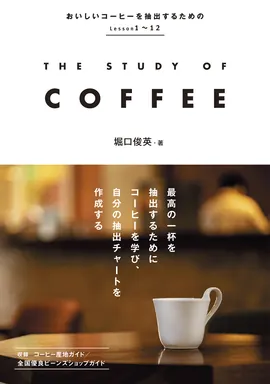
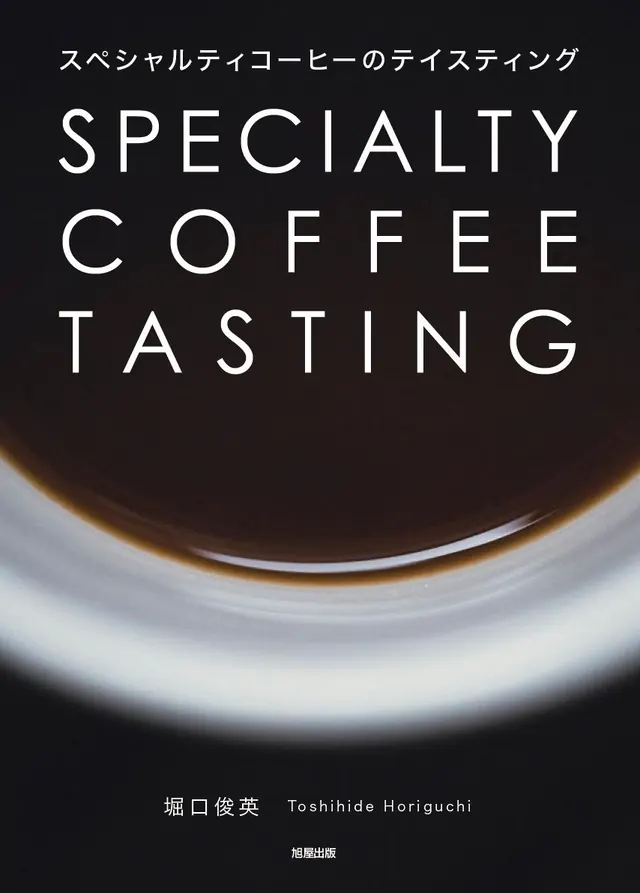
スペシャルティコーヒーのテイスティング is a 448-page Japanese manual by 堀口俊英, Toshihide Horiguchi. Asahiya, the publisher, provides more than a synopsis: it publishes an extraordinarily detailed table of contents, bibliographic data, several interior images, and an explanation of the project. This material makes it possible to assess the book's architecture and questions with considerable precision, although it does not replace reading its complete arguments, tables, and results.
The proposition is broader than its shortened Western title might suggest. It does not merely teach a cupping session. It attempts to connect perception with scoring protocols, physicochemical composition, and instrumental measurement, then applies that framework to varieties, countries, processes, roasting, bean circulation, and training. The independent Hanmoto catalog confirms the author, publisher, B5 format, 448 pages, and ISBN, and reproduces the same general contents.
Horiguchi also presents the book as the outcome of thirty years of change in his practice, from commercial coffee and the premium segment of the 1990s to contemporary specialty coffee. That chronology makes the volume more than a taxonomy: it documents how a Japanese professional revised his criteria as the market, the lots available, and assessment institutions changed.
Five parts and an unusual scale
The preliminary apparatus establishes conditions that consumer books often leave implicit: sample traceability and harvest, roasting, tasting time, panel composition, scores, country data, analysis, taste sensor, and statistical treatment. The first part then defines tasting, its purposes, and its language. It includes JIS terms, floral and fruit families, acids, texture, defects, the flavor wheel, the WCR lexicon, and examples drawn from auctions.
The second part is the methodological core. It explains the SCA system, green coffee grading, the protocol, the author's criteria, Cup of Excellence, and SCAJ. It then opens three lines of comparison: physicochemical analysis of organic acids, lipids, sucrose, amino acids, caffeine, moisture, and water; the use of a taste sensor; and a proprietary ten-point scale for each attribute, with fifty total points. The contents announce comparisons between that scale, the SCA score, chemical values, and the instrument.
The third and fourth parts turn the framework into a comparative atlas. They cover arabica, canephora, and liberica; Gesha, Typica, Bourbon, SL lines, Catimor, Sarchimor, F1 hybrids, and other varieties; then coffees from South America, Central America, Africa, the Caribbean, and Asia. This is not a simple list of aromatic notes: the contents repeatedly acknowledge the difficulty of identifying a variety and devote separate cases to processes, harvests, defects, and auction lots.
The fifth part returns to the conditions that produce or alter what is perceived: climate, soil, shade, harvesting, washed, natural, and honey processing, anaerobic fermentation, roasting, storage, packaging, transport, and training. This progression, from measurement to product and from product to its chain, is the book's greatest structural distinction.
The dialogue with contemporary sensory science
The volume knows the contemporary tools: it explicitly cites the WCR lexicon and the wheel, and it does not reduce quality to an impression without context. The WCR Sensory Lexicon defines 110 flavor, aroma, and texture attributes accompanied by intensity references. Its purpose is descriptive and reproducible: to help different panels measure comparable phenomena. The associated wheel did not arise merely as an editorial illustration. The study published in the Journal of Food Science organized 99 terms through free sorting by 72 participants and multivariate analysis; its own authors describe it as a living document.
That context helps readers approach Horiguchi's system with caution. Comparing human assessment, chemistry, and an instrument is a legitimate and valuable question. A correlation, however, does not show that a sensor can replace a panel or that a chemical concentration alone explains a quality judgment. Assessing his results would require examining the number and selection of samples, replication, panel calibration, treatment of outliers, magnitude of the correlations, and uncertainty. The contents announce those analyses, but the public page does not allow them to be audited.
The publication date also matters. The SCA Coffee Value Assessment separates physical, sensory descriptive, affective, and extrinsic assessments. Instead of compressing everything into a single score, it distinguishes what is in the cup, how much the evaluator likes it, and which origin or process information contributes value. Horiguchi's fifty-point system may be pedagogically clear and perhaps useful to consumers, but it should not simply be confused with this newer architecture. The contrast between the two frameworks is precisely one reason to read it.
A Japanese perspective with professional memory
Sensory coffee literature often circulates in English and adopts North American or global standards as though they exhausted the practice. This book introduces a voice formed in the Japanese market, connected to SCAJ and to decades of buying, roasting, teaching, and tasting. The contents do not erase that location: they discuss Japanese imports, domestic circulation, warehouse preservation, and the arrival of coffees from different origins.
That perspective matters because sensory vocabulary is not a neutral collection of words. Available references, food memory, and translation condition how easily a taster recognizes and communicates a descriptor. WCR provides introductions in Japanese and Chinese, but the core lexicon still requires local adaptation and training. Horiguchi appears to respond to that problem by combining international terms, Japanese standards, and examples from his own practice.
The historical dimension also provides a healthy caution. The author records the transition from premium to specialty coffee and notes recent divergences in values between consuming countries and generations. The contents alone cannot show how he substantiates each diagnosis, but proposing that quality is a changing construction avoids presenting a score sheet as a natural law.
Available reception and the absence of independent criticism
The sources found for this edition are primarily the publisher and a bibliographic catalog. Both provide exceptional information about content and edition, but they do not constitute independent critical reception. The sources consulted yielded no extensive academic or professional review that assesses the experiments, compares the ten-point system with other panels, or discusses its statistical results.
That absence does not imply negative reception; it means none should be invented. The publisher's claim that the book contains up-to-date material for the global sector is promotion, not consensus. Nor does the author's career automatically validate every conclusion. The publisher's dossier documents positions, publications, and teaching activity, all relevant to understanding his experience, but professional authority does not replace methodological assessment.
Limits and discrepancies
There is a minor calendar discrepancy: Asahiya gives September 19, 2024, and Hanmoto gives the 21st. It is reasonable to interpret the former as the publisher's release date and the latter as its arrival in bookstores, but the distinction is not explicitly explained. Both dates are therefore retained rather than manufacturing a single exact date.
The principal limit of this dossier is documentary. It analyzes the complete contents and public information, not all 448 pages or the tables. The robustness of the scoring system, the external validity of its samples, and the sensor's capabilities cannot be certified from chapter headings. Claims about climate, varieties, fermentation, transport, or chemistry should be checked individually against primary literature when used to make decisions.
Nor does this appear to be a short manual for learning the basic cupping ritual. Its length, number of cases, and blend of memoir, protocols, and analysis make it better suited as a reference for tasters, buyers, roasters, trainers, and advanced readers. Anyone seeking a current operating standard must also work with current SCA documents; anyone seeking a calibrated lexicon should also consult WCR.
Read with those precautions, the volume occupies a singular place. It brings together in one work a Japanese memory of specialty coffee, an international map of coffees, and an explicit attempt to compare judgment, composition, and instrument. That does not make it a definitive measure of quality. It offers something intellectually more useful: several measures set against one another and the obligation to ask why they agree, why they diverge, and what part of the experience each one leaves out.