A collective work about a problem of interactions
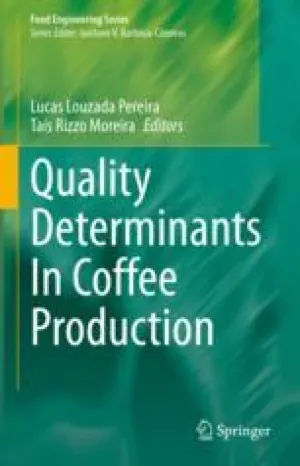
Quality Determinants in Coffee Production is a scientific reference edited by Lucas Louzada Pereira and Taís Rizzo Moreira in the Food Engineering series. They are not the sole authors of its 443 pages: they coordinate a collection of chapters written by specialists connected to agronomy, engineering, microbiology, biochemistry, analytical chemistry, roasting, and sensory evaluation. The Springer record presents precisely this multidisciplinary perspective.
The title does not promise to identify one master variable. Its editorial thesis is that quality emerges from relationships among plant material, environment, management, harvesting, drying, storage, microorganisms, chemical composition, roasting, and sensory measurement. The preface rejects the simplistic allocation of a fixed percentage to preharvest and another to postharvest. That decision is intellectually useful: it forces readers to ask which conditions made an effect observable and which later stage may have modified it.
It is a technical book for researchers, advanced students, quality managers, producers with specialized support, and postharvest professionals. It is not a recipe manual. Many chapters explain mechanisms, equipment, classifications, or methods of analysis; turning them into a farm operation requires attention to scale, costs, safety, environmental conditions, and local validation.
Nine verifiable chapters
The complete Springer table of contents makes it possible to describe the content without reconstruction. The first chapter covers harvesting, drying, and storage. The second examines global warming and climate change. The third studies soil microorganisms and beverage quality. The fourth addresses the biochemistry of fermentation; the fifth, chemical constituents; and the sixth relates processing and fermentation. The seventh deals with roasting, the eighth with physical classification and sensory analysis, and the ninth with specialty-coffee trends.
The sequence moves from agricultural operations to mechanisms and ends with evaluation and the market. Its center of gravity is Brazil, especially Espírito Santo, and it combines arabica and canephora. That location provides detail on dryers, Brazilian classification, cultivars, and tropical conditions. It should not be mistaken for homogeneous coverage of every origin: Ethiopia, Colombia, Indonesia, and Central America have different microbial ecosystems, infrastructures, varieties, and commercial conventions.
Including roasting does not divert the subject. The chemical and physical potential of green coffee is expressed only through thermal transformations, and an unsuitable profile can conceal or create differences. Even so, the book does not turn "quality" into a property fully controlled by the roaster. The raw material establishes constraints that heat cannot undo.
Harvesting, drying, and storage
The first chapter is the most operational: fruit selection, preprocessing, washing, dry and wet routes, moisture, airflow, patios, dryers, storage, and classification. It is a chain of control. Harvesting unripe fruit, mixing maturity stages, or delaying processing alters the substrate that will reach fermentation and drying. Drying quickly at excessive temperatures can damage tissue; drying too slowly can prolong microbial activity and favor defects.
Later independent science supports the importance of the system but also its uncertainties. A review of cherry and green-bean chemistry concludes that genetics, environment, maturation, cultivation, processing, and storage affect composition. At the same time, it reports fragmented results and a lack of experimental consistency. The fact that two lots differ after processing does not demonstrate that the process name is the only cause.
A storage study published in 2023 followed washed and natural coffees in different packages and temperatures for twelve months. At 20 °C they aged faster than at 10 or -10 °C, and processing explained part of the variation. It is a controlled observation, not an instruction to freeze all green coffee: energy use, condensation, the cold chain, humidity, and opening packages alter risk under commercial conditions.
Moisture and water activity are useful for monitoring stability, but no number summarizes freshness or sensory potential. Sampling, meter calibration, and heterogeneity within the bag matter. The book is more useful when it teaches readers to measure and document than when a reader extracts a threshold without its context.
Fermentation: possibility, not guarantee
The fourth and sixth chapters are the volume's most distinctive feature. They separate general biochemistry from specific processing routes and examine bacteria, yeasts, fungi, organic acids, sugars, amino acids, phenols, lipids, spontaneous fermentation, starter cultures, wet, natural, and semidry processing, oxygen availability, and mycotoxin risk. They present fermentation as a transformation by microbes and the fruit itself, not as a marketing label.
The 2023 review in Food Research International organizes protocols through four variables: fruit treatment, oxygen, addition of water, and use of starter cultures. Its conclusion is cautious: different protocols alter microbiota and the cup, but there is still no single process capable of raising quality or producing a given profile in every environment. Better control of temperature and aeration and greater reproducibility are needed.
That caution must accompany any applied reading of the book. A starter culture that worked in one variety, altitude, and lot may not dominate the microbiota of another farm. "Anaerobic" does not by itself describe pressure, residual oxygen, temperature, time, mass, pH, or hygiene either. Intense descriptors do not guarantee absence of defects or safety. The producer needs to record variables, dry in time, and verify the result sensorially and microbiologically.
The volume was published while these techniques were growing rapidly. Its value is in showing mechanisms and vocabulary; it cannot incorporate every subsequent trial, review, and change in nomenclature. Nor should it be read as authorization to transfer a laboratory fermentation to tonnes of fruit without evaluating heat transfer, uniformity, cleaning, and cost.
Climate, soil, and agronomic quality
The second and third chapters expand "production" beyond postharvest. Temperature, precipitation, radiation, altitude, and water deficit condition phenology, ripening, and composition. Soil microbiota participate in nutrient cycling, growth, and pathogen suppression, but the causal chain from a microbial community to a cup descriptor is long and exposed to numerous confounding factors.
The systematic review of climate and quality assembled 73 articles and found variable effects of light, altitude, water stress, temperature, carbon dioxide, and nutrition. Higher altitude and lower light exposure showed the most consistent sensory trends, but long studies of interactions and adaptation viability are lacking. It is therefore incorrect to turn "shade improves quality" into a universal dose; excess shade can reduce production or favor disease depending on species and environment.
The climate chapter was built around the IPCC Fifth Assessment Report and scenarios available during writing. The Sixth Assessment Report added evidence about impacts, vulnerability, inequality, and limits to adaptation. The 2020 text remains useful for understanding mechanisms and zoning in Espírito Santo, but current decisions should use more recent climate series, scenarios, and policies.
Classification and sensory analysis
The eighth chapter connects physical defects, Brazilian classification, and cupping. It is a necessary bridge: size, density, color, or defect count describe properties of the lot, but the beverage is evaluated after controlled roasting and preparation. Statistics, repetition, and panel calibration matter because sensory judgment contains human variability.
Since publication, the SCA has developed the Coffee Value Assessment, which separates physical evaluation, sensory description, affective impression, and extrinsic information. This evolution limits how current forms or protocols reproduced in the book may be, not the need to work with blind samples, constant conditions, and defined vocabulary.
A total score should not be confused with chemical composition or universal preference. Two coffees with a similar number can have different profiles and find different markets. Chromatography and volatile maps help identify compounds, but detecting a molecule does not by itself prove its perceptual impact: concentration, threshold, matrix, and interactions determine what is actually smelled or tasted.
Reception and position in the literature
No extensive independent critical review of the volume was located. In the August 2026 consultation, Springer shows approximately 18,000 accesses and 49 citations. These are dynamic indicators of academic consultation, not assessments of chapter-by-chapter accuracy. Stores such as Hoepli and ARK verify the edition and distribution, but mainly reproduce the publisher's description.
Its clearest reception is thematic: fermentation, climate change, microbiology, and green-bean quality have continued to grow as lines of research. Later works cite chapters from the volume and review the same problems with broader bodies of literature. That confirms the relevance of the questions; it does not demonstrate that every 2020 answer remains the best available.
The work occupies an intermediate position between a production manual and an academic compilation. Its strength is to show connections that an exclusively agronomic or sensory guide would separate. Its potential weakness is the heterogeneity inherent in a collective book: chapters with different objectives, scales, and levels of evidence share one cover.
Editions, limits, and suitable reader
Springer identifies three different ISBNs: 9783030544362 for the hardcover published December 12, 2020; 9783030544379 for the ebook of December 11; and 9783030544393 for the paperback of December 2021. Gota records only the hardcover because it is the manifestation verified by two independent sources and does not mix metadata from different formats. The copyright says 2021, and many catalogs call it the "2021 edition"; the hardcover's commercial date remains 2020.
The extent is expressed as xvii preliminary pages plus 443 numbered pages. Some stores may show 460 or 464 by adding preliminary matter, final leaves, or data from another binding. The record uses 443, Springer's bibliographic figure, and retains the discrepancy here.
It is recommended for readers who need to connect farm and postharvest operations with chemical, microbiological, and sensory mechanisms. It is not the best first reading for a producer without technical support or a replacement for current protocols. It should be accompanied by later research, local regulations, and trials at the actual working scale. Read within those limits, it offers something difficult to obtain in one work: an explanation of why quality does not belong to one stage, but to interactions among many stages that can amplify or contradict one another.