The product before it becomes a profile
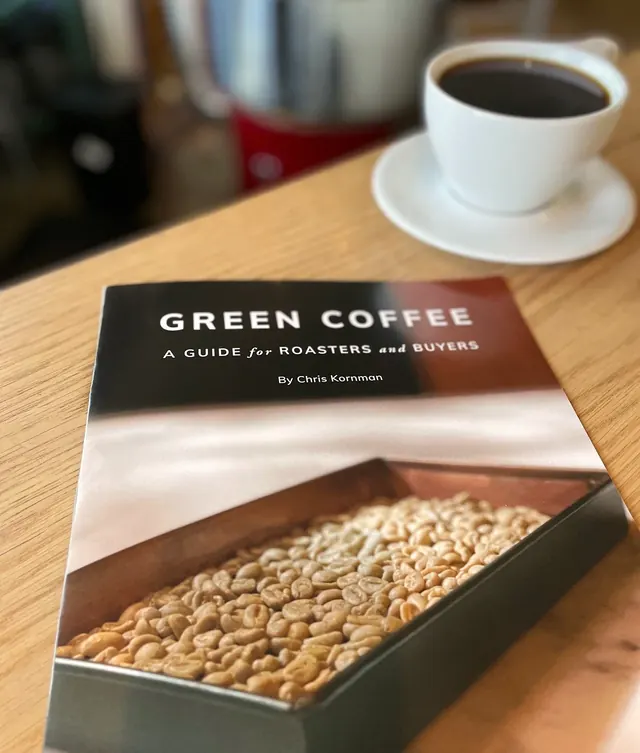
Green Coffee: A Guide for Roasters and Buyers attempts to correct a common asymmetry: roasting education can begin when coffee is already inside the machine, even though much of its composition, stability, and potential was decided earlier. Chris Kornman treats green coffee as a seed, an agricultural commodity, an object of evaluation, and a raw material that will react to heat.
The Roast Magazine announcement summarizes history, processing methods, sourcing, and evaluation protocols. The Royal Coffee page adds analysis and presents the objective as a combination of practical suggestions and theoretical understanding. The main audience is roasters, buyers, quality control staff, and traders, although the writing aims to be accessible to nonprofessional readers.
It is not a roasting-curve manual in disguise. Its premise is that size, density, water content, water activity, defects, processing, and age affect what a curve can do. Nor is it a complete agronomy: it surveys the plant and origin in order to explain the material that reaches the warehouse, not to design a farm in detail.
Verified content and progression
Public sources do not provide a page-by-page table of contents as complete as those available for some other works in this selection, but they do allow its architecture to be verified. Roast Magazine lists history, processing, sourcing, and evaluation. Royal Coffee confirms the progression from context and production to analysis. The Comunicaffè review describes biological structure, cultivation, origin regions, trade dynamics, size, density, moisture, defects, logistics, warehousing, decaffeination, and the relationship to roasting.
That path avoids separating departments that work on the same lot. In purchasing, a physical specification without cupping can accept a stable but sensorially unsuitable coffee. In roasting, density in isolation does not determine the energy that should be applied. In quality control, a good shipment sample does not guarantee that months of transportation and warehousing will preserve the profile.
Its usefulness lies in combining signals and context. A measurement describes a property under a particular method; it does not replace the processing history or the roaster test. Kornman insists that coffee is agricultural and variable. Comunicaffè values precisely the fact that the book does not offer univocal solutions but adaptable criteria.
Measuring without turning the metric into the goal
Size, density, and water content are practical controls, but none summarizes quality. Density can change with species, variety, maturity, environment, and processing. Two beans of similar density may differ in structure and composition. Moisture describes the mass of water relative to total mass; water activity describes its availability for reactions and equilibrium with the environment. Confusing the two can conceal aging or instability risks.
A storage study in Colombia tracked moisture, water activity, and cupping score for seven months in jute and PICS bags. Hermetic barriers preserved the variables better, and water activity was more clearly related to sensory change than moisture. The experiment was designed for a simulated small-farm situation and did not include the whole international transit process.
Another twelve-month trial combined temperatures, natural or washed processing, and jute or GrainPro. Temperature and processing method affected compounds and the cup, while the packaging effect was not identical across every outcome. These data support a multivariable reading: a warehouse specification must include environment, time, processing, sampling, and objective, not merely the name of a bag.
Processing, fermentation, and causality
The book gives processing a central place because it transforms fruit into stable material and alters flavor precursors. Independent literature supports that relevance, but prevents simple rankings of washed, natural, and honey processes. In a wet-processing experiment with Catimor in Yunnan, fermentation duration, depulping or demucilaging, and soaking altered microbiota, metabolites, and sensory evaluation. Extended fermentation produced fruitier and more acidic cups in that trial, while soaking reduced some of the differences.
The result does not authorize extending every fermentation. There was one location, one variety, and two replicates; temperature, local communities, and management change on other farms. Nor does it demonstrate that "fruitier" always means higher commercial quality. For a buyer or roaster, the useful conclusion is to ask about observable variables, require traceable lots, and test stability, not automatically reward a fashionable process label.
The book's breadth may compress these uncertainties. A teaching classification needs categories; real production contains hybrid processes, spontaneous fermentations, and protocols that do not share nomenclature. The reader must distinguish description, proposed mechanism, and demonstrated result.
Agronomy and sustainability: context is not decoration
Treating coffee as an agricultural product requires looking further back than processing. Shade is a good example of why general rules fail. A meta-analysis of more than 200 yield observations found different responses among 18 arabica cultivars: some neutral, others declining, and others with an optimum curve. Overall, low or moderate shade, approximately 10-39%, had little negative effect or even a benefit for certain cultivars, while greater cover tended to reduce yield.
The authors call for more data by cultivar, shade tree, and environment. Therefore neither "shade improves quality" nor "shade reduces productivity" works as a global specification. A buyer promising sustainability must understand variety, agroforestry design, climate, costs, and ecosystem services as well as the cup. A manual can teach what to ask; the answer belongs to a particular farm and time series.
From warehouse to roaster
A distinctive strength is that the book closes the loop with roasting. Green analysis does not fully predict a curve, but it does prevent all lots from being treated as equivalent. Size distribution can affect transfer; water and structure consume energy; defects may express themselves unevenly; aging reduces possibilities that no profile can recover.
The relationship should not become a deterministic recipe. High density does not always require the same heat input, because equipment geometry, batch size, airflow, initial temperature, and sensory objective matter. The strongest proposal is experimental: document properties, use a reasonable starting profile, cup, and correct. The book's value lies in expanding the data that accompanies that cycle.
Who may find it useful
It is suitable for roasters who want to understand raw-material variability, buyers who need to speak with production and quality teams, and groups seeking a common foundation. It may serve advanced enthusiasts, but its price, scale, and orientation answer to professional work.
It does not replace current protocols, sensory calibration, local agronomic advice, or storage studies for each facility. Its best chapters work as a bridge: they explain why an observation deserves a test and which variables to record. Read alongside later evidence, it teaches that green coffee is not a constant that precedes roasting. It is a living material that already contains decisions, potential losses, and possibilities that heat can only reveal or degrade.
Verified edition and discrepancies
The cataloged edition is the English ISBN 9780998771748, published by Roast Magazine. Roast Rebels and ThriftBooks identify the same ISBN. Roast Magazine announced publication for April 2022 and describes a softcover edition.
There is a material discrepancy: the publisher announcement states 172 pages, while Royal Coffee and Roast Rebels give 179. Without examining a copy, it is impossible to know whether they count preliminary matter differently or whether a printing was corrected. The record therefore does not publish pagination. Nor does it catalog the digital file: commercial sources confirm that it exists but do not provide a separate, specific ISBN here that meets the collection's standard.