A small book about an enormous stage
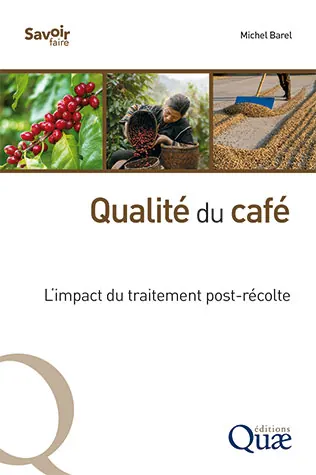
In Qualité du café : l'impact du traitement post-récolte, Michel Barel condenses a clear thesis: the potential created by variety, environment, and agronomy can be preserved, transformed, or degraded between harvest and storage. The official Quæ excerpt states that it takes this potential as its starting point and focuses on actions that producers and operators can control.
It is neither a treatise on cultivation nor a roasting book. It is a technical guide for relating decisions to attributes: maturity, reception, depulping, mucilage, water, drying, hulling, sorting, moisture, molds, and defects. It is also addressed to buyers and roasters who need to formulate specifications or reconstruct the probable history of a lot.
Its brevity facilitates consultation and forces simplification. Expressions such as "everything is decided" in postharvest have teaching force, but they should not erase genetics, climate, plant health, roasting, or preparation. The text itself recognizes an earlier potential. Quality is a system; the book chooses to study the portion in which many losses can still be prevented.
Verified structure
The publisher's table of contents divides the volume into three parts. The first asks what quality is. It distinguishes the perspective of different actors, attributes, signals, controls, and commercial types. This opening matters because producers, exporters, roasters, and consumers do not value exactly the same things. Moisture, defects, safety, flavor, consistency, origin, and price can conflict.
The second part follows the determinants from before harvest and moves into maturity, dry and wet routes, natural, artificial, and split drying, depulping, semi-washed coffees, demucilaging, washing, and waste management. It continues with hulling, grading by size, density, and color, storage, quality control, molds, and ochratoxin A.
The third brings together the origin of defects, recommendations for each operation, and diagnostic questions. This closing form prevents the reader from being left with a list of machines: every action should be associated with an observable risk and a check.
The UniLaSalle catalog confirms the author, subject, language, and agricultural orientation. It also summarizes the book's usefulness for producers, buyers, and roasters. It does not demonstrate that every recommendation works in every environment, but it verifies that the work was conceived as an agricultural-science tool, not a gastronomic essay.
Maturity and processing: categories that are not enough
Separating unripe, ripe, overripe, or damaged fruit reduces predictable sources of defects. A visual category does not capture composition, internal damage, or microbiota, however. Maturity must be related to variety, harvest method, interval before processing, and market objective.
The distinction between dry and wet routes organizes learning well. The 2018 review of postharvest factors confirms that processing alters organoleptic attributes and that gaps remain in explaining every mechanism. Saying that one route "produces higher quality" without specifying raw material, control, drying, and evaluation is too broad.
A wet-processing trial in Yunnan compared depulping and demucilaging, normal or prolonged fermentation, and soaking. It found changes in microbiota and metabolites, and sensory differences linked mainly to duration. Demucilaging produced quality comparable to depulping in that context, and soaking tended to make results more homogeneous. The work used Catimor, one region, and two replicates, so it cannot become a worldwide recipe.
Fermentation: the large field that kept growing
The book appeared when controlled fermentation was already attracting attention, but the literature has grown rapidly. A 2023 review selected 74 recent references and proposed describing protocols by fruit treatment, oxygen availability, addition of water, and use of starter cultures. Its most useful conclusion is negative: it is still not possible to define a single process capable of increasing quality or producing a specific profile in every environment.
Starters can improve reproducibility or differentiate aromas under controlled conditions, but the outcome depends on time, temperature, substrate, local microbiota, and subsequent drying. Moreover, raising a score slightly does not necessarily explain stability, safety, buyer acceptance, or implementation cost.
This research does not invalidate Barel's classification; it makes it more precise. "Wet process" is a family within which different biological processes occur. A good postharvest logbook must record enough variables to repeat or correct a process, not merely name the route.
Drying, structure, and delayed effects
Drying stabilizes coffee, but speed and temperature can leave damage that becomes apparent during storage. A study published in 2023 compared air at 40 and 50 °C with sun drying, maintained coffee between 10.5 and 11.5% moisture, and tracked quality for twelve months. At first there were no clear sensory differences; after eight months, every lot dried at 50 °C showed defects, and the probability of a clean cup favored 40 °C and sun drying.
The design controlled storage and used blocks, but studied washed coffee under specific conditions. "50 °C" describes air, not necessarily uniform bean temperature; load, airflow, and the state of the fruit matter. The result supports Barel's caution about mechanical drying, not a universal prohibition based on a single number.
The lesson is that finishing at a target moisture is not enough. Membrane integrity, water activity, color, germination, and chemical changes can anticipate deterioration. Immediate cupping may not reveal latent damage.
Storage, molds, and safety
The chapter on ochratoxin A is a reminder that sensory quality and safety are not equivalent. Coffee without an obvious defect may still require control of moisture, water activity, and contamination. No visual inspection replaces analysis when regulation or risk requires it.
A twelve-month experiment crossed temperature, process, and bag type. Lower temperatures preserved several indicators better; natural and washed processes followed different trajectories, and packaging did not dominate every comparison. The research uses controlled chambers, which many farms and warehouses cannot reproduce economically.
The practical recommendation must be gradual: dry uniformly, prevent rewetting, measure the environment and product, separate lots, control pests, use a barrier when the risk justifies it, and sample over time. "Hermetic" does not freeze quality or correct a coffee that entered storage in an unstable state.
Quality, specifications, and purchasing power
Barel is right to define quality as a set of attributes whose importance changes according to the actor. This prevents cup score from being treated as the only truth. For a producer, yield, cost, and resistance may be essential; for export, moisture, defects, safety, and volume; for a roaster, stability and aromatic potential.
Stating that the buyer defines quality also requires a discussion of power, however. A specification can reward care or transfer cost and risk to the producer. The manual helps formulate technical requirements, but it must be complemented with price, financing, tolerances, sampling method, and responsibility in the event of rejection. Sustainable quality does not consist only of demanding more controls.
Reception and limits
The independent reception located is modest. Gloubik Sciences describes it as documented, illustrated, and useful for understanding how many points can generate defects, from maturity and molds to drying and storage. It is a substantive but personal review; it does not demonstrate adoption in technical programs or measured impact.
Barel's authority comes from decades of work in postharvest and quality, but experience does not replace experimental references. The volume's greatest limitation accompanies its strength: it offers a manageable synthesis of a heterogeneous chain. It should be read alongside local protocols, health regulations, calibrated sensory analysis, and recent research on microbiota.
Who may find it useful
It is a good entry point for producers, technicians, buyers, roasters, and students who need to visualize the complete sequence without facing an encyclopedia. Its lists of risks and questions make it possible to audit a process and talk with suppliers.
It is not enough to design a facility, validate a fermentation, or manage ochratoxin. Nor does it turn aromas into a reliable diagnosis of a past operation. Its most durable function is to teach readers not to treat green coffee as the natural result of drying a fruit: every transition needs control, records, and explicit limits.
Edition and discrepancies
The main edition is the French print edition ISBN 9782759232062, Éditions Quæ, August 27, 2020. Quæ states 112 pages; UniLaSalle and Eyrolles record 110. The record omits pagination and uses print without claiming a particular binding.
Quæ assigns 9782759232079 to the PDF and 9782759232086 to the ePub. Some retailers group several formats under the first identifier. To avoid mixing manifestations, the catalog retains only the print edition, supported independently by the publisher and the university catalog.