A thesis, not a profile manual
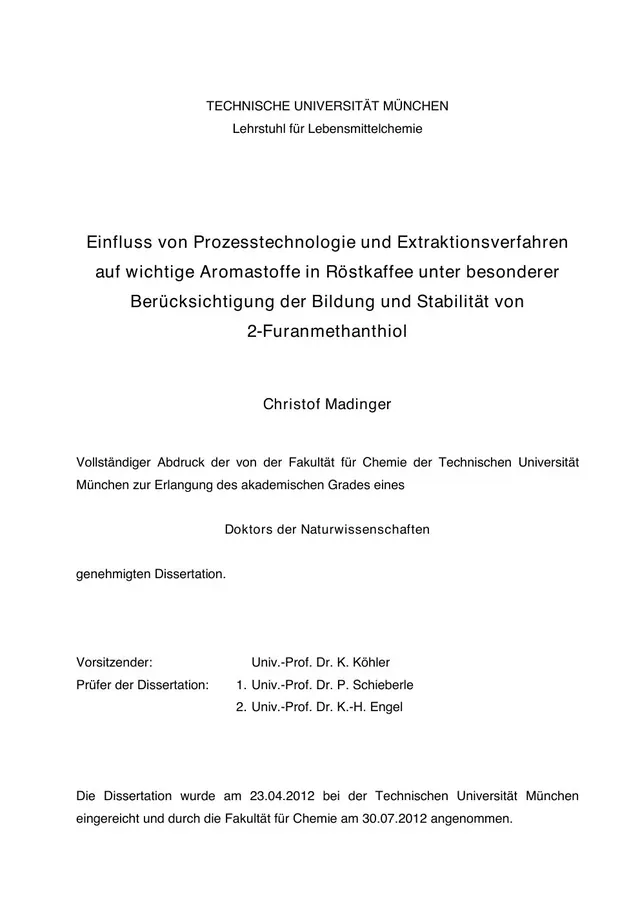
The long German title precisely describes the subject: the influence of process technology and extraction methods on important odorants in roasted coffee, with particular attention to the formation and stability of 2-furanmethanethiol. This compound is also known as 2-furfurylthiol, or FFT, and has an intensely roasted, sulfurous note characteristic of coffee at very low concentrations.
Christof Madinger submitted the dissertation to the Technical University of Munich's Faculty of Chemistry in 2012. The mediaTUM record identifies Peter Schieberle as supervisor and summarizes the results. Its natural audience is food chemists and aroma specialists. A roaster can draw lessons from it, but will not find gas curves ready for production.
The difference in genre matters. The thesis formulates questions, describes materials and methods, presents results, and separates conclusions. Its claims concern specific coffees, treatments, analytical methods, and conditions. They should not be turned into general rules about "more aroma" without preserving that scale.
Exact structure of the work
The German National Library table of contents and the PDF make it possible to reconstruct five main blocks. The introduction reviews molecular sensomics, green and roasted coffee, volatile compounds, factors affecting aroma, proposed formation pathways, and objectives. The results are divided into two broad areas: the effects of drying, extraction, and storage on odorants; and studies of FFT precursors in coffee and mustard.
These are followed by conclusions on aroma quality and formation of the compound, a summary, and an extensive experimental section. The latter documents materials, fractionation, "in-bean" recombination, isotopic labeling, roasting, storage, sensory evaluation, isolation, chromatography, identification, and quantification. References and appendices complete the volume.
Mustard is not a casual digression. FFT also forms when white mustard seeds are roasted. Comparing matrices helps in the search for precursors and tests whether a pathway proposed for coffee is truly specific or works only in simple model systems.
Molecular sensomics and key compounds
Molecular sensomics does not count every volatile and select the most abundant. It combines chemical separation with olfactometry, dilution analysis, identification, quantification, and sensory tests to determine which molecules can contribute to perception. A compound at low concentration may be important if its threshold is extremely low; another that is abundant may have little odor impact.
Among other tools, the thesis uses extract and headspace dilution analysis, gas chromatography with olfactometric detection and mass spectrometry, and stable isotope dilution. These methods reduce some biases, but they do not make the matrix simple. FFT is reactive: it may be lost during sample preparation, bind to other components, or oxidize. The analytical method determines which fraction is observed.
Calling FFT "the most important aroma" should therefore be understood as shorthand for its key role in sensory models and typical coffee odor, not as a claim that one molecule is the aroma of coffee. Perception emerges from mixtures, concentrations, release into the headspace, and the context of the beverage.
Green-coffee drying and variation among beans
According to the institutional summary, the green-coffee drying methods compared showed no significant effect on the formation of the key odorants examined after roasting. It is a valuable negative result: under those conditions, changing drying technology did not produce the expected difference in the measured markers.
It does not mean that all drying is sensorially equivalent. The thesis studied defined treatments and samples, and "no significant difference" depends on variability, sample size, and observed variables. Other postharvest effects, including fermentation, defects, water activity, or damage, may alter the cup without appearing in the same set of odorants.
The work also quantifies variation among individual roasted beans. That heterogeneity is a reminder that a ground sample averages seeds that did not necessarily receive identical heat or begin with the same composition. In production, consistency of blending and transfer may matter as much as the mean value of a curve.
Extraction: from grounds to beverage
Madinger compared preparation with a coffee machine and a moka pot, carried out sensory analyses, and calculated extraction rates for selected odorants. The repository's conclusion is clear: preparation method decisively altered individual yields and therefore the beverage aroma. Not all compounds move from grounds into water in the same proportion.
Independent research from a later or nearby period on nine extraction methods broadens the context. It measured headspace compounds, solids, acids, caffeine, and sensory attributes in four espressos and five long-brew methods. The espressos were more concentrated; long beverages generally extracted a greater amount per cup. Efficiency depended substantially on solubility and the amount of water.
The two studies are not interchangeable. They used different coffees, recipes, and instruments, and the nine-method study did not focus exclusively on FFT. Together they show that "coffee extraction" is not a single percentage: nonvolatile solids and odorants have different kinetics, losses, and partitioning. A higher refractometric yield does not guarantee more aroma available to the nose.
Formation of 2-furfurylthiol
One pathway proposed in model systems derived FFT from ribose and cysteine through Maillard chemistry. Madinger's work, supported by recombinations, fractions, and isotopic labeling inside the bean, concluded that in his model it did not form from that simple pair, but from a high-molecular-weight precursor. The same exclusion was investigated in mustard.
The peer-reviewed 2009 precedent on in-bean experiments had already shown that pathways suggested by models could fail in the real matrix: it ruled out the 2-furaldehyde route and found no incorporation of the C5 skeleton of arabinose into FFT. At the same time, it confirmed pathways for other compounds. The lesson is not that Maillard chemistry is irrelevant, but that a reaction between pure reactants does not demonstrate the dominant route inside a complex seed.
Identifying a macromolecular precursor narrows the question; it does not necessarily resolve its complete structure or every possible pathway. Conclusions must retain the language of the model and labeling used.
Stability and loss of freshness
The thesis found considerable instability of FFT during storage in both whole-bean and ground coffee. Grinding increases surface area and facilitates release and contact with oxygen, but the losses are not solely evaporation. The compound can react with the matrix.
A 2019 study of binding and stability in the beverage examined robusta coffee, storage for one hour at 40 °C, and model systems. FFT was one of the most unstable volatiles, and reversible binding to hydroxyhydroquinone explained an important share of the loss. Temperature, pH, and matrix had effects. The accelerated conditions and use of robusta prevent the transfer of an exact shelf life to every coffee served.
Later NMR research on interactions between odorants and melanoidins distinguished covalent and noncovalent interactions and observed that temperature changed FFT behavior. In sensory models, the high-molecular-weight material reduced roasted and sulfurous notes. This reinforces the picture of dynamic loss, but it remains a controlled system, not a direct measurement of every consumption situation.
Reception, usefulness, and limits
No extensive critical review or reliable bibliometric measure of the complete thesis has been located. Its verifiable presence is in mediaTUM, the German National Library, and the German Digital Library. The absence of reviews does not reduce its methodological quality; it prevents claims of influence that are not documented.
For an aroma chemist, its value lies in primary methods and results. For a roaster, it provides useful limits: a key compound may have a complex formation pathway, vary among beans, be extracted in a method-dependent way, and disappear through volatilization or reaction. No single temperature target guarantees retention in the cup.
The volume dates from 2012. Instrumentation and the literature on thiols have advanced, so it should be read alongside later studies. Nor does it cover the whole sensory experience, consumer preference, or the economics of preservation. Its molecular precision complements those scales; it does not replace them.
Printed edition and repository
The German Digital Library records a first edition, ISBN 9783938896563, in German, published in 2012 by the Deutsche Forschungsanstalt für Lebensmittelchemie, with VII + 269 pages. It also identifies the work as a TUM thesis. The record and the DNB table of contents are two independent sources specific to the edition.
mediaTUM shows 283 pages for the PDF file. The file includes a cover, preliminary pages, and repository elements that may not be counted in the bibliographic extent. Without physically comparing both objects, no other edition is inferred. Gota retains the 269 numbered pages plus seven preliminary pages from the national record and links to the institutional PDF as access to the complete content.