A collective work from agricultural engineering
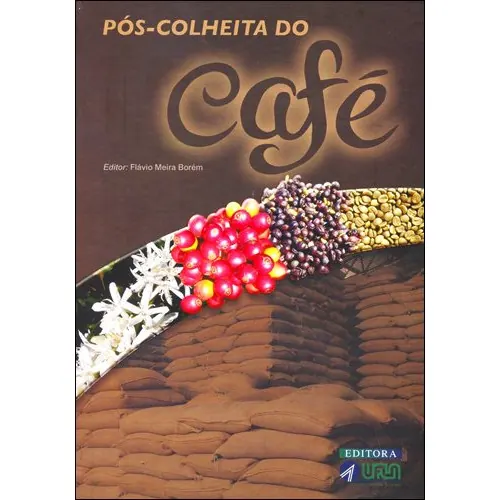
Pós-colheita do Café is a Brazilian technical reference edited by Flávio Meira Borém and published by Editora UFLA in 2008. It does not merely compare natural and depulped coffee or list defects. It constructs postharvest as a system of matter, water, heat, microbiology, facilities, labor, and commercial control.
The contemporary launch announcement reports 25 professionals from UFLA, Embrapa Café, EPAMIG, IAC, universities, government, and companies. It describes three years of organization and updating, supported by the Brazilian Coffee Research and Development Consortium within a technology dissemination project. That origin explains the tone: theory applied for producers, technicians, and students.
Its breadth is the main difference from shorter manuals. Coffee postharvest is not only fermentation or sun drying. It requires sizing equipment, managing energy and waste, controlling pests and fungi, storing, milling, and working safely. The work makes visible that a quality decision can also be an engineering, cost, or occupational-exposure decision.
Seventeen verified chapters
The contents published by Livraria Funep begin with the anatomy and chemical composition of the fruit and seed. They continue with water in fruit and beans, hygrometry, and physical and thermal properties. These foundations prepare the chapters on processing, waste treatment, drying, and energy.
The book then introduces mathematical modeling and simulation of drying, storage, bulk coffee and structural criteria for silos, and postharvest facilities. The final sections address storage pests, toxigenic fungi and mycotoxins, milling and remilling, the environment, occupational safety, and certification.
The Wageningen Library classifies the monograph under postharvest treatment and lists processing, pulp, drying, storage, transport, and roasting as subjects. The Embrapa catalog records it as a work edited by Borém, with 631 pages and color illustrations. These sources confirm that it is a technical collection rather than a single-author book, even though some retailers simplify responsibility as "author."
Water, hygrometry, and why a percentage is not enough
Placing water and hygrometry before drying is a sound teaching decision. Moisture on a wet basis expresses total quantity; water activity indicates availability for reactions and equilibrium with the environment. Two coffees with similar moisture may behave differently if internal distribution, temperature, or packaging changes.
A Colombian storage study compared jute and hermetic PICS bags over seven months. The bags maintained moisture, water activity, and sensory score better, and water activity explained more of the quality change. The trial simulated small-farm conditions and did not include every variation in international transportation.
The lesson updates the book without denying it: moisture data are necessary, but a robust storage decision adds water activity, temperature, relative humidity, time, and the packaging barrier. The equilibrium changes when a lot is opened, sampled, or moved.
Drying: temperature, bean condition, and delayed damage
The volume devotes several chapters to drying, energy, and modeling because removing water uniformly without damaging structure is a transfer problem, not a simple instruction to "dry to 11%." A Brazilian experiment with natural and depulped coffee compared patio drying and air heated to 40 and 60 °C. As temperature increased, electrical conductivity, potassium leaching, and acidity rose; sugars decreased, and treatment at 60 °C harmed quality under those conditions.
A universal limit cannot be extracted from one cultivar and a particular set of equipment. Air temperature, bean temperature, airflow, layer depth, turning, processing, and maturity interact. A method can be extracted: record thermal history and check integrity rather than evaluating the operation only by speed.
A 2023 study followed coffee dried with air at 40 or 50 °C and in the sun for twelve months. Scores were comparable at the beginning; later, more defects appeared at 50 °C, and the probability of a clean cup favored 40 °C and sun drying. The delayed difference reinforces a concept important to this work: drying damage can remain latent and become apparent in storage.
Fermentation and processing after 2008
When the book was published, fermentation was still often treated as a stage for removing mucilage or as a spontaneous part of processing. Since then, metagenomics, metabolomics, and trials with starter cultures have grown. A wet-processing study in Yunnan showed that duration, depulping or demucilaging, and soaking change microbial communities, metabolites, and the cup.
Extended duration produced fruitier and more acidic profiles in that Catimor and that environment, but the result does not define a Brazilian protocol. Local microbiota, oxygen, temperature, water, variety, and subsequent drying alter the trajectory. Later research does not make the processing chapter obsolete; it adds variables that a technician in 2026 should record.
It also demands care with language. "Anaerobic fermentation" may describe containers, oxygen availability, or marketing without making two protocols equivalent. Repetition requires documentation of raw material, vessel, time, temperature, pH, oxygen when possible, inoculation, and the transition to drying.
Storage, aging, and invisible defects
The chapters on storage, pests, fungi, and mycotoxins are central because stability is never absolute. A 2021 study of volatile compounds stored natural and depulped coffees in permeable and hermetic packaging for extended periods. It detected chemical changes before some sensory damage became evident; natural coffees in permeable packaging showed early latent signals that later appeared as aging.
The result suggests that periodic cupping is necessary but not sufficient. Color, water activity, compounds, integrity, and environment can provide earlier warnings. It also shows that the initial process affects stability. A packaging recommendation should not be separated from time and temperature.
Fungi and mycotoxins require another level of caution. The absence of a moldy odor or flavor does not prove safety. Prevention through uniform drying, hygiene, and control of rewetting is essential, but regulatory verification requires appropriate sampling and analysis. A manual explains risk; it does not certify a lot.
Energy, waste, facilities, and work
The work retains a rare breadth by including energy, waste, and safety. Faster drying can consume fuel or electricity; using water shifts the burden to effluent; building silos and dryers concentrates mechanical, dust, heat, and noise hazards. Cup quality does not justify ignoring those burdens.
The modeling chapter can help with sizing, but every formula depends on assumptions about climate, material, and equipment. It must be validated with measurements. Likewise, a technology that is efficient on a large farm may be inaccessible or difficult to maintain for a small unit. Sustainability requires total cost, availability of spare parts, training, and safety, not only thermal performance.
Reception, continuity, and influence
The documented reception is mainly institutional and technical. The 2008 announcement presents the launch at UFLA before agribusiness professionals and links the book to research dissemination. Embrapa and Wageningen added it to their catalogs. This is evidence of circulation as a reference, not a critical review or a measure of adoption on farms.
Continuity is visible in the later work Tecnologia de Pós-Colheita e Qualidade de Cafés Especiais. Editora UFLA presents it as an update and expansion supported by more than 25 years of work, with risk analysis, sizing, deterioration, and sensory analysis. This succession confirms that the field and the editorial project itself continued to change. It should not be confused with a new edition of the 2008 ISBN.
No extensive reception in book-review journals has been located. Its most defensible influence is its use as a technical source and the continuity of a Brazilian research line. Institutional praise must be distinguished from independent validation of each chapter.
Who may find it useful
It is especially valuable for agricultural engineering, processing technicians, warehouse managers, students, and producers who need to understand mechanisms and sizing. It also gives buyers and roasters a vocabulary for asking about drying and stability beyond the process name.
Its date requires work with later literature, current standards, and local advice. It is not an operating manual that can be copied without knowing the equipment, scale, and climate. Its strongest teaching remains current: postharvest is a connected chain. Controlling one stage without observing the next may produce apparently correct coffee that deteriorates months later.
Edition, responsibility, and bibliographic limits
The retained edition is ISBN 9788587692429, Editora UFLA, Portuguese, 2008, 631 pages, and print. Wageningen University & Research Library and Livraria Funep agree on those fields. No exact day is published: the announcement dates the launch event, not necessarily the commercial release of every copy.
Responsibility presents a discrepancy. The contemporary launch says "edited" by Flávio Meira Borém and describes 25 professionals; Embrapa uses the bibliographic form "Borém, F. M. (ed.)." Funep labels him as author, probably because of a limitation in its commercial record. The catalog retains editor, exactly as established by the research selection, and the dossier makes the variant visible rather than adding as coauthors participants whose responsibility has not been verified on the title page.