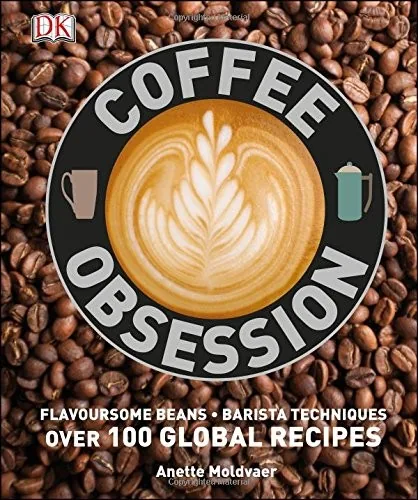
What kind of book it is
Coffee Obsession combines three possible books: an introduction to specialty coffee, a condensed atlas of producing countries, and an illustrated beverage recipe book. Anette Moldvaer leads the journey from quality, buying, and storage to equipment, espresso, milk, and more than one hundred recipes. DK's design favors short entries, maps, visual sequences, and reference pages that do not necessarily need to be read from beginning to end.
The author brings relevant professional experience. She was the 2007 World Cup Tasters Champion, cofounded Square Mile Coffee Roasters, and worked as a green coffee buyer and judge. Those credentials help explain the attention given to origin, flavor, and bar technique. They do not turn the volume into a scientific treatise or guarantee that every recommendation is universal: practical authority and experimental evidence are different domains.
The Sprudge launch review described it as a blend of atlas, encyclopedia, and recipe book. That formula captures its best quality. Rather than separating green coffee from the final beverage, it teaches that provenance, process, roast, grind, water, equipment, and service form a chain.
Four sections and many reading paths
The TCDC catalog records four main sections: coffee knowledge, coffees of the world, equipment, and recipes. The first explains markers of quality, selection and storage, grinding, water, espresso, and milk. It provides the working vocabulary needed to understand the later entries.
“Coffees of the World” organizes production into broad regions: Africa; Indonesia, Asia, and Oceania; South and Central America; and the Caribbean and North America. Within that geography, the book addresses species and varieties, cultivation, harvesting, processing, sensory profiles, and roast suggestions. Its scale is deliberately panoramic. A country or macroregion serves as an entry point, not as a homogeneous unit.
The equipment section links device and technique. The work ranges from French press and filter brewing to espresso and milk tools. It does not provide a comparative instrumental test of every device; it explains function, use, and expected result so a home reader can identify what is needed.
The recipe section is arranged in easy-to-navigate families: classics, hot black or white coffees, cold versions, iced blends, and alcoholic drinks. The indexed contents of the 2014 US edition also show interludes on culture, flavor appreciation, home roasting, decaffeination, pairings, vessels, and syrups. It is used to understand the parallel architecture, not to complete metadata for the British edition.
Origin as a map, not a destination
Organizing by country helps connect variety, environment, processing, and tasting language. It also invites an overly direct reading: “this country tastes like this.” Research on coffee terroir confirms that elevation, temperature, water, soil, shade, and management may contribute to differences. At the same time, postharvest processing, storage, roasting, grinding, and brewing transform the final expression.
A national tasting note should therefore be understood as a historical or commercial tendency under particular conditions, not an essence. Two neighboring farms may cultivate different varieties, ferment in different ways, and sell lots with distant profiles. The roaster and brewer add further decisions. Attributing causality to origin requires standardized tasting protocols and, when possible, instrumental analysis.
Time changes the atlas as well. A systematic review of 73 studies found that elevation, light, temperature, water stress, CO2, and management are related to quality, although many effects are variable or nonlinear. The most consistent evidence favored higher elevation and less light exposure for certain attributes; it did not permit a simple prediction for every region. The 2014 profiles are a useful snapshot, not a permanent climatic guarantee.
Technique and science after 2014
The book is right to present grind, water, ratio, time, and temperature as connected parts. A scientific review of extraction confirms that these variables, together with pressure and geometry, affect kinetics, composition, and flavor. It also identifies gaps: changing one variable often moves others, and many methods have been studied using protocols that are difficult to compare.
Temperature illustrates the problem. A recipe needs an actionable instruction, but a number alone does not determine flavor. In a sensory study of filter coffee, samples were brewed at 87, 90, and 93°C while grind and time were adjusted to match TDS and yield. Under those conditions, temperature had minimal sensory effect, while strength and extraction explained much more.
The result does not say that any temperature will do. Outside that range, with other recipes, or without compensating through grind and time, changing heat alters transfer and composition. It does qualify the language of the “perfect temperature”: a domestic recommendation works as a starting point within a system, not as an isolated property of water.
Recipes involving espresso, milk, ice, alcohol, or syrups expand the system even further. In them, quality cannot be evaluated through extraction yield alone. Dilution, serving temperature, texture, added sweetness, fat, aroma release, and ingredient balance all matter. The recipe collection teaches beverage construction; it does not prove that any formula is sensorially optimal for every audience.
Reception and contribution
Sprudge particularly valued the infographics, definitions, and accessibility for readers beginning to explore specialty coffee. The book could live on a table and be consulted in fragments, an advantage over dense manuals. Its visual approach also broadened the audience: no command of chemistry or bar experience is required to understand the bean's journey.
The documented reception is mostly popular and favorable. No academic review of the volume or independent validation of its more than one hundred recipes has been located. Popularity, graphic quality, and the author's career should not be confused with scientific verification of every claim. Its influence is cultural and pedagogical: it makes a complex chain visible and encourages experimentation.
Edition discrepancies
The Slovart listing and TCDC agree on ISBN 9781409354680, Dorling Kindersley, hardcover format, 224 pages, and 2014. QBD distinguishes publication on June 25 from release on July 1. Because no single editorial date has been confirmed by two sources, Gota retains only the year.
The US edition uses ISBN 9781465419552. It may share the year, length, and much of the structure, but it is not the same commercial product. Nor should “more than 130 recipes,” a figure found in promotions or reviews, be turned into a proven count for every manifestation. “More than one hundred” is the stable promise of the cataloged edition.
Limits and readers
Breadth is both the book's strength and its limit. A single volume cannot offer equal depth in agronomy, green buying, roasting, espresso, milk, history, and cocktails. Geographic entries simplify local variation; instructions assume access to equipment and ingredients; some material on health or decaffeination requires specialist updating.
It is especially useful for visual learners, enthusiasts who want to organize concepts, and baristas at the beginning of their training. An advanced professional may use it as a map of 2014 coffee culture or as a beverage repertoire, but will need specialized literature on water, chemistry, extraction control, agronomy, and climate.
Read with caution, its message endures: a cup does not begin in the coffee maker, and a recipe does not end with its milliliters. Raw material, place, process, roast, equipment, technique, and service context all intervene. Coffee Obsession makes that chain visible and desirable; it is up to the contemporary reader to prevent its graphic clarity from becoming excessive certainty.