A manifesto, not an encyclopedia
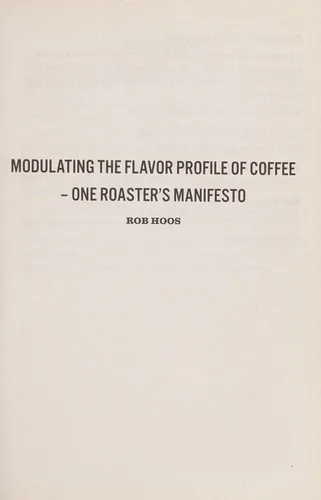
The subtitle One Roaster's Manifesto honestly delimits the project. Rob Hoos does not present a total theory of roasting or a systematic review of all the literature. He records a way of working born from production profiles, tasting notes, and comparisons made across different machines and coffees. The Daily Coffee News launch interview explains that he began deliberate experimentation around 2011 and that much of the book derives from more than 7,500 roasts connected to later observations.
The question is not “how to copy a curve,” but how to modify one part of the thermal history and recognize the direction of sensory change. Hoos proposes moving from a paradigm based only on color, smell, and accumulated experience to one that retains the senses but adds recording, intention, and comparison. “Control” does not mean that every variable is isolated; it means knowing what was changed, keeping everything else as stable as production permits, and tasting again.
The verifiable structure
The contents reproduced by Douban and the Oil Slick Coffee review agree on the sequence. After “Why This Is Worth a Read,” an opening, the manifesto, and a paradigm shift, comes the importance of selecting suitable green coffee. Then come charging and the start of chemical reactions, the Maillard reaction, development time, degree of caramelization or pyrolysis, and the buildup of pressure within the seed. The conclusion summarizes flavor modification, offers a provisional ending, and adds an appendix on how to think about flavor.
It is not a treatise organized by chemical components. Its architecture follows the decision points of a batch. The author's page summarizes five relatively controllable sections: the initial or drying stage, the stage associated with Maillard, development, extension of roasting or pyrolysis, and total time. Those labels are useful for recording even though their boundaries are not chemical switches.
What modulation means
The practical thesis is that changing the duration or intensity of specific portions recurrently shifts acidity, sweetness, body, and roast character. Hoos avoids promising a single recipe and insists in the interview on discussing causes and effects rather than prescribing a result. Green coffee establishes the possible range; the roaster can guide expression within that range, not create any flavor from any raw material.
This distinction guards against two exaggerations. One is believing that origin and process completely determine the cup and roasting only “reveals” it. The other is imagining that a curve can impose any profile regardless of precursors, moisture, density, or structure. The book occupies an intermediate position: green coffee imposes limits, while thermal history selects, transforms, or destroys part of that potential.
The term “Maillard phase” requires caution. Yellowing and browning are observable signals, but Maillard reactions do not begin or end at one identical second for every bean. They coexist with water loss, sugar degradation, acid changes, gas generation, and structural transformations. Extending the visual interval between yellow and first crack changes several things at once.
What later experiments show
Independent literature supports the general idea that different profiles produce different chemistry and perception. Baggenstoss and colleagues compared time-temperature conditions in a commercial drum and a fluidized bed, tracking sixteen aroma compounds and physical properties. Even at a common final color, high temperature with short time and low temperature with long time did not produce the same kinetics. When both systems reproduced a similar bean temperature path, aroma formation was similar.
That finding is compatible with Hoos's attention to history, but it does not validate his five sections as independent variables. The researchers controlled specific equipment and endpoints, not the manifesto's complete vocabulary. Nor did they measure universal preference.
A 2020 study isolated, as far as possible, four development times in a washed Colombian coffee, a one-kilogram Probatino, and a final color around Agtron 76. NMR, volatile compounds, and a descriptive panel separated the samples. Short development was associated with more fruit, sweetness, and acidity; long development with roasted and nutty notes, bitterness, and astringency. This is more direct confirmation that subtle modulation can matter.
To maintain color, however, final temperature had to change, and only one coffee and one machine were tested. It does not demonstrate that “more development” produces the same magnitude of change in natural coffees, canephora, larger batches, or different transfer designs. Research using eight sensory studies adds another qualification: time had an effect, but color was a stronger predictor. Modulation requires controlling both.
Pressure, structure, and sensors
The chapter on pressure is a reminder that the bean is not a static chemical sample. Water and gases are generated or displaced, the structure expands, and it eventually fractures at first crack. That change modifies mass transfer and the release of volatiles. An external temperature reading still does not directly measure internal pressure or uniformity among seeds.
When attempting to transfer a profile between machines, matching displayed temperatures can be misleading: thermocouple position and response, batch size, and the mixture of air and coffee alter the signal. A later industry test attempted to match color and milestone times on Probat, Loring, and Diedrich machines, according to Daily Coffee News. It was a professional demonstration using triangle tests, not a peer-reviewed article with a published full design. It suggests a route for testing, but does not settle how much each heat-transfer mechanism contributes.
Reception and influence
Daily Coffee News presented the book as a response to the scarcity of practical information on manipulating flavor and emphasized that Hoos shared work many roasters kept secret. The Oil Slick Coffee review especially values its treatment of Maillard and the move from intuition toward data. Both sources are close to the sector and favorable; neither constitutes independent experimental validation.
Its influence is visible in courses and conversations that divide the profile into observable sections. That popularity carries a risk: turning trends into rigid tables. The title itself provides the antidote. A manifesto proposes a framework for investigation; it does not close the investigation.
How it can be used
The ideal reader already knows how to record a curve and taste consistently. That reader can select a stable coffee, define color and rest, repeat a baseline profile, and modify one section without deliberately changing the others. The inevitable consequences should be recorded: final temperature, mass loss, total duration, and first-crack behavior. Coded tastings and replicates help distinguish a trend from an expected impression.
It is not the best first introduction to chemistry or machine safety. Nor does it replace literature on heat transfer, volatile analysis, or sensory science. Its contribution is methodological: treating the profile as a series of testable decisions and accepting that the range of modulation depends on the coffee and the system.
Edition and discrepancies
ISBN 9780692417706 is confirmed by Internet Archive and Douban. Lulu dates publication March 3, 2015 and describes paperback binding. The full title includes the subtitle One Roaster's Manifesto.
The extent is not stable across sources: Douban gives 65 pages, Lulu and the launch report 66, and Internet Archive counts 78 pages in the scanned object. They are probably counting the cover, preliminary matter, numbered pages, and digital leaves differently, but this has not been physically verified. The YAML therefore identifies the edition without fixing a page count. That deliberate absence avoids turning a cataloging difference into false precision.