A sensory introduction situated in Italy
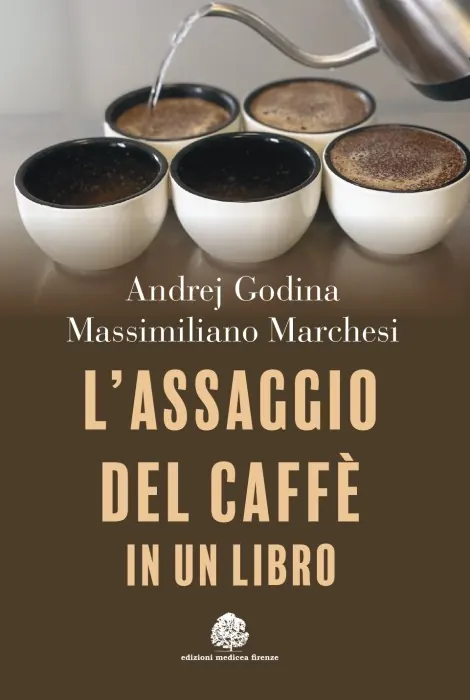
L’assaggio del caffè in un libro, by Andrej Godina and Massimiliano Marchesi, begins from a specific cultural observation: in the symbolic homeland of espresso, much everyday consumption still treats coffee as a largely undifferentiated product. The description from Edizioni Medicea sets that habit against the diversity of defects, sweetness, aromas, and sensations a cup can contain. Its stated aim is not to turn every reader into a professional judge, but to give readers the means to pay attention, compare, and choose.
The publisher's record documents a 2022 Italian edition with 160 pages, dimensions of 17 by 24 centimeters, and sewn paperback binding, with ISBN 9788898015856. The Libreria Universitaria record provides a second commercial identification of the same edition. The publisher also provides an extensive table of contents, sufficient to understand its scope. It does not, however, offer the complete text or developed protocols, so this analysis distinguishes the verifiable structure from conclusions that would require reading and replicating the method.
The book belongs to the Caffè in un libro collection, conceived as a series of compact manuals. That explains its scale: it does not attempt to become an encyclopedia of physiology or an international standard, but to gather in one volume the concepts needed to move from undifferentiated consumption to more conscious observation.
From history to types of tests
The opening chapters provide context on history, botany, light, medium, and dark roasting, and four families of preparation: espresso, moka, filter, and single-serve systems. This opening avoids presenting flavor as something that appears only during cupping. Species, thermal transformation, and extraction all form part of the perceived result.
The center of the book is devoted to sensory analysis. The contents distinguish descriptive, hedonic, discriminative, and analytical tests, as well as combinations among them. This classification is important. A discriminative test asks whether two products are perceived as different; a descriptive test attempts to name and measure attributes; a hedonic test records liking or preference. These questions are related, but treating them as interchangeable leads to common errors: a taster's ability to describe accurately does not mean that person represents the taste of a market, and a majority preference for one sample does not show that it has greater intensity of a specific attribute.
The methodological section includes rules, protocol, sensory physiology, the passage from stimulus to perception, interaction between smell and taste, psychological influences, and a flavour assessment sheet. It then addresses the selection and training of judges, panel performance, consumer panels, and laboratory organization. The order is sound: a tasting sheet does not produce objectivity by itself; it requires conditions, references, repetition, and assessment of the people who use it.
The practical part turns to taste and smell training, the SCA wheel, Le Nez du Café, the WCR lexicon, cupping preparation, the SCA protocol, and attributes associated with quality coffee. The remainder expands the framework to preservation, shelf life, the birth of specialty coffee, espresso profiles, choice according to the moment of consumption, and an extended parallel between coffee and wine.
What it contributes beyond an aroma wheel
The greatest virtue of the contents is that it does not confuse sensory education with memorizing descriptors. The WCR Sensory Lexicon identifies 110 flavor, aroma, and texture attributes and assigns references for measuring intensity. It is a powerful tool, but it needs a procedure and a panel. The Italian book places physiology, types of tests, recruitment, training, and the laboratory precisely around that vocabulary.
Nor is the current flavor wheel a list born from tradition. The work by Spencer and colleagues organized 99 lexicon terms through a sorting task involving 72 participants and statistical clustering and scaling techniques. The article explains both its usefulness and its limits: it supports reproducible communication and characterization, but it is a living document, and some final decisions required expert interpretation.
This comparison improves the reading of the manual. Recognizing “jasmine” or “chocolate” is not the same as scoring quality, and using a word from the wheel without a shared reference does not guarantee that two people mean the same intensity. The chapters on panel performance and combining tests are therefore promising. The public text does not reveal how much detail they provide on experimental design, replication, or statistical analysis, but the conceptual separation is documented in the contents.
Description, liking, and value
Since the book appeared, the SCA has consolidated the Coffee Value Assessment, which divides assessment into four planes: physical, descriptive, affective, and extrinsic. Descriptive assessment records aroma, flavor, texture, and aftertaste; affective assessment records an impression of quality or preference; extrinsic assessment includes information such as origin, process, or certifications. This separation provides a useful framework for updating the reading of Godina and Marchesi.
The book already recognizes the difference between descriptive and hedonic tests and devotes space to both trained panels and consumers. There it agrees with the direction of the CVA: not pretending that all experience fits into one score. Its contents nevertheless still discuss “sensory attributes for a quality coffee” and contrast commercial and specialty espresso. Assessing how it resolves that tension would require reading the full definitions and forms. A descriptive property does not automatically become excellence; quality includes affective, cultural, and commercial decisions.
The publisher's case for choosing coffee carefully is reasonable as an invitation. It is not, by itself, a scientific criterion. The manual's value lies in offering questions and exercises so that choice can be informed, not in replacing one preference with another dictated by specialists.
Italy, espresso, and the comparison with wine
Situating sensory analysis within Italian culture adds interest. The book does not abandon espresso or present filter coffee as a superior stage. It compares profiles, explains moka and single-serve systems, and asks how choice changes with the time of day. That breadth can help readers who arrive from everyday habits rather than from a green coffee buying laboratory.
The parallel with wine runs through fruit, terroir, varieties, harvest, depulping, fermentation, maturation, roasting, packaging, preservation, tasting, and occasions for consumption. As a pedagogical device, it can show that coffee is also a transformed agricultural product rather than a uniform raw material. But an analogy does not prove equivalence. The coffee bean passes through radically different processes, supply chains, and thermal transformation; the concept of terroir should not be used to attribute every aroma to a single geographical cause.
The work even includes coffee and cocktails, along with advice, a glossary, and a bibliography. That panoramic ambition is useful for orientation, although 160 pages necessarily compress entire disciplines. It should be read as a gateway, not as a replacement for manuals on sensory statistics, chemistry, roasting, or extraction.
Reception and conflicts in the evidence
The public sources consulted do not contain an extensive independent review of the work. The publisher provides its argument, contents, and material data; the bookseller confirms the edition. There is not enough basis to claim positive or negative critical reception. Its position as the final volume in a specialized collection describes its editorial place, not its impact.
There are also insufficient public samples to audit the “new form” mentioned in the contents, the exact testing protocol, or the metrics used to assess a panel. This dossier therefore does not certify those instruments. Nor does it turn promotional claims about the mediocrity of Italian consumption into a representative measurement of the country: they express the authors' and publisher's thesis.
Available reception should be distinguished from the authors' professional standing. Their experience in coffee and sensory analysis justifies the project, but no résumé eliminates the need for transparent references, samples, and methods. The bibliography included in the book will be decisive for anyone who wants to use its claims in professional training.
Who it serves and how to read it
It is particularly suitable for curious consumers, baristas in training, and café staff who need to organize concepts before entering technical literature. Its sequence helps readers avoid jumping directly to the wheel: it first asks which test is being performed, which sense is involved, who is assessing, and under what conditions; only then does it introduce tools and protocols.
For a laboratory or advanced program, it will need to be supplemented with current SCA standards, the WCR lexicon, and texts on sensory design. The sections on preservation, extraction, and wine likewise require specialized literature if they are to support production decisions.
Its most solid contribution is cultural and methodological at once. Instead of asking consumers to accept an expert's verdict, it shows that “I like it,” “it is different,” and “it has this attribute” are different statements. Learning to separate them does not diminish pleasure. It makes it possible to discuss a cup more precisely and then choose it for one's own reasons.