A Handbook Built as a System
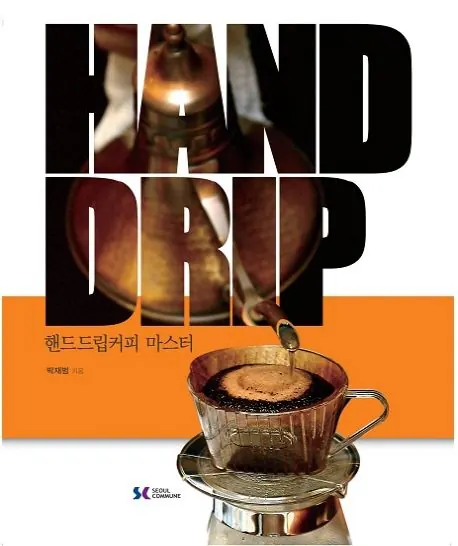
핸드드립커피 마스터 can be translated as Hand-Drip Coffee Mastery. It is a Korean handbook by 박재범 that attempts to explain hand drip as a complete system. It does not begin with a recipe or with a dripper brand. It begins with coffee as a product, moves through roasting, and then devotes most of the volume to extraction theory, tools, stream control, and a detailed sequence of work.
The Kyobo listing describes the author as an engineer by training, a professional in other sectors, the operator of a roasting café, and a participant in fair-trade initiatives. That career explains the project’s tone: it seeks a physical structure for a practice often transmitted through demonstration. The commercial biographical note helps situate the voice, but by itself it does not turn every proposed mechanism into a scientific result.
The complete table of contents reproduced by Kyobo and Bookstore 12 makes it possible to verify five chapters, a prologue, an epilogue, indexes of figures and tables, and a bibliography. This architecture distinguishes the book from a short recipe collection. It also exposes its limitation: general knowledge, bar experience, mechanical analogies, and prescriptive recommendations coexist within a single voice.
From Roasted Fruit to Extraction
The first chapter summarizes origins, market development, cultivation, harvesting, natural and washed processes, green-coffee classification, and specialty coffee. The second follows transformations during roasting: increase in volume, color change, first and second crack, mass loss, aroma formation, profiles, and roast degrees. These sections provide conceptual preparation. Pouring technique cannot correct a defective bean, an unsuitable roast, or poor storage.
The third chapter forms the theoretical core. Its contents list cohesion, adhesion, and gravity as properties of water, followed by dissolution, diffusion, and saturation. It then separates extraction yield and concentration, relates both to flavor, and presents four broad forms of extraction. That separation remains pedagogically important: a concentrated beverage is not necessarily more extracted, and a dilute beverage may have removed a high fraction of the available solubles.
A scientific review of extraction parameters confirms that particle size and distribution, time, temperature, water composition, and ratio affect kinetics and the final profile. It also stresses that these variables are interdependent. The book is right to gather them; readers should avoid turning its expository order into a simple causal chain in which every dial has only one effect.
Variables and Dripper Families
The list of variables is broad: bean quality and storage, roast degree, dose, grinding, delivery speed from the kettle, passage speed within the bed, final volume, temperature, pouring pattern, choice of dripper, pH, filter material, and the sensory condition of the person tasting. The book compares Melitta, Kalita, Hario, and Kono, and distinguishes plastic, ceramic or glass, and metal. It also treats paper, cloth, and metal as different filter media.
Geometry is not decoration. A flow and extraction model published in PLOS ONE compared a cylindrical bed with a truncated conical one and found relevant local variation in velocity and extraction within the cone. Outlet concentration could look similar while the interior of the bed still followed different paths. This supports the book’s question about dripper shape, but it does not demonstrate that one of the four commercial models is superior or validate a particular recipe.
The chemical and sensory comparison of V60, AeroPress, French Press, and an automated system found distinguishable volatile profiles under the tested conditions. Material, shape, flow, and operator intervention combine in the outcome. It is a useful warning to read the handbook’s families as systems, not as fixed flavor labels.
From Stream to Posture
The fourth chapter shifts attention to the body and equipment. It details the kettle, the idea of a vertical stream, the height at which turbulence appears, consistency of stream thickness, choice of spout, grip, and posture. It then moves to dripper position, the path over the bed, installation of the paper, the server, and its cleaning. This attention to detail shows that repeatability does not depend only on numbers: it also requires the operator to reproduce the same flow rate and path.
The verified sequence includes boiling water, choosing a dripper, placing the filter, measuring coffee, grinding, leveling the bed, measuring temperature, performing preinfusion, distributing water in pulses, and mixing the beverage before serving. The contents go so far as to establish visual distances and margins from the edge. These instructions are observable and trainable; they should not be confused with universal principles. A margin may work with the author’s dripper, dose, and grind and fail when bed resistance changes.
Fines illustrate this caution. The handbook recommends reducing them and maintaining a consistent grind. A 2024 study showed that adding fines to an espresso bed reduced permeability and flow rate and prolonged time. This supports the general mechanism of resistance, but it did not study gravitational hand drip and does not authorize the conclusion that every fine particle is always undesirable. A distribution with very few small particles can also change packing and extraction.
Temperature, Measurement, and Flavor
The book pays close attention to preparing enough water, avoiding reheating midway through the pour, measuring in the body of the kettle, and controlling the temperature of the tools. This is useful discipline because it makes the thermal condition repeatable. Interpreting flavor as the direct consequence of one isolated number is another matter.
A drip experiment published in Scientific Reports brewed coffee at 87, 90, and 93 °C and adjusted grinding and time to match concentration and yield. Under those conditions, temperature had little appreciable sensory effect compared with TDS and extraction. This does not mean that pouring at any temperature is equivalent. It means that temperature changes process speed and that its effect in the cup depends on how the other variables move. The best reading of the handbook’s thermal control is therefore experimental: keep it stable to attribute changes with greater confidence.
Extensions: Ice, Chemex, and Cold Drip
The fifth chapter extends the method to hand drip over ice, Chemex, and water drip. In cold preparation with ice, it distinguishes ice’s functions of chilling and preserving a low temperature, and presents Hario and Kalita models. For Chemex, the verified material covers folding the paper, rinsing, grinding, preinfusion, extraction, and a version over ice. Water drip appears as its own system, with an upper reservoir, coffee chamber, extraction, and storage.
These pages do not make three different processes equivalent. Brewing hot over ice retains a high-temperature extraction phase and dilutes as it chills; slow cold drip follows different kinetics; Chemex adds a specific geometry and paper. The value of the closing chapter lies in showing which parts of the system change and which remain questions of ratio, contact, filtration, and temperature.
Reception and Documentary Limits
Kyobo shows user ratings and Bookstore 12 marks the title as sold out, but neither signal is enough to establish professional influence, cumulative sales, or critical reception. No substantial independent review devoted to the book was located. The dossier does not turn store ratings into consensus or lack of stock into evidence of success.
Nor should the word “scientific” in promotional copy be presented as external certification. The book uses physical concepts and organizes practice analytically; it is not a peer-reviewed monograph. Its bibliography and structure make it possible to ask where a claim comes from, but the evidence must be evaluated mechanism by mechanism.
Edition and Access
Kyobo and Bookstore 12 identify ISBN 9791185060088, 박재범, 서울꼬뮨, and January 5, 2016. Kyobo records 196 pages. Commercial dimensions are not identical across platforms, and none of the listings consulted unambiguously states the binding; Gota therefore retains “print” rather than inventing paperback or hardcover.
No commercial English edition has been verified. Hand-Drip Coffee Mastery is the editorial title of this page, not a published translation. The documented edition is in Korean. Read with that language limitation and in light of later science, the book remains valuable for a specific reason: it makes visible the number of physical, material, and bodily decisions concealed behind an apparently simple pour.