A path from personal taste
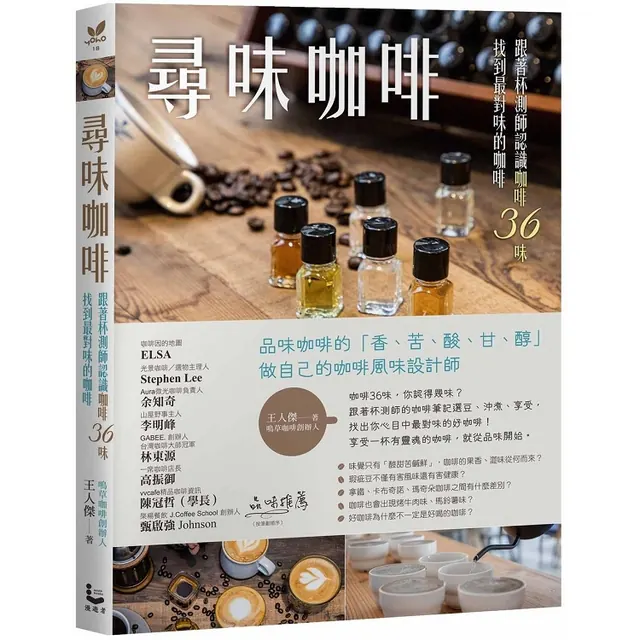
The full title of 尋味咖啡 promises to recognize 36 flavors with the help of a taster and to find the coffee that best suits each person. That final part is essential. 王人傑, Wang Ren-jie, does not frame sensory skill as obedience to a hierarchy of prices, championships, or prestigious lots. According to the publisher's extensive record, learning to drink means distinguishing differences, reflecting on them, and constructing one's own preference.
The work appeared in Taiwan on July 10, 2019, in traditional Chinese, with 160 color pages and paperback binding. The publisher documents the ISBN, dimensions, author, date, and complete contents; Kingstone confirms those details in the record for the electronic edition linked to the same work. The publisher's page also reproduces the foreword and several interior pages, allowing readers to go beyond a back-cover description, although it does not amount to access to the entire book.
Wang writes from a career spanning tea, café service, roasting, quality control, and Taiwanese production. The publisher's biography records professional certifications and his 鳴草咖啡 project, which aims to connect coffee, territory, and ecological restoration. That context explains why the book combines consumer education, bar practice, and an ethical dimension of choice.
Taste, choose, and brew
The structure follows three verbs. The first part, “tasting coffee,” begins before technical vocabulary: it calls for attention and openness, covers sweetness, the relationship between flavor and roasting, the 36 families, cupping, the Q Grader, aroma vials, the wheel, and the assessment form. The pedagogical idea is clear: expand everyday sensory memory before demanding exact names.
The second part, “choosing coffee,” deciphers café menus, espresso culture, extraction by percolation, immersion, and pressure, and differences between “specialty” and “single origin.” It then covers cultivation, harvest, selection, natural, washed, and honey processing, defects, and simplistic uses of altitude. This part moves perception into purchasing decisions: understanding which menu information can anticipate an experience and which serves merely as a commercial signal.
The third part, “brewing coffee,” introduces conditions for a satisfying cup, distinguishes brewing from extraction, mentions extraction quantification, addresses water, and concludes with equipment and manual pouring practice. It includes a simple home preparation and variations for flat-bottom, trapezoidal, and conical filters. This is not an exclusively sensory book: it uses taste as feedback for choosing and adjusting.
The progression is one of its greatest strengths. Many manuals begin with an ideal recipe and relegate perception to the result. Wang reverses the order: first learn what one is seeking, then choose the raw material, and finally modify preparation. An extraction figure therefore does not replace judgment, but helps interpret observed changes.
The 36 notes and contemporary vocabulary
The promotional page presents the “36 notes” as a system classified by the specialty association. The contents group them under aromatic taint, enzymatic reactions, sugar browning, and dry distillation, recognizable categories from the former SCAA wheel and historical aroma materials. That framework was influential and may remain pedagogically manageable, but it should not be confused with the current descriptive system.
The WCR Sensory Lexicon contains 110 flavor, aroma, and texture attributes with definitions and intensity references. The revised wheel is based on that lexicon. The 2016 scientific article explains how 72 participants organized 99 attributes through free sorting, hierarchical clustering, and multidimensional scaling. It also acknowledges that the wheel is a living document and that some general labels were added through expert judgment.
“36” therefore does not describe the total number of possible coffee flavors or WCR's current repertoire. It is a smaller educational set. It may be useful at the beginning because it reduces cognitive load and connects odors with processes, but a professional reader will need to update categories, references, and terminology. The book's record indicates no revision after 2019.
There is another important qualification: a wheel organizes words; it does not automatically make a perception objective. Two people may associate a reference differently because of food experience and language. Training improves communication when it defines samples, intensities, and conditions. The book appears to recognize this by insisting on practice and recording, but the public pages do not make it possible to assess the exact calibration it proposes.
Quality, preference, and independence
The most interesting thesis in the foreword is that price and prestige do not replace taste. Wang uses the example of preferring a Mandheling profile to a more expensive Gesha: knowing objective differences precedes personal choice rather than eliminating it. That position aligns remarkably well with the SCA's later methodological evolution.
The Coffee Value Assessment separates four assessments: physical, descriptive, affective, and extrinsic. Description attempts to record what is perceived; affective assessment captures an impression of quality or preference; extrinsic assessment includes origin, process, certifications, and other information. This separation helps formalize what the book explains in consumer language. A cup can be descriptively complex and not be liked; another can be liked because it is familiar without receiving a high professional score.
Not all of the discussion fits that caution equally well. The foreword attributes to great wine tasters the ability to recognize variety, vintage, harvest time, and even solar exposure in a blind tasting, and it suggests that a cup can narrate soil, climate, and care. As a metaphor for paying attention, it is effective. As a general empirical claim, it exceeds what is demonstrated in the sources consulted. Numerous variables overlap, and inferring provenance requires blind designs and measured results, not only personal experience.
The promotional material also claims that certain green coffee defects harm not only flavor but health. Without reading the argument and its references, it should not be generalized. “Defect” is a broad category; any health conclusion requires identification of the compound, dose, and specific toxicological evidence.
A Taiwanese voice and its reception
The book provides a valuable location. It presents a Taiwanese wheel, a biography connected to tea and local cultivation, and a learning path designed for the menus, equipment, and habits of its market. Against sensory literature dominated by English, that cultural mediation shows that learning descriptors also means translating food memories.
The publisher reproduces recommendations from café, training, and coffee media professionals. One praises the “taste, choose, brew” sequence; another emphasizes that the work begins from the ordinary point of view without abandoning technical knowledge. This is relevant reception within the sector, but it should be classified correctly: these are endorsements included in promotional material, not independent reviews or studies of use.
The sources consulted yielded no extensive criticism comparing its recipes, taxonomy, or claims with experimental results. Nor does the Kingstone page show substantive buyer assessments. There is no basis for claiming critical success beyond the testimonials selected by the publisher.
Limits and the right reader
The main limit is temporal. Published in 2019, the book uses tools and language that precede the implementation of the CVA. This does not invalidate its exercises in attention, comparison, selection, or pouring, but it requires distinguishing them from a current standard. Its specific instructions on water and extraction should also be checked against current research and standards before being turned into universal rules.
Its 160-page scale and illustrated orientation necessarily entail synthesis. Production, defects, water, extraction, and sensory analysis are fields too large to be exhausted here. In return, the work offers an accessible sequence for consumers and beginners, especially useful for anyone who feels excluded by a menu's vocabulary or believes that “good coffee” is simply the most expensive one.
Read critically, its central message retains its force: shared language exists to support comparison, not to cancel individual experience. Descriptive precision and preference serve different functions. When readers learn to say what changes and also why they prefer it, they stop consuming someone else's hierarchy and begin to construct judgment. That combination of sensory literacy and autonomy is the most enduring contribution of 尋味咖啡.