A Book Situated in a Particular Moment
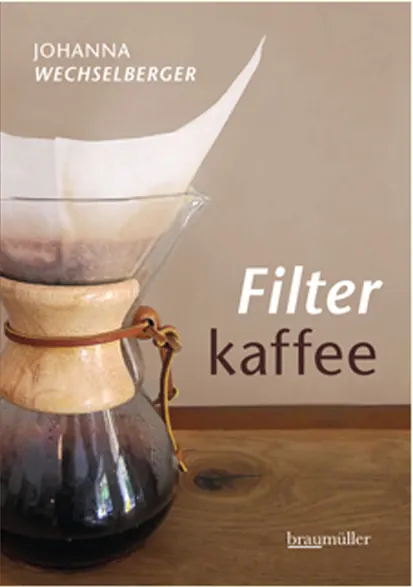
Filterkaffee appeared in 2013, when filter coffee was regaining visibility after being seen as a routine machine-made beverage. The Kaisergranat listing presents it as a book by Johanna Wechselberger, published by Braumüller Verlag on November 15, 2013. The author’s own shop retains the product, now sold out, and summarizes its premise: new ways of filtering and coffees roasted specifically for them opened another way to enjoy the beverage.
It is a compact guide for consumers and home brewers, not an academic monograph. Its task is to organize practical choices: which roast to use, what changes between a machine and a manual filter, how some contemporary devices work, and how to care for the equipment. That scope explains both its usefulness and its limitation. A short book can teach readers to notice variables and brew intentionally; it cannot cover all the physics, chemistry, and sensory diversity of filtration.
The perspective comes from an Austrian roaster and trainer. It does not claim to provide a global history of coffee or a neutral collection of every existing method. It documents which questions appeared necessary in the German-speaking market of 2013, during the renewed appreciation of domestic filter coffee.
From Choosing Coffee to Maintenance
The two principal sources agree on three sections. The first follows the journey “from bean to cup” and asks which roasts are suitable for filter coffee. The second addresses correct preparation with a machine or manual filter. The third, presented as “Filter Coffee 2.0,” introduces Hario, Kalita, and AeroPress and asks how they work and how they affect flavor.
The description adds detailed advice for manual preparation, explanations of machines, and instructions for maintenance and care. This sequence is pedagogically sound: it does not separate the recipe from the coffee or the result from the condition of the equipment. A dirty filter, a showerhead with uneven distribution, or a grinder with retention can produce changes that the reader mistakenly attributes to pouring technique.
There is no authorized public preview of the complete table of contents. We therefore do not attribute specific doses, times, temperatures, or machine models to the book. Nor do we assume that every method receives equal space. The listings allow topics and audience to be described, not procedures to be reproduced.
Filter Roast Is Not an Absolute Category
Asking which roast suits filter coffee requires relating bean development, solubility, and sensory aim. In general terms, roasts with more advanced transformations may extract readily, while less-developed coffees may require a different balance of grind, temperature, and contact. But “light,” “medium,” and “dark” are not universal measurements: two roasters may use the same words for different colors and levels of development.
The strength of the book’s approach lies in starting before the dripper. A recipe cannot correct a coffee that is incompatible with the drinker’s preference. The risk appears if “filter roast” is interpreted as a sufficient seal of approval. Origin, process, age, density, roast curve, and storage still shape the beverage. Choosing well reduces the number of later corrections, but it does not remove the need to taste.
The date matters again. Roast profiles specific to filter were already being discussed in 2013, but vocabulary, color meters, and resting practices have continued to evolve. The guide retains value as orientation; any quantitative claim should be checked against current coffee and instruments.
Machine, Pouring, and Geometry
The opposition between machine and hand can lead to a false hierarchy. A well-designed and maintained machine distributes water repeatably; manual pouring offers room for intervention, but also introduces variation. Quality does not automatically come from a visible gesture. Temperature, wetting pattern, flow rate, bed depth, particle size, and filter form a system.
Hario, Kalita, and AeroPress represent different geometries and dynamics. V60 relies on a conical bed and gravity flow; Kalita is commonly associated with a flat bottom and several holes; AeroPress combines immersion, filtration, and moderate manual pressure. Naming them together does not make their recipes interchangeable.
A comparison published in 2023 brewed the same coffee with V60, AeroPress, French Press, and Pure Brew. Volatile and sensory analyses distinguished the methods; paper and metal were associated with different profiles under those conditions. The study supports the guide’s intuition that the device changes the experience. It does not prove that one method is superior or always produces the same descriptors: it worked with a particular coffee, set of configurations, and panel.
Grinding, Flow, and Adjustment
In percolation filter coffee, grinding changes both surface area and resistance. A finer setting can increase extraction and slow passage, but it may also encourage uneven flow or clogging if fines are abundant. A coarser setting can speed it up, although the relationship changes with dose, bed shape, paper, and pouring. Total time is an outcome of the system, not always an independent variable.
The 2023 study of particle size distribution and French press offers a useful caution. It compared conventional heterogeneous grinds with sieved fractions and found that real distributions could extract more solids and several compounds than uniform fractions. It does not reproduce a V60 because a press works by immersion, but it demonstrates that reducing a grind to one diameter erases information.
For the home reader, the most transferable procedure is to keep water, dose, and method constant, change one condition, and try again. Recording the grinder setting and time helps; deciding by flavor closes the loop. The number supports learning, but does not replace taste.
Cold Brewing, Immersion, and Changing Categories
The public description includes “Immersion Brew” among its tags, although it does not show how much space the subject receives. The field has expanded since 2013 with more hybrids, valves, and cold preparations. Those later developments should not be projected onto the book.
A study published in 2024 examined grind, temperature, ratio, and hot and cold preparations. Its existence illustrates the difficulty of attributing a difference to “cold” or “hot” when time and concentration also change. The results of one protocol do not define an entire category; they help design comparisons in which the variables are stated.
The guide retains one current idea: a method needs a functional explanation. When the market adds a device, the useful question is not whether it is fashionable, but how it organizes contact, flow, and filtration and what maintenance it requires.
Reception and Limits
The critical reception located is very limited. Kaisergranat provides metadata and descriptive copy, not a developed evaluative review. Die Rösterin is the author’s shop. Established is a retailer. These sources establish circulation and advertised content, but they do not support claims about awards, sales, international influence, or professional consensus.
The absence of independent reviews does not make the book irrelevant. It does require its importance to be stated modestly: it is an accessible account of the filter revival in Austria and Germany, written by an identifiable professional and aimed at beginners as well as advanced home users. There is not enough public evidence to call it definitive.
Descriptions of equipment also age. Models, papers, grinders, and recommendations may disappear or change. Maintenance remains essential, but it must follow current instructions for the specific materials involved. The studies cited in this dossier contextualize mechanisms; they neither validate recipes one by one nor demonstrate that the book contains their conclusions.
Edition and Readers
ISBN 9783991001065 has a valid check digit. Kaisergranat records Braumüller Verlag, the author, and the exact date. The term Taschenbuch and the sales listing support identifying it as a paperback. None of the principal sources consulted reliably shows the extent, so the catalog omits it.
It is especially useful for readers of German seeking a short introduction before moving to technical treatises. It is also of interest as a 2013 historical document: Hario, Kalita, and AeroPress already appear as signs of a new domestic filter culture. Its most durable lesson is not that one device wins, but that coffee, roast, method, and care must be understood together.