Brewing Coffee as an Engineering Operation
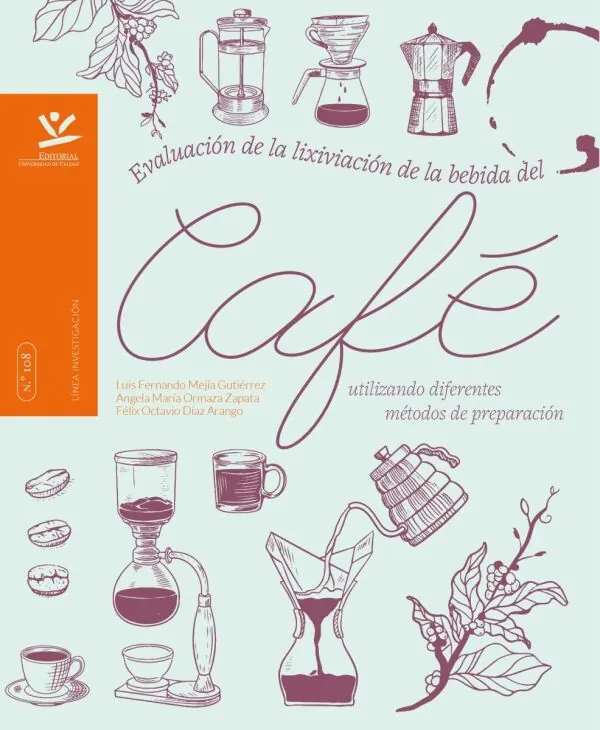
Evaluación de la lixiviación de la bebida del café utilizando diferentes métodos de preparación is a research monograph published by the University of Caldas in 2023. Project MUSE places it in the Research Books series, records 272 pages, and summarizes its purpose: to study hot and cold beverages through principles of mass transfer, mathematical verification, and sensory evaluation of operating variables.
The word “leaching” shifts the point of view. Brewing is no longer only a recipe and is understood instead as solid-liquid extraction: water contacts particles, dissolves and transports components, and produces a beverage whose composition changes over time and with the conditions. This language enables modeling and comparison, but it does not eliminate coffee’s complexity or turn every sensation into a closed equation.
The stated objective has a commercial orientation: to standardize grinding, bean yield, and cup profile for different types of beverage. Standardizing should not mean making every cup identical. It means stating conditions, reducing unwanted variation, and knowing what to adjust for a defined result.
Five Chapters and Two Appendices
Project MUSE’s table of contents makes it possible to describe the structure precisely. After the preliminary matter, introduction, and initial references, chapter 1, pages 25 to 38, presents the coffee beverage. Chapter 2, pages 39 to 60, develops the subject of leaching. Chapter 3, pages 61 to 88, surveys brewing methods.
The center of the work is chapter 4, pages 89 to 236: mass transfer by leaching in beverage preparation. Its length, 148 pages, shows that this is not a superficial guide to devices. Chapter 5, pages 237 to 254, relates cup quality to the brewing process. Two appendices complete the volume: a sensory-analysis glossary based on NTC 2758:2002 and a record of the experimental component.
The distribution reveals the argument. It first defines beverage and operation; then classifies methods; next develops the experimental analysis; and finally connects process and perception. The appendices make the vocabulary and the experiment’s traceability explicit. We do not reproduce equations, tables, or particular results because the public preview provides only the table of contents and summary, not the full text.
Mass Transfer and Coupled Variables
The 2020 review of extraction science places the problem within a network of phenomena: wetting, diffusion, advection, solubility, particle distribution, temperature, and hydrodynamics. Roasted coffee is not a uniform solid. It has pores, fractures, and compounds with different solubilities and kinetics.
The variables are therefore coupled. Grinding finer increases surface area, but in a percolation bed it can also increase resistance, prolong contact, and encourage uneven pathways. Raising temperature can accelerate processes, although not every compound responds in the same way. Increasing time changes composition, but its effect depends on whether the water remains still, flows, or is renewed.
A model is useful when it states its assumptions and domain. It can help anticipate trends, compare methods, or design an operation. It should not be extrapolated automatically from one coffee, grinder, and geometry to every business. The monograph is valuable precisely because it treats brewing as a quantifiable problem; the reader must preserve the experiment’s boundaries.
Yield, Strength, and Cup Profile
Extraction yield estimates the proportion of dry mass that entered the beverage. Strength expresses concentration. A strong cup may result from a large dose and moderate yield; a more dilute one may have extracted a larger fraction. Confusing these quantities produces mistaken diagnoses.
The sensory profile adds another dimension. A total figure does not identify which compounds are present, in what balance, or how a person perceives them. The relationship between yield and quality is not a universal curve. Roast, origin, process, water, serving temperature, and panel training change the outcome.
A 2023 comparison of methods distinguished V60, AeroPress, French Press, and Pure Brew through volatile compounds and sensory evaluation. Paper and metal were associated with different profiles under the protocol. The evidence supports studying each method as a system. It does not demonstrate that the device’s name is the sole cause or that its attributes recur with every coffee.
Useful commercial standardization keeps ratio, water, grinder, procedure, temperature, and service consistent, and defines acceptable variation. It also requires tasting. A refractometer can detect that two beverages differ in concentration; it cannot decide which one best expresses the business’s aim.
Hot and Cold Preparations
The MUSE summary states that the work examines hot and cold beverages in depth. Comparison is difficult because temperature usually changes alongside time, grind, and concentration. A prolonged cold infusion and a hot extraction subsequently chilled do not differ only in degrees: they also follow different kinetics and dilutions.
A study published in 2024 examined temperature, time, grinding, and ratio together in hot and cold preparations. This kind of design helps separate effects and interactions, but it remains conditioned by the coffees and configurations used. It does not permit all cold coffee to be labeled less acidic, sweeter, or sensorially superior.
The contribution of an engineering perspective is to force the comparison to be formulated: the same strength or the same recipe, the same serving temperature or not, the same coffee, which time, and which grind. Without those conditions, “cold versus hot” combines several experiments. Final preference remains open even after variables have been controlled.
The Sensory Component
Chapter 5 and the glossary show that the work does not reduce quality to mass transfer. It connects process and cup and provides a standardized vocabulary. The use of NTC 2758:2002 should be understood historically: it identifies the reference employed by the authors, not a claim that it is the only current standard or that every international panel uses exactly the same terms.
A panel can describe intensity and quality under training and a protocol. Its results gain value when there is randomization, repetition, service control, and statistical analysis. The open sources do not allow the complete design, sample size, or every treatment to be audited. This dossier therefore does not present specific experimental conclusions as general facts.
Commercial quality also includes cost, speed, ease of cleaning, safety, and repeatability. A method with an attractive sensory profile may be unworkable at a particular volume. The monograph is right to mention commercial purposes, because optimizing an operation requires more than one objective to be stated.
Reception and Scope
No independent academic review of the volume was located. MUSE provides a record, summary, and table of contents; Librería Siglo, Nextory, and PocketBook sell or distribute the file. PocketBook shows zero reviews. These pages establish circulation and allow the edition to be reconstructed, but they do not assess the quality of the modeling, clarity, or reproducibility.
The label “research book” describes the publishing series; by itself, it does not guarantee peer review. The work should be judged by its methods, data, assumptions, and discussion. Nor do the external studies cited here validate its conclusions; they serve to situate its questions and identify common cautions.
Its importance within Gota is specific: it contributes a Spanish-language Latin American monograph that treats brewing through food engineering rather than only through barista practice. That broadens the catalog’s language, geography, and method without requiring an undocumented influence to be attributed to it.
Edition and Access
ISBN 9789587594195 has a valid check digit. MUSE records a 2023 copyright, Editorial Ucaldas, Spanish, and 272 pages; the book was added to MUSE on January 25, 2024, a platform date that should not be confused with publication. Librería Siglo identifies a DRM-protected PDF, 14.1 MB, from 2023. Nextory and PocketBook specify September 21, 2023.
The catalog uses that date for the digital edition and retains Editorial Universidad de Caldas as the intellectual publisher. PocketBook’s mention of Siglo del Hombre may relate to distribution rather than necessarily indicating another edition. No print manifestation is created because the open sources do not provide two specific records distinguished by ISBN and format.
It is a reference for researchers, trainers, and professionals seeking to connect recipe, model, and evaluation. Its safest lesson is not which method wins: it is that every comparison must define the system, variables, yield, and sensory criterion before turning a cup into a conclusion.