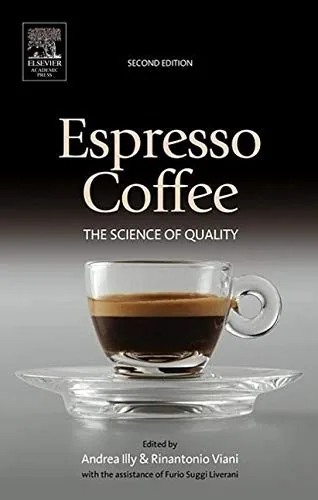
What kind of book it is
Espresso Coffee: The Science of Quality is not a recipe book or an introduction to bar work. It is a collective work of food science and technology that attempts to explain where espresso quality comes from and how it can be modified throughout the chain. Elsevier's publisher description addresses researchers, technologists, and specialists in food chemistry or biology. That audience is evident: the book assumes comfort with physicochemical processes, measurement, and technical literature.
Its principal editorial decision is not to isolate extraction. Before reaching the machine, the volume covers the plant, green coffee, roasting, grinding, and preservation. It then continues into the beverage, perception, and health. Espresso thus appears as the final result of a system, not as a recipe defined only by dose, yield, and time.
That breadth is why the book remains a reference. It also explains why it should not be read as a uniform authority: each chapter belongs to a different discipline, and many of those disciplines have changed substantially since 2005.
A journey from plant to cup
The contents of the second edition organize the book into ten chapters. The first asks what quality means and how its commercial, food, and sensory dimensions relate. Chapters two and three step back to the plant and green coffee: botany, plant breeding, agronomy, harvest, postharvest processes, drying, defects, grading, blending, decaffeination, and composition.
The central part follows the transformations that bring the bean closer to the beverage. The roasting chapter covers the process, techniques, and chemical changes; the grinding chapter includes fracture mechanics, grinders, particle size distribution, and operating variables; the preservation chapter studies physical and chemical changes during storage and packaging.
Only then does percolation appear. Its chapter addresses characterization of the bed, modeling, the machine, and extraction variables. The chapter devoted to the cup connects beverage characterization with organoleptic assessment and preparations that include milk. The final two chapters broaden the focus again to the physiology of taste and smell, psychophysics, and possible health effects of consumption.
The value of this structure does not lie in every section retaining equal currency. It lies in showing that a variation observed in the cup may have agricultural, thermal, mechanical, chemical, or sensory antecedents. For someone who works only at the bar, that change of scale is probably the volume's most enduring lesson.
A reference born between science and industry
The editors bring profiles spanning research and large industry. According to their biographies at Elsevier, Andrea Illy trained in chemistry, worked in research, and assumed responsibility for quality and management at illycaffè. Rinantonio Viani spent part of his career in Nestlé laboratories, chaired the Association for Science and Information on Coffee, and worked on scientific and physiological aspects of coffee.
The publisher also states that specialists prepared the chapters in consultation with major manufacturers. This offers access to industrial problems, measurements, and processes that an independent manual could hardly bring together. It also determines the perspective: the work understands quality through applied science, process control, and production at scale. It does not represent every espresso culture by itself, nor does it claim to.
This dual condition must remain visible. Proximity to industry does not invalidate the content; it explains which questions are treated as central, which variables are measured, and which parts of the chain receive more attention.
From chemistry to a broader science
The first edition appeared in 1995 with the subtitle The Chemistry of Quality and 253 pages, according to its Google Books record. The second changed Chemistry to Science and grew to xvi + 398 pages. The front matter itself states “First published 1995 / Second edition 2005.”
The subtitle change aptly describes the ambition of the new volume: chemistry remains fundamental but shares space with agronomy, genetics, engineering, mechanics, sensory analysis, psychophysics, and nutrition. It cannot be claimed that every difference between the two editions responds to that shift without comparing both complete texts, but the change in title, extent, and organization is documented.
There is a small date discrepancy. Elsevier records December 22, 2004 as the commercial date, while the front matter and WorldCat catalog the edition in 2005. Gota's dossier retains 2004 as the publisher's release and notes 2005 as the bibliographic date; concealing a verifiable variant would offer false precision.
Why it still matters
Its principal strength is end-to-end coverage. It is unusual to find botany, processing, roasting, grinding, storage, extraction, and perception in one volume with specialist authorship. Each chapter includes a bibliography, so the book also functions as a gateway to the literature available when the edition closed.
Academic reception was favorable. Massimo F. Marcone reviewed it in Food Research International as a broad reference for food scientists and nutritionists. Its influence did not end with that review: later work on coffee-to-water ratio, crema, extraction kinetics, and the effect of fines has continued to cite chapters or the complete volume. A later citation does not show that every conclusion remains current, but it does show that the book's architecture remains recognizable to contemporary research.
For an advanced barista or roaster, its usefulness does not consist in delivering parameters ready for use. It consists in providing language and models for asking better questions: what property is being measured, at which stage it originated, which mechanism might explain it, and what evidence could distinguish a cause from a simple correlation.
What has aged
Two decades are a long time for a work that gathers active fields. The molecular genetics section predates the Coffea canephora genome published in 2014 and recent chromosomal and population studies of Coffea arabica. It should be used as a historical state of the discipline, not as a current genetic synthesis.
Extraction modeling has also advanced. Research in 2020 studied uneven flow, yield, and waste through models unavailable to this edition. A 2024 study in Scientific Reports examined the role of fines specifically. These developments do not render the percolation chapter useless; they show which questions have been refined since then.
Espresso aroma has likewise generated later specialized literature. A 2021 review gathered knowledge about aromatic profiles and key odorants in a level of detail that a general 2005 synthesis could not provide.
The health section demands even greater caution. The umbrella review published by BMJ in 2017 found more favorable than harmful associations, but stressed the observational nature of much of the evidence and the difficulty of establishing causality. The book's health conclusions should not be carried into current recommendations without first reviewing subsequent evidence.
There are also visible omissions from the contents: there are no standalone chapters on climate change, labor conditions, the political economy of coffee, or contemporary specialty culture. This does not prove that they never appear in any passage, but it does delimit the kind of map the work offers.
Who may find it useful
It is a suitable reference for readers who want to understand espresso as a technical system and are prepared to work through a dense text. It may be especially useful for quality managers, roasters, trainers, equipment designers, and advanced baristas who need to connect practical observations with scientific disciplines.
It is not the best first purchase for learning to dial in a recipe or solve urgent service problems. Nor does it replace current reviews in genetics, extraction, aroma, or health. Its place is between a contemporary introduction and specialized literature: it offers the general map, makes it possible to identify the field to which each problem belongs, and helps determine what must be updated next.
Read that way, the book retains a function that is difficult to replace. It does not represent “the last word” on espresso. It represents one of the most complete attempts to explain how numerous sciences together construct what we call quality.