What kind of book it is
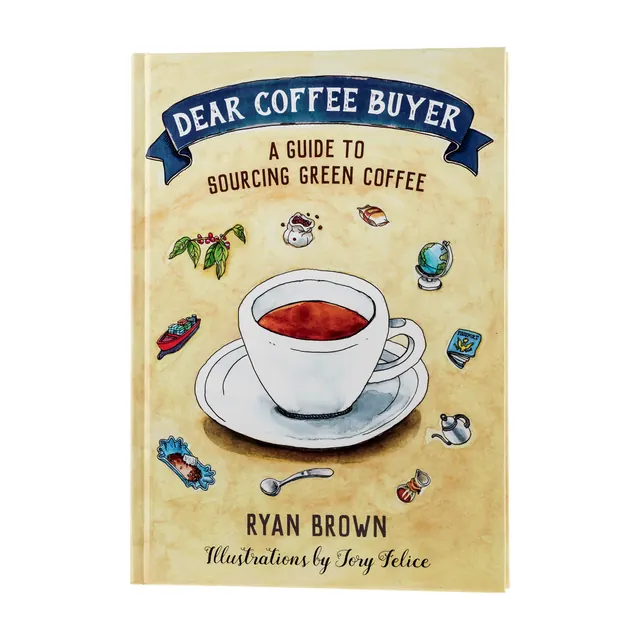
Dear Coffee Buyer: A Guide to Sourcing Green Coffee is a professional manual written from the buyer's position, not a general agronomy or a neutral guide to international trade. Ryan Brown starts from a concrete problem: during his early years, he found little public information about forecasting, samples, suppliers, travel, contracts, and quality control. In the interview with The Coffee Compass, he explains that he organized the book around the questions and mistakes he remembered from his initial period and consulted less experienced buyers to check what remained difficult.
That origin determines its greatest strength. Green coffee does not appear as a bag that arrives at the roastery with every problem already resolved, but as an agricultural purchase that must be planned months in advance, pass through harvest, processing, export, and transport, and retain sufficient quality until the lot is consumed. Forecasting, the coffee offering, seasonality, supplier relationships, evaluation, and commercial storytelling form one job. The book shows that choosing an excellent sample is not enough if the volume is wrong, the timing does not fit, the coffee ages, or the organization does not know how to sell it.
It also determines the limitation. Brown writes a deliberately "opinionated" guide, according to the Daily Coffee News presentation. A professional opinion can accelerate learning and reveal invisible costs, but that does not give it universal validity. Practices that are reasonable for a US specialty roaster may not transfer unchanged to a cooperative, a small importer, a regulated market, or a harvest exposed to different climate risks.
Three parts for a little-seen profession
Daily Coffee News describes three main sections. The first addresses the buyer's job and responsibilities: offering philosophy, forecasting needs, working with suppliers, and the way a coffee is presented. The second focuses on the green product during its different stages. The third discusses how to begin a career and build a sourcing program, with contributions from other professionals about skills and opportunities.
The sequence matters. Before classifying defects, a company must know what it needs and what it can buy responsibly. It must then understand how growing, harvesting, processing, packaging, and storage alter what is evaluated. Finally, it must turn that knowledge into a system that other people can operate. Travel anecdotes are not mere decoration: they show how much buying depends on incomplete information, relationships, and decisions made far from the laboratory.
Brown covers varieties, processes, origins, cupping, prices, and forecasting. The Coffeedesk record confirms that scope and the full-color illustrated edition. Nevertheless, this is not an encyclopedia in 123 pages. Its structure selects what a buyer must recognize to avoid preventable mistakes; it cannot develop genetics, microbiology, agricultural economics, contract law, and sensory analysis in equal depth.
Processing: useful guidance, conditional evidence
One of the most valuable areas is the connection between processing and purchasing. Knowing whether a lot is washed, natural, or mechanically demucilaged helps formulate questions about drying, water, stability, and sensory profile. Those names do not predict the result by themselves, however. The 2018 academic review of postharvest factors assembled evidence that each stage can alter organoleptic quality while also identifying gaps that prevent a process category from becoming a guarantee of cup quality.
Later experimental research makes this context dependence even more visible. A large-scale trial in Yunnan compared depulping and demucilaging, fermentation duration, and soaking in Catimor Coffea arabica. Duration altered microbial communities, metabolites, and the cup; long fermentations produced fruitier and more acidic profiles, and soaking tended to make differences more homogeneous. The design used one variety, one area, and two biological replicates, so it does not demonstrate that extending fermentation improves every coffee.
The Barista Hustle technical interview shows how Brown should be read. He advocates washed processing as a preference and presents mechanical demucilaging as an option capable of producing excellent coffees with less pressure on water resources. At the same time, he recognizes customary differences in acidity, body, and fruit. He does not claim that the two processes are sensorially identical. That precision avoids a false opposition between quality and the environment, but it does not quantify total water use, energy, effluent, or results across multiple farms.
The warehouse is part of the purchase
The book is right to include packaging and storage in the buyer's work. Contracting well does not automatically preserve the lot. A seven-month Colombian study compared traditional sacks with two- and three-layer hermetic PICS bags. The bags limited moisture exchange and maintained water activity and sensory score; there was no statistical difference between two and three layers. Its authors warn that they simulated storage at origin and not complete transport to consuming countries.
A twelve-month experiment published in Scientific Reports crossed natural or washed coffee, jute or GrainPro bags, and five temperatures. It found chemical and sensory losses dependent on process and temperature, without a single solution dominating every comparison. Extreme cold preserved some outcomes, but it requires energy and infrastructure that the experiment does not turn into a universal economic recommendation.
These studies support Brown's insistence on specifying and monitoring conditions, but qualify any simple rule. Moisture and water activity are not interchangeable; packaging acts within an ambient temperature and humidity; the initial process changes the aging trajectory. The buyer needs data about the lot, not only a commercial word printed on the sack.
Direct trade, storytelling, and asymmetries
Brown questions convenient uses of "direct trade" and origin stories. This is an important contribution because the buyer also decides what information is requested, what is paid, and which version reaches the consumer. A direct relationship can improve communication and continuity, but the absence of intermediaries does not by itself prove a sufficient price, a balanced distribution of risk, or equivalent bargaining power.
The book teaches readers to work with suppliers and build an offering philosophy. It should be supplemented with verifiable accounts: price paid at each level, quality costs, financing, lot rejection, currency risk, and the consequences of changing specifications. The buyer's experience illuminates one part of the chain; it does not replace the producer's voice or an independent economic assessment. A narrative can communicate traceability, but it can also simplify a community into a marketable story.
This limitation does not make the manual useless. On the contrary, it allows the book to be used correctly. Its questions about forecasting, relationships, and consistency are organizational tools. Its judgments about varieties, processing, and trade are professional hypotheses that must be checked against origin data, contracts, and contemporary analysis.
Documented reception and influence
The visible reception was mainly professional. Daily Coffee News presented it as a practical guide for avoiding mistakes and detailed its architecture. The Coffee Compass treated it as an unusual entry into a mysterious profession. Scott Rao promoted it enthusiastically, and specialist retailers continue to distribute it. That circulation indicates recognition within the sector, not an independent academic assessment or consensus across the entire coffee trade.
We found no broad tradition of critical reviews in scientific journals or comparative literature. This should be stated because praise from the publisher, sales channel, and colleagues is not equivalent to external validation. The most defensible influence is educational: the book put public language around tasks that were often learned within a small number of companies.
Who may find it useful
It is particularly useful for baristas, roasters, or quality managers moving into buying, and for small businesses that need to turn intuition into a calendar, specifications, and monitoring. It also helps the general reader understand why price and flavor do not originate with the roaster.
It does not replace a course in agronomy, microbiology, contracting, or sensory analysis. Nor does it provide a universal formula for "direct trade." Its best use is to take each chapter as a list of questions: what volume is needed, what risk each party assumes, how quality will be verified, what information is missing, and what will happen if the coffee changes in transit.
Verified edition
The cataloged edition is the English ISBN 9781532364822, published by Scott Rao Coffee Books. Amazon and Coffeedesk agree on 123 pages; Coffeedesk also identifies hardcover and color. Amazon shows January 1, 2018, but interviews and launch coverage are concentrated in April and May. The record retains 2018 without a month or day. No other edition or commercial translation has been added without two sources specific to its ISBN.