Identifying the work before assessing it
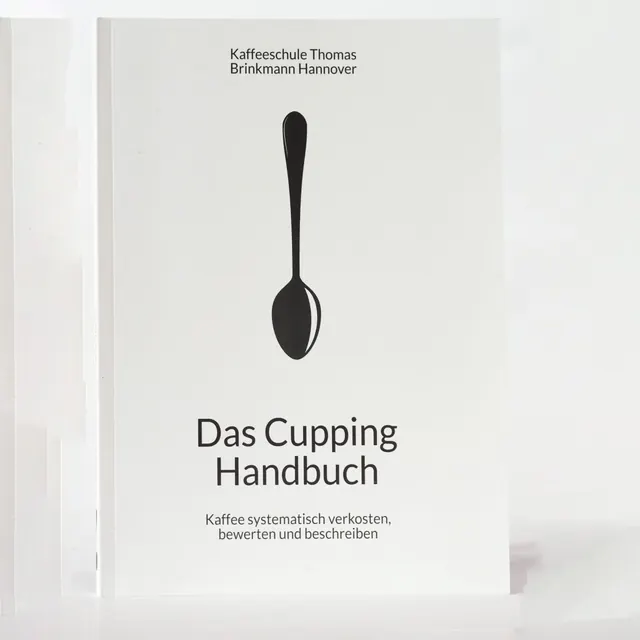
Das Cupping Handbuch: Kaffee systematisch verkosten, bewerten und beschreiben, by Thomas Brinkmann and Nadine Karbach, presents itself as a manual for turning coffee tasting into an orderly practice. The canonical edition for this dossier is the German print edition from Signifikant Media: the German Digital Library record, drawn from the DDB/DNB bibliographic environment, links the title, authors, publisher, year 2021, 116 pages, and ISBN 9783948653026. Rösterei Heer commercially identifies the same title, a length of 116 pages, five chapters, German language, and a 17 by 24 centimeter format. The strong agreement between the two sources makes it possible to describe that manifestation even though the bookseller does not need to repeat every field in the national catalog.
This precision is necessary because there is no single uniform public record. The official Brinkmann Coffee page offers a 116-page digital product, but its ISBN is 9783948653057, not the one belonging to the selected print edition. Other associated materials show 2020 or 2021 and counts of 119 or 126 pages. It is not certain that every difference is an error: edition, language, medium, preliminary pages, or how the PDF is counted may be involved. Without a publisher's concordance table, these data should not be merged. This dossier analyzes the shared intellectual project but retains the 2021 print book as the bibliographic object and treats the digital version as a related manifestation.
Five chapters for building a system
The public pages describe a five-chapter structure. The first asks why cupping is performed and which decisions it can support. That question sounds elementary, but it conditions everything else. A session designed to detect defects, buy a lot, monitor consistency, train vocabulary, or produce a commercial description should not be organized in the same way. The form, panel, samples, and degree of replication should respond to the intended use.
The second chapter introduces the physiology of taste and smell, along with tactile dimensions and other conditions of perception. The third moves into the cupping procedure, its codes, preparation, concentration, and possible psychological errors. The fourth compares forms and systems associated with the SCA and Cup of Excellence and includes questions of reference, calibration, and Canephora assessment. The fifth concentrates on sensory description and on vocabularies developed by different organizations and companies. The official presentation says that the volume brings together more than thirty references; promotional material also mentions hundreds of terms and training questions.
This itinerary distinguishes the book from a quick instruction sheet. It does more than specify grams, water, grind, time, and spoon technique. It places around the procedure three problems that often remain invisible: what is being measured, who interprets the perception, and which language communicates it. The result seems intended for professionals who need to understand the reasoning behind the ritual, not merely repeat it.
The English sample PDF makes it possible to verify the project's general ambition and organization, but it must be handled with care. It previews an English manifestation and does not by itself prove the pagination, date, or ISBN of the German print edition. It is useful for observing structure and tone; bibliographic identification rests on sources specific to the edition.
Preparing a sample is also measurement
One of the most useful contributions of a manual like this is the reminder that the cup does not exist apart from the protocol. Sample roast, rest, ratio, water quality, grind, temperature, time, crust break, and evaluation order can alter what is perceived. When these variables are not controlled, two tasters may not be judging the same stimulus even when they share a table and form.
The contemporary SCA framework reinforces that reading. SCA-102 on sample preparation and mechanics places preparation within the assessment system, while SCA-103 on descriptive assessment treats description as a distinct operation. These documents postdate or accompany the evolution of the Coffee Value Assessment and should not be attributed retrospectively to Brinkmann and Karbach. They function here as a comparison: they show why separating preparation, observation, and judgment remains a current concern.
There is also distance between a written protocol and actual practice. The SCA article “How Do Cuppers Cup?” examines precisely how cuppers apply and revise elements of the procedure. Its relevance to this book lies in the methodological question, not in any supposed validation of the manual: a standard can define conditions, but laboratories and buying tables introduce variations. Making those decisions visible is preferable to pretending there is uniformity.
Perception, concentration, and bias
Including physiology and psychology keeps the tasting sheet from becoming an imaginary machine of objectivity. Retronasal olfaction, taste, and tactile sensations contribute differently to experience. Adaptation, sample order, the expectation created by a prestigious origin, knowledge of price, or the influence of other participants can alter response. Blind coding helps, but it does not by itself resolve all these effects.
The reference to concentration is especially important. Detecting an attribute, recognizing it, and estimating its intensity are different tasks. A person may notice a difference without finding the word; may identify “citrus” without deciding whether it recalls lemon, orange, or citric acid; may share a descriptor with someone else and disagree about intensity. Calibration requires references and repetition, not merely a conversation after tasting.
The book appears useful when it presents these limits as a normal part of the work. The goal should not be to eliminate human subjectivity, which is impossible, but to design conditions that reveal which question was asked and how much the answer can support. A trained panel can improve descriptive consistency; it does not therefore automatically represent consumer preference or turn a quality scale into a physical property of the sample.
Describing is not the same as evaluating
The subtitle brings together three verbs: tasting, evaluating, and describing. Their proximity can obscure the fact that they answer different questions. Description records attributes and intensities; evaluation applies a criterion or expresses an impression of quality; preference communicates liking. A coffee can clearly show fermentation, bitterness, or a particular texture and receive different evaluations according to purpose, market, and taster.
The comparison of SCA and Cup of Excellence forms is therefore promising. Each system was designed for specific uses, and not all its scores are interchangeable. A competition sheet, a purchasing decision, and internal quality control can use similar words while weighting different phenomena. The manual gains value if it makes readers understand a form's architecture before adding its boxes.
This is also where the date matters. The SCA system has evolved toward a more explicit separation of description, affective response, extrinsic information, and physical assessment. It would be wrong to require a work published around 2020-2021 to reproduce later documents. It is useful, however, to read it alongside current standards in order to recognize continuities and changes. Its historical explanation of forms can help readers understand why the profession is revising a total score that condensed observation and judgment for years.
Discrepancies, limits, and the right reader
The principal documentary limitation is the mixture of manifestations. The selected print edition is identified by ISBN 9783948653026, Signifikant Media, 2021, and 116 pages. The official digital product uses ISBN 9783948653057. Associated materials show 2020 and 2021 as well as 116, 119, and 126 pages. The differences may plausibly correspond to German and English, print and PDF, revised versions, or counts with and without preliminary matter; no public source consulted provides the concordance needed to demonstrate this. One figure is therefore not corrected with another, and the digital ISBN is not presented as if it belonged to the print book.
The second limit is access. The preview and descriptions make it possible to reconstruct topics and approach, but not to audit the more than thirty references, the selection of vocabularies, every form, or the depth of each exercise. Concrete technical claims should be checked against the full text and current standards before being used to certify a laboratory or train assessors.
The clearest reader is a barista, roaster, buyer, trainer, or advanced enthusiast who already knows the basic cupping gesture and wants to understand its system. It can provide valuable context for a first experience, although its conceptual density may exceed a quick guide. For a professional panel, it should be supplemented with current SCA documents, sensory references, and validated internal procedures.
Its most convincing contribution lies in joining pieces that are often taught separately. Preparing a sample, perceiving, naming, scoring, and deciding are not identical stages, but they condition one another. A manual that requires readers to state the purpose, control variables, recognize biases, and choose the appropriate form improves the conversation even when it does not produce a single final score. Read this way, Das Cupping Handbuch does not offer an automatic truth about the cup: it offers an architecture for asking more precise questions and knowing what kind of answer each method permits.