What kind of book it is
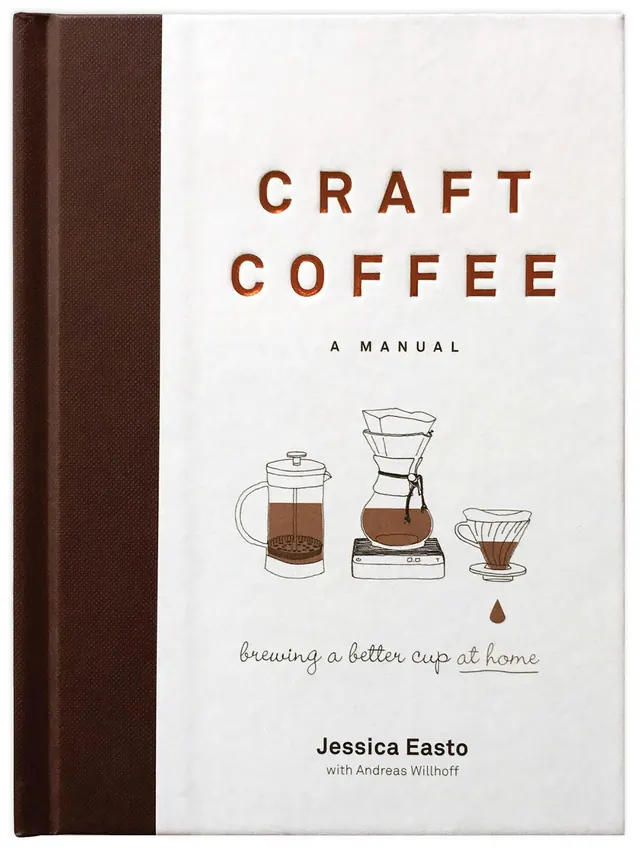
Craft Coffee: A Manual: Brewing a Better Cup at Home is an extensive guide to home brewing, not a scientific treatise or a recipe book limited to one device. Jessica Easto and Andreas Willhoff attempt to close a specific gap: the one separating the language and routines of a coffee shop from a person who buys good coffee but does not know which equipment is worthwhile, what a ratio means, or why two apparently identical brews taste different.
The Agate Publishing listing states that purpose without concealing its limits. The book excludes espresso and concentrates on pour-over, immersion, and cold brewing through ten devices. It covers extraction, equipment, beans, buying, flavor, and methods. That breadth makes it an entry manual to a system, not the final authority on every part of the system.
Its most important choice is pedagogical. Instead of beginning with a recipe and demanding obedience, it presents variables the reader can recognize, measure, and change. It then relates those variables to tools, coffee, and perception. The cup appears not as the result of a secret gesture, but as a series of decisions conditioned by budget, time, taste, and practice.
Six chapters before the cup
The table of contents published by Agate makes it possible to reconstruct its architecture precisely. The introduction explains how to use the volume, surveys the waves of coffee, and distinguishes specialty coffee from the craft coffee label. The first chapter covers extraction, strength and yield, ratio and dose, grinding and contact time, water, temperature, pouring, and adjustment. The second compares immersion and percolation, filters and devices, and examines grinders, scales, kettles, thermometers, and containers.
Chapters three and four move away from the dripper. They present varieties and cultivars, origin, processing, roasting, and decaffeination; then explain where to buy, what seasonality means, how to read a bag, and how to store coffee. The fifth separates perceived acidity, perceived sweetness, bitterness, mouthfeel, and aroma before proposing flavor evaluation. Only the sixth offers complete methods. A troubleshooting appendix, resources, and index close the book.
This delay before the recipes is deliberate. The detailed James' Coffee Blog review observes that theory becomes achievable changes and that experiments distributed through the text invite readers to test the variables. The cafespaces reading confirms the six chapters and describes the final recipes as starting points, not the only acceptable results.
Extraction as a decision system
The first chapter gathers variables that still structure a useful discussion of brewing. Strength or concentration is not the same as extraction yield. Ratio relates coffee and water; grinding changes surface area, resistance, and kinetics; time and temperature affect material transfer. Weighing and recording them makes it possible to repeat a cup and formulate a correction.
Science predating the book supported that general approach. A comparison of nine methods published in 2013 combined instrumental and sensory analysis. It found relationships between total solids and body, headspace intensity and aroma, and caffeine or chlorogenic acids with bitterness and astringency. It also showed that there is no best method in the abstract: each system produced its own composition and profile.
What that evidence does not allow is turning every association into an instant diagnosis. A bitter cup does not by itself reveal a single yield; changing grind can also change flow and time; two grinders at the same number do not produce the same particle distribution. The manual is more reliable when it teaches the reader to move one variable and taste again than when its categories are read as exclusive causes.
Easto's later advice summarizes this discipline well. In Sprudge, she recommends starting with one device, practicing until it is understood, and continuing to brew and taste. It is a less spectacular strategy than collecting drippers but methodologically better: it reduces simultaneous changes and builds sensory memory around a known system.
Ten devices, not a universal hierarchy
The final selection includes French press, AeroPress, Abid Clever, siphon, Melitta, BeeHouse, Walküre, Kalita Wave, Chemex, and Hario V60. Each organizes contact, flow, filtration, and user work differently. The initial division between immersion and pour-over offers a first orientation, although devices such as Clever or AeroPress combine phases and do not fit cleanly into a binary opposition.
Here the book functions as both buying guide and operating manual. Before giving recipes, it explains what each device does and which additional tools it requires. That sequence avoids recommending a gooseneck kettle to someone using a method that is not very sensitive to pouring, or making a scale a test of belonging. Booklist highlighted precisely the combination of equipment, measurements, technique, and cup description, as well as a non-elitist tone.
Accessibility does not eliminate debatable opinions. In the Sprudge interview, the interviewer questions the characterization of the siphon as a consistent method requiring relatively little technique. Easto defends it because her recipe, adapted from Blue Bottle, uses clear control points and demands less mastery of pouring; she also admits that the filter and cleaning are cumbersome. The exchange reveals how the book should be read: “easy” means easy under a particular recipe and for a particular person, not a universal property of the device.
From the ideal chart to plural preferences
The manual uses the classic language of strength, extraction, and adjustment, and a contemporary review identifies the Coffee Brewing Control Chart as support for thinking about underextraction and overextraction. That chart has been an effective pedagogical tool: it separates concentration and yield and shows how ratio relates them. Its problem appears when the central zone stops being an operational reference and becomes a universal definition of good flavor.
The new Coffee Brewing Control Chart published in 2023 brings together 32,076 descriptive sensory measurements and 3,186 consumer ratings. It found attributes that change in more complex ways across the chart and two preference groups with different liking zones. Its authors replace the word “ideal” with a description of profiles and preferences, while acknowledging that their mostly young Northern California consumers do not represent the whole world.
This later revision does not invalidate Easto's proposal. On the contrary, it strengthens her insistence on discovering what each reader appreciates. It does require absolute authority to be withdrawn from labels such as weak, strong, underextracted, or overextracted when they are used as judgments of taste. TDS and yield describe the beverage; they do not decide for the person drinking it.
Temperature, water, and grinding after 2017
Three variables show how far scientific detail has advanced. The first is temperature. A 2020 study of drip coffee brewed at 87, 90, and 93 °C but adjusted grinding and time to equalize strength and yield. Under those conditions, temperature had minimal sensory effect; TDS and extraction explained much more. This does not mean temperature is irrelevant: it changes rate and requires compensation through other variables. It means that a heating figure alone does not determine final flavor.
The second is water. The 2014 work by Hendon and the Colonna-Dashwoods, available when the book was written, used computational chemistry to study the binding of sodium, calcium, and magnesium with coffee compounds. It proposed differences in extraction capacity and emphasized the role of bicarbonate. Its authors also warned that no single composition produces flavorful extractions with every coffee. Speaking only of water TDS erases which ions form that total, its alkalinity, and its relationship to a particular roast.
The third is grinding. A 2023 French press investigation compared conventional grinding, with a heterogeneous distribution, and homogeneous fractions obtained by sieving. Conventional and bimodal distributions extracted more volatile and bioactive compounds than some uniform fractions; the homogeneous fine fraction was not automatically superior. This is a result specific to immersion, not a defense of poor grinders. It is enough to qualify the intuitive idea that greater uniformity always means a better cup.
Cold coffee, freshness, and buying beans
The inclusion of cold brew extends the book's domestic usefulness and reminds readers that low temperature can be offset by much more time. An immersion study published in 2023 examined sizes from 282 to 1,057 micrometers, temperatures from 4 to 37 °C, times from five minutes to eighteen hours, and several ratios. Higher temperature and smaller grinding accelerated and increased extraction; ratio changed yield and titratable acidity but not extraction rate. Cold brew had lower titratable acidity and fewer polyphenols than the compared hot preparation. These relationships are more useful than assigning cold coffee a unique essence of “smoothness.”
The buying chapter also ages better by teaching readers to interpret information than by fixing calendars. Origin, processing, roast, and date guide expectations, but a label does not guarantee the flavor it names. Storage matters materially. A 2022 experiment with opened bags tracked volatile compounds, oxygen, and carbon dioxide. Every system lost freshness; a bag with an integrated closure worked better than transferring beans to another container, using tape, or using a clip. Exposure during handling can matter as much as the word “airtight.”
The finding does not turn one commercial closure into a universal solution. It does support a practical priority of the manual: buy attentively, keep the beans whole, limit air, heat, and moisture, and do not expect a recipe to rescue degraded raw material.
Learning to name flavor
Separating perceived acidity, perceived sweetness, bitterness, body, and aroma helps leave behind the single verdict of “good” or “bad.” The sensory chapter invites readers to observe what changes as the cup cools and which attribute they want to preserve or correct. Its value lies in building comparison, not guessing descriptors printed on a bag.
An important scientific foundation was published in the same year the manuscript was being prepared. The sensory lexicon developed in 2016 used more than one hundred coffees from fourteen countries, trained panels, and references to identify 110 attributes. Its contribution was not proving that every consumer must find jasmine or blackberry, but providing repeatable experiences associated with words.
Easto later explored that problem more deeply. In a 2023 Fresh Cup interview, she explains that a note is not very useful if the consumer does not share its reference, and that cultivation, processing, roasting, water, age, and brewing change the experience. This later revision makes the manual's intuition more precise: developing a palate does not mean getting the roaster's word right, but accumulating references, paying attention, and communicating defensible comparisons.
Reception, influence, and limits
Initial reception valued an unusual combination: density without hostility. Wired recommended it as a starting point for anyone wanting to perfect their coffee and highlighted its attention to detail. Booklist gave it a starred review and celebrated its expansion of focus from recipe to bean, processing, roasting, labeling, and troubleshooting. Sprudge observed that even a professional could use it as a review of the pieces involved in a brew.
Its influence is domestic and pedagogical, not a scientific revolution. It helped present manual brewing as a learnable practice for someone who does not work in a coffee shop. It made two messages compatible that are often separated: measurement improves repeatability, and personal taste remains the purpose. It also showed that equipment should be justified by the problem it solves, not by its position in a hierarchy of consumption.
Breadth has costs. Six chapters cannot address sensory physiology, water chemistry, agronomy, roasting, trade, and ten devices with equal depth. The text predates UC Davis sensory research, several recent particle studies, and a more qualified understanding of home storage. Its recipes fix a snapshot of devices and practices from 2017. Some remain good beginnings; none should be confused with the last word from the manufacturer, competition, or laboratory.
Nor is it a critical history of coffee. Although it explains waves, origins, processes, and labels, its main question is how to improve a cup at home. Labor relations, the price paid to the producer, climate, and the material consequences of the “craft” category remain outside the center. The analogy with craft beer can make a movement accessible, but it does not resolve what quality means or who can afford it.
Who may find it useful
It is especially suitable for someone who has bought a grinder or first manual device and needs to connect actions with results. It also serves baristas at the beginning of training and coffee shops that want to provide something more useful than a short recipe with a bag. The advanced reader can use it as a map and a document of 2017 home coffee culture, but will need later sources for water, hydrodynamics, preference, and sensory analysis.
It does not require adopting all its instruments at once. Its philosophy accommodates limits: one person can improve freshness and grinding before weighing every pour; another can record ratios and times. The most transferable investment is learning one device, repeating, tasting, and taking notes. A scale helps because it preserves a relationship, not because it turns perception into numerical obedience.
The manual's most durable lesson is that brewing better does not mean performing more steps. It means knowing which decision is being made, what evidence the cup provides, and which variable should change next. Read with the science accumulated since its publication, Craft Coffee remains a good entry point: accessible without pretending coffee is simple and practical without denying that taste belongs to the drinker.
Edition and access
The principal edition cataloged in Gota is hardcover ISBN 9781572842335. Agate Publishing records 272 pages, two-color printing, and an on-sale date of November 7, 2017. Booklist attributes it to Jessica Easto and Andreas Willhoff and identifies it as an Agate hardcover. The publisher line may appear as Agate Publishing, Agate Surrey, or Surrey Books, an Agate imprint; these are formulations of the same publication, not demonstrated different editions.
Ebook ISBN 9781572848047 was released on November 14, 2017, according to the specific Agate listing. The page groups the work under an extent of 272 pages, but a reflowable electronic file does not necessarily retain fixed pagination. The Gota commercial record therefore retains 272 pages for the hardcover and does not transfer them to the ebook.
Easto's official website reports translations into Russian, Czech, Polish, Simplified Chinese, and Traditional Chinese. That statement documents international circulation but is not enough to add editions to the catalog: each needs an ISBN, date, and two sources of its own. No commercial Spanish edition has been verified. Café artesanal: un manual is the editorial title of this dossier; the two editions documented here remain in English.