A bridge between two communities
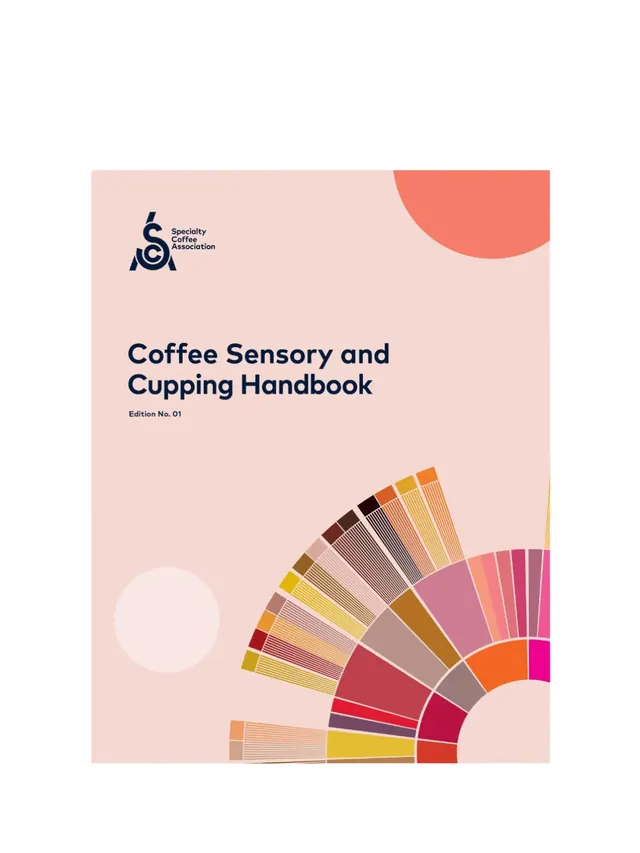
Coffee Sensory & Cupping Handbook begins with a separation that had lasted too long: coffee professionals practiced cupping with tools of their own, while sensory science developed methods for studying perception, bias, repeatability, and communication across many foods. The Specialty Coffee Association presents the volume as a synthesis of thirty years of advances in smell, taste, and mouthfeel, combined with cupping practices and the revision of the flavor wheel.
Its authors stand precisely on that boundary. Mario R. Fernández-Alduenda served as the SCA's technical officer, and Peter Giuliano as executive director of the Coffee Science Foundation and head of research for the association. They do not write a university monograph or an isolated operational form. They try to explain to professionals why an evaluation works, what can distort it, and how private perceptions can be turned into useful information.
The reverse direction matters too. The Global Coffee Report announcement says that the work seeks to help sensory scientists understand the specific needs and tools of the coffee trade. The manual is therefore a translation in both directions.
What it actually contains
The English edition has 130 pages, paperback format, and ISBN 9781399903295, according to the Eight Ounce Coffee listing. That length requires selection. Its core is not memorizing a list of descriptors, but understanding the perceptual system and designing observations that reduce error and confusion.
The work addresses smell, taste, and oral sensation as related but distinguishable components of experience. It places cupping within sensory analysis, explains the need for controlled conditions, and connects perception with language. It also introduces the problem of bias: knowing a sample's origin, price, process, or identity can change expectations; hearing an influential taster can pull the group along; using a scale without defining its purpose mixes intensity, quality, and liking.
Cupping appears as a tool with several functions. It can detect defects, describe a profile, support buying, control production, train memory, or communicate value. No form serves all those purposes equally well. This is one of the manual's most important ideas: before tasting, one must know what question is being answered.
Perceiving is not measuring a molecule
The book helps dismantle the image of the taster as an infallible instrument. Perception involves receptors, attention, memory, learning, and context. Two people can receive similar stimuli and use different words; the same person may vary because of fatigue, adaptation, health, or expectations. Experience improves discrimination and vocabulary, but it does not eliminate human variability.
Nor is there a simple equivalence between a descriptor and a compound. A “fruity” note may result from multiple volatiles, proportions, and interactions, and the same compound changes in effect depending on concentration and matrix. Chemical analysis can support an explanation; it does not automatically replace sensory evaluation.
This perspective guards against two common excesses. The first is considering all tasting merely subjective and therefore useless. With uniform preparation, blind design, repetition, and training, comparable data can be obtained. The second is presenting a score as an absolute physical property of the bean. A number comes from a particular method, scale, group of tasters, and purpose.
Language, lexicon, and references
Communicating flavor requires shared words, but sharing a word does not guarantee a shared experience. The World Coffee Research Sensory Lexicon, published in 2016, was designed with attributes, definitions, references, and intensities to support descriptive evaluation. The taster's wheel visually reorganizes part of that vocabulary to make it navigable.
The manual places those instruments in context. A wheel helps users move from a broad family to a more specific term; it does not by itself prove that the note is present. A physical reference makes it possible to discuss what a descriptor means and train intensity, but some references are unavailable or do not mean the same thing in every culture. Translating words without adapting experiences can create false uniformity.
The responsible goal is not to produce increasingly extravagant descriptions. It is to communicate with enough precision that another person understands what was perceived, at what intensity, and under what conditions. Sometimes a broad, reproducible category is more informative than a brilliant association on which no one can align.
Cupping and descriptive analysis are not synonyms
An academic comparison of cupping and descriptive analysis shows why they should not be confused. Professional cupping usually combines description, defect detection, quality impression, and commercial decision. Classical descriptive analysis trains a panel to identify and quantify attributes without necessarily asking about liking or market value.
Each can learn from the other, but they answer different questions. If description and preference are combined in one number, it becomes difficult to know why two tasters disagree. Did they perceive different intensities, apply different quality criteria, or simply prefer different profiles? Separating tasks produces more interpretable data.
The distinction between alignment and calibration is useful as well. A professional analysis by Spencer Turer explains that alignment is closeness among people on a panel, while calibration compares them with a recognized reference. A group can agree and still be systematically displaced; it can also recognize a reference and disagree about liking. The manual provides foundations for understanding those differences, not an automatic guarantee of a competent panel.
Lingle's legacy and the 2021 update
The SCA presented the book as an expansion of Ted R. Lingle's work, first published thirty-five years earlier. The historical manual had given the industry a structure for discussing olfaction, taste, mouthfeel, taints, defects, and tasting method. Fernández-Alduenda and Giuliano incorporate later advances in psychology, sensory design, and language.
This is not simply a matter of adding new aromas to an old list. The principal change is epistemological: making error, bias, test purpose, and the separation among types of judgment visible. The 2021 work recognizes professional tradition while attempting to connect it with broader sensory-science criteria.
That relationship explains its favorable reception as a training resource. Institutional promotion calls it the most complete work of its kind; that assessment comes from the publishing organization and should not be confused with an independent academic comparison. Its relevance is better documented by the problem it addresses and by its position between the 2016 wheel and the later reform of standards.
The decisive change of 2024
The book appeared before the SCA completed its Coffee Value Assessment. In November 2024, the association adopted three CVA components as official standards: preparation and cupping mechanics, descriptive assessment, and affective assessment. The SCA expressly stated that they replace the 2004 protocol and form.
That reform applies a central insight of the manual: description and an impression of quality are not the same operation. CVA seeks to represent coffee through multidimensional data instead of reducing it to a single score. The 2021 volume therefore remains useful for fundamentals, but should not be used as the sole source for the current official procedure.
The extent of obsolescence should be stated precisely. Knowledge about perception was not “revoked.” Standards and forms changed. To conduct an official assessment, current CVA documents must be consulted; to understand why biases should be controlled, references trained, or judgments separated, the manual retains value.
Who it is for and how to read it
It is appropriate for tasters, buyers, roasters, quality managers, barista trainers, and sensory scientists entering coffee. It does not promise to turn a reader into a calibrated panel. That competence requires repeated practice, references, control of samples, and analysis of results.
The most productive reading pairs each concept with a small design: taste blind and nonblind, compare random and fixed order, separate intensity from liking, or repeat a sample under a different code. This allows the distinction between personal confidence and reproducible data to be experienced.
Its limits must remain visible. It is an institutional SCA publication oriented primarily toward the professional needs of specialty coffee. It does not replace primary research, resolve intercultural translation by itself, or eliminate the commercial relationships that influence evaluation. Its great merit is more modest and more important: teaching that tasting well is not expressing an opinion with confidence, but constructing conditions in which perception, language, and decision can be examined.