A complete chain in a single volume
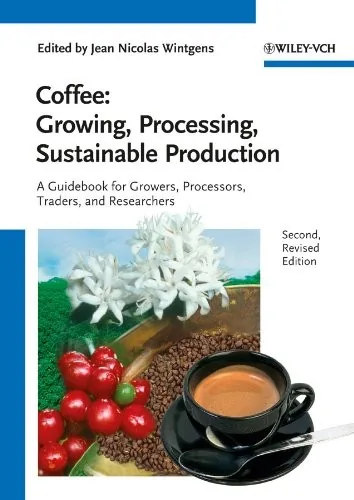
Coffee: Growing, Processing, Sustainable Production is a collective reference work edited by Jean Nicolas Wintgens. Its subtitle, A Guidebook for Growers, Processors, Traders, and Researchers, defines the project better than a short label: it brings together operational and scientific knowledge from the plant through evaluation of green coffee. It is not a brewing book or a narrative introduction to origin. It is a reference manual for anyone who needs to identify a pest, understand a processing operation, or relate agronomic management to quality.
The Wiley-VCH record attributes the chapters to forty specialists from producing countries and presents guidelines with broad applicability. That global ambition gives the book scale, but it must be read cautiously: an international recommendation is a starting point, not a substitute for local climate, soil, cultivar, law, resources, or experience.
The cataloged edition is the revised second edition of 2012. It retains the value of a large technical snapshot and, at the same time, has an age that matters. Genomics, climate change, controlled fermentation, emerging diseases, and sustainability measurement have produced new evidence. The volume remains useful for recognizing the system; on its own, it cannot represent the current state of every specialty.
Verified structure: from the coffee tree to the data
The publisher's contents and the WorldCat record organize the work into six parts. The first covers the plant, botany, genetics and genomics, selection, propagation, biotechnology, environment, establishment, and maintenance. It adds vermicomposting, organic production, frost, organic matter, sustainability, and shade management.
The second part focuses on pests and diseases: regional problems in Africa and Asia-Pacific, nematodes, fungal and viral diseases, resistance to coffee leaf rust and coffee berry disease, spraying, and quarantine. The third covers yield estimation, harvesting, green-coffee processing, ecological processing, and by-products. The fourth follows storage, shipping, defects, quality factors, and evaluation. The fifth addresses economics and technology transfer. The sixth brings together units, sources, data, abbreviations, and terms.
This architecture is a contribution in itself. It shows that quality does not originate in a single operation. Variety, nutrition, plant health, maturity, processing, drying, and storage form a trajectory. It also reminds readers that productivity and sustainability cannot be resolved by looking only at the cup: costs, transfer, risk, and the capacity to apply a technology matter too.
Agronomy: breadth does not mean a universal recipe
The agronomy chapters make it possible to identify variables, but the time elapsed requires their relationships to be reviewed. Shade is a good case. A meta-analysis published in 2022 normalized more than two hundred yield observations and found different responses among 18 arabica cultivars. On average, low or moderate shade could maintain yield, while high levels tended to reduce it; some cultivars showed a neutral response and others a curve with an intermediate optimum.
For Coffea canephora, another meta-analysis of thirty studies found interactions with clone, age, rainfall, and location. Shade improved several growth and yield responses in certain clones and at certain ages, but levels above 30% were associated in the reviewed body of work with lower beverage quality. This is not a contradiction that can be resolved by choosing a single percentage: arabica and canephora, cultivar, age, and microclimate respond differently.
A review of 246 publications places agroforestry within climate adaptation, biodiversity, pests, physiology, quality, and producer decisions. It also detects a geographic bias toward Latin America. "Sustainable shade-grown coffee" is therefore not a closed technology. It requires selecting species, regulating cover, measuring water and disease, valuing ecosystem services, and calculating farm economics.
The book is useful when it forces readers to consider these interactions. It ages when a broad guideline is read as a guaranteed result. Agronomy needs local trials, harvest series, and participation by the people who will bear the risk.
Processing and quality after 2012
The work devotes a substantial section to harvesting, ecological processing, defects, and evaluation. Later research confirms that postharvest operations are decisive, but has refined the mechanisms. A 2018 review relates postharvest operations to organoleptic quality and warns that gaps remain in explaining all results. There is no universal hierarchy in which a process label guarantees a score.
An experiment in Yunnan tracked microbiota, processing waters, bean metabolites, and the cup during wet processing of Catimor. Fermentation duration, depulping or demucilaging, and soaking changed the results. Longer fermentation produced fruitier and more acidic profiles within that trial; soaking tended to reduce differences. There was only one variety, one area, and two biological replicates, so the finding does not prescribe times for every farm.
This evidence expands the manual's map. In 2012 it was reasonable to describe broad processing routes; today it is advisable to record temperature, oxygen, added water, time, microbial population when possible, and drying conditions. Quality emerges from their interaction, not from the word "washed" or "natural."
Storage, transport, and deterioration
Separating production from storage would be a mistake, and the book does not make it. Green coffee continues changing after drying. A twelve-month study compared natural and washed processing, jute and GrainPro, and temperatures from -10 to 20 °C. It observed changes in chlorogenic acids, caffeine, trigonelline, and sensory evaluation. Temperature, processing, and packaging interacted; no condition preserved every indicator perfectly.
The trial shows two limitations of general recommendations. First, better preservation may require energy and investment that must be evaluated economically and environmentally. Second, a chemical result does not automatically equal sensory preference. Applying the storage chapter requires water activity, moisture, temperature, time, packaging barrier, sampling, and calibrated cupping.
The chapters on shipping and defects remain valuable because they connect technical loss and commercial loss. Specifications must nevertheless be updated with current standards and the actual route of each chain, including container condensation, delays, and repeated sack opening.
What "sustainable" means in this work
The presence of chapters on organic matter, organic cultivation, shade, ecological processing, and economics prevents sustainability from being reduced to certification. Even so, the term has acquired greater demands since 2012. Environmental, social, and economic outcomes must now be distinguished: emissions, water, soil, biodiversity, occupational exposure, income, value distribution, and resilience.
A practice may save water and increase energy use; shade may protect the microclimate and reduce yield under some conditions; certification may improve traceability without guaranteeing sufficient income. The book offers pieces of the analysis, not a complete accounting of those trade-offs. Its technical perspective and the industrial careers of several contributors should be complemented with socioeconomic research and producer experience.
Who may find it useful
It is suitable for agronomy students, technicians, researchers, quality managers, and professionals who need a complete view. It can direct the advanced roaster toward the stage where a defect originated and the producer toward areas for further consultation. Its density and price place it far from a light introduction.
It should be used as a map from 2012, not as an automatic protocol. Each chapter should be read alongside current standards, recent literature, and local extension recommendations. Its most enduring lesson is systemic: changing one part of the chain shifts effects into others. The best reading does not seek a worldwide recipe, but an orderly way to ask what variable, evidence, cost, and limitation correspond to a particular decision.
Edition and discrepancies
The record retains a single commercial edition: ISBN 9783527332533, revised second edition, in English, published by Wiley-VCH in 2012. Wiley-VCH states June, 984 pages, and softcover; WorldCat records lv + 983 pages; other Wiley pages state November and 1040. NHBS confirms the ISBN, edition, year, and paperback, but does not resolve the count. The month and pagination are omitted rather than manufacturing an agreement that the sources do not provide.