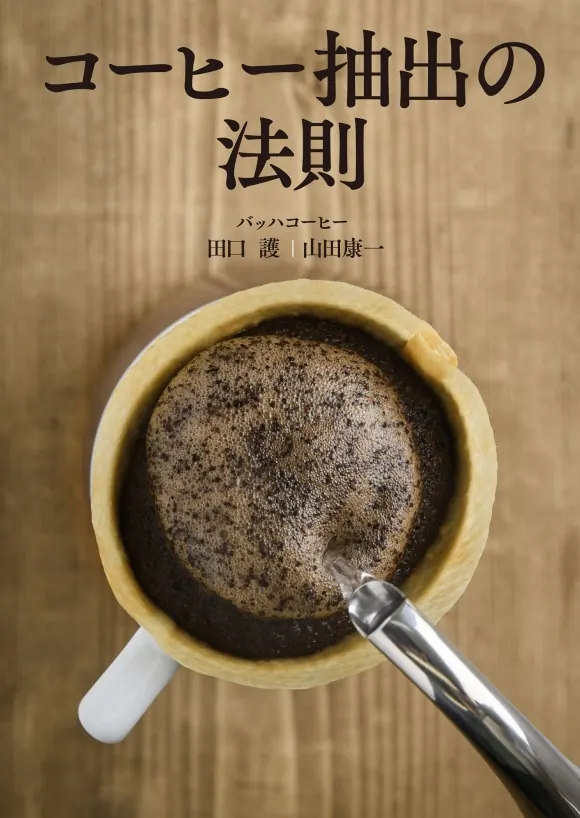
What kind of book it is
『コーヒー抽出の法則』, published by NHK出版 in 2019, is a practical technical manual by 田口護 and 山田康一. Both are connected to カフェ・バッハ, Café Bach: Taguchi founded the establishment and developed a long career in roasting and education; Yamada served as general manager and factory manager. The book gathers that professional school of thought and translates it into a system that someone can observe at home.
The word 法則 means law, but here it does not denote a universal physical law. The NHK出版 presentation promises to teach six elements that determine flavor and techniques for controlling it. Its editorial meaning is to organize decisions, not to claim that every cup can be predicted with an equation independent of the coffee, water, grinder, or perception.
The best approach is to treat each “law” as a working hypothesis: hold conditions constant, change one variable, taste, and record. This procedure turns craft experience into reproducible learning. It also makes it possible to identify where a rule simplifies interactions that later research describes as more complex.
Verified structure
The official table of contents allows the contents to be described without reconstructing recipes. A preliminary chapter gathers what should be known before brewing. The first chapter explains the mechanism of extraction and presents preparation and basic paper-drip technique. The second addresses flavor components and six factors. The third compares tools and ends with tasting directed toward controlling the result.
The six factors listed in the table of contents are roast level, grind size, amount of coffee, water temperature, extraction time, and amount extracted. The commercial description on the same page uses “extraction speed” where the contents say “time.” These are not identical quantities, although they are related. This dossier preserves the discrepancy rather than merging them into an apparently more precise list.
The tools section includes paper drip, nel or flannel, metal filter, and French press. Tower Records reproduces that architecture. The book is therefore not limited to a pouring choreography. It compares systems with different filtration and contact and uses the cup test at the end to assess results.
No exact doses, temperatures, or sequences are attributed because a complete authorized view has not been consulted. A review can summarize a recipe, but that is not enough to ensure that every number has been transcribed correctly or that it represents a general recommendation from the authors.
Six variables that move together
The framework is useful because it forces the reader to name what changes. Roast changes solubility and the set of precursors; grinding alters surface area and, in percolation, resistance; dose changes ratio and bed geometry; temperature changes transfer rate and viscosity; time or speed describes how long contact lasts and how it flows; beverage yield determines concentration and dilution.
The difficulty is that one action affects several columns. Grinding finer can increase surface area, reduce flow, and extend time. Pouring faster can raise the water column, change agitation, and alter average temperature. Increasing dose changes both ratio and bed depth. For this reason, “one variable at a time” is an approximate experimental discipline, not a guarantee of physical independence.
A 2020 scientific review confirms that time, water composition, temperature, pressure, particles, and ratio affect kinetics, composition, and flavor. It also warns that parameters are coupled and that transport models and reproducibility are still lacking for many methods. The review supports the need for the book's system, not every causal explanation or specific range.
Temperature and roast without absolute rules
The guide connects roast and temperature with flavor control. This is reasonable: a more developed coffee and a lighter one do not have the same structure or composition. However, saying that a temperature “produces bitterness” or “extracts acidity” in isolation confuses mechanism, concentration, and perception.
In a 2020 study of drip coffee, researchers brewed at 87, 90, and 93 °C and adjusted grind and flow to equalize strength and extraction percentage. Under those conditions, the sensory effect of temperature was small compared with TDS and yield. This does not mean temperature is unimportant: it helped determine which adjustments were necessary to reach the same result. It means that a temperature figure alone does not decide the profile when other variables compensate.
Roast introduces another difficulty. A rule developed from a café's repertoire may work well within that repertoire without describing coffees of very different fermentation, density, or development. The safest method is to use the recommendation as a starting point, record the coffee and date, and taste before generalizing.
Paper, cloth, metal, and immersion
The comparison of tools is a strength because it shows that “extraction” does not describe a single domestic process. Paper, cloth, and metal retain particles and oils differently; a French press keeps coffee immersed before separation. Geometry, material, and flow change composition and texture, as well as requiring different gestures.
A 2023 comparison brewed the same coffee with a V60, AeroPress, French press, and Pure Brew. It found distinguishable volatile and sensory profiles across methods. Paper and metal filters showed different associations in that design. The experiment supports the book's decision to compare tools, but it does not establish that paper, nel, metal, or press has an essential and unchanging flavor. It used only one coffee and specific protocols.
Cloth also requires practical attention not resolved by a format label: cleaning, residual moisture, and storage alter its behavior. Nor is a metal filter a uniform category; perforation size and geometry differ. The book offers useful families, while a current application must identify the particular tool.
Flow and grinding after 2019
Although an espresso study does not prove a drip technique, it helps explain why variables do not add linearly. A 2023 investigation varied flow rate, grind setting, and temperature and collected successive fractions. Within its conditions, flow had the strongest effect on the mass of several compounds, and its influence increased with finer grinding and higher temperature.
The result is qualitative and belongs to a particular machine and grinder. It should not become a recipe for paper or press. Its contextual value is to demonstrate interaction: the influence of one variable depends on the levels of others. The metaphor of six dials is pedagogically useful as long as we remember that turning one can move the whole system.
Reception and limits of the evidence
No academic review or extensive professional critique was found. Booklog gathers reader ratings that appreciate the theoretical approach, the figures, and reproducibility; they also describe a sober presentation. These impressions are useful for understanding reception, not evidence that a chemical claim is correct.
A specialized Japanese review confirms the emphasis on drip and notes additional interview/writing and scientific-supervision credits that do not appear as principal authors in the publisher listing. Those credits are mentioned here as context, but the catalog retains 田口護 and 山田康一 as contributors because NHK identifies them that way.
The book conveys a particular school. Its idea of a good cup, preference for certain roasts, and pouring style belong to Café Bach and the Japanese context of the work. They are not neutral and do not need to be. The limitation appears when professional experience is presented as the only solution or when “control” is interpreted as the ability to guarantee universal liking.
Edition and discrepancies
ISBN-13 9784140333006 is valid. NHK出版 records release on February 21, 2019, B5 format, and 112 pages. Kyobo shows February 20 and 111 pages; Tower Records also counts 111. The review that transcribes the colophon places the first printing on the 20th. It is plausible that one date is printing and the other commercial release, and that a final page is unnumbered, but no institutional source explains the differences.
Gota retains February 21 and 112 pages because they are the publisher's data, and identifies the format cautiously as print. It does not call it hardcover or paperback without sufficient bibliographic evidence. Nor does it add the ebook that appears in stores: a distinct ISBN and two specific sources would be needed before treating it as an independent edition.
For a current reader, the manual's value lies in learning to think in variables and compare systems. Later science adds a decisive correction: a relationship observed with one coffee and one method is not a universal law. Brewing rigorously means measuring, tasting, and keeping visible the conditions under which a rule worked.