What kind of book it is
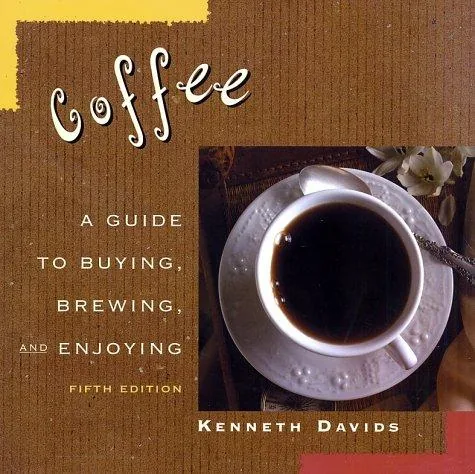
Coffee: A Guide to Buying, Brewing, and Enjoying belongs to an early phase of specialty coffee communication in the United States. Kenneth Davids published the first version in 1976 and revised it over decades. The 2001 fifth edition brings together history, buying, tasting, social responsibility, roasting, grinding, brewing, espresso, cultivation, health, a glossary, and resources. It is a general guide for consumers who want to participate actively in the quality of their cup.
Its historical perspective matters. In 1976, access to freshly roasted coffee, a range of origins, well-prepared espresso, or quality home grinders was far more limited than it is today. Explaining how to recognize, store, and brew coffee meant building an audience for practices that were not yet ordinary. The fifth edition appeared after the expansion of specialty coffee shops and roasters, but before many current tools, studies, and habits.
The work is not merely a recipe book. The WorldCat record presents an itinerary asking how coffee began, how to buy and taste it, and how to recognize place in the cup; how coffee can contribute to a better world; how to roast, grind, and brew it; and how to approach espresso and health. The conversational chapter titles keep the consumer at the center of each decision.
From buying to understanding
Buying comes before equipment because no technique can fully recover old or poorly roasted coffee. The guide teaches readers to interpret provenance, roast, and presentation, and connects selection with storage. It then introduces tasting and vocabulary: naming acidity, body, aroma, or a defect allows comparison and communication, although a word is neither a molecule nor a guarantee of enjoyment.
The section on place expands buying toward origin, cultivation, and processing. Davids participated in consolidating a culture that treated coffee as a differentiable product rather than a uniform commodity. That movement gave visibility to regions and lots, but also developed simplifications: countries turned into fixed profiles, scores treated as truth, and a language of quality separated from price or production conditions.
The chapters on roasting, grinding, and brewing connect raw material with domestic actions. The work includes conventional methods and espresso, as well as a section specifically about espresso at home. In 2001, that coverage responded to equipment and expectations different from today's. It retains transferable principles, but cannot anticipate twenty years of grinders, temperature control, pressure profiling, commercial cold brew, or home measurement.
Reception and historical influence
The Coffee Review profile states that the book sold nearly 250,000 copies across five editions and recalls a 1996 Specialty Coffee Association of America award for contributions to coffee literature. This is evidence of circulation and industry recognition, but it comes from the organization cofounded by Davids and must be attributed as such.
Daily Coffee News places it at the dawn of the specialty movement and records the later decision not to produce a sixth edition, but to write a new work for the twenty-first century. The interview confirms that the author himself considered a partial update inadequate for a framework born decades earlier.
Davids's influence also runs through Coffee Review, founded in 1997. Its history of the one-hundred-point scale explains how he adapted to coffee an evaluation language already familiar from wine and education, and how the sector later developed systems of its own. It is valuable primary testimony for understanding the period, not an independent evaluation of whether scoring improves communication or distributes value fairly.
No academic reception of the fifth edition was located. It can be established that the book had many editions, significant sales, and professional recognition. It is more prudent to describe it as an influential bridge between industry and consumer than to attribute the expansion of specialty coffee to it alone.
Brewing science: what remains and what changes
The multivariable framework endures. A 2020 scientific review characterizes coffee brewing as solid-liquid extraction influenced by time, water composition and temperature, pressure, particle size, and ratio. It also warns that those variables interact and that some popular knowledge rests on studies that are difficult to compare.
This means that general advice from 2001 may work as a beginning without being a current conclusion. A change in grind can alter surface area and flow; a different ratio changes concentration and yield; water changes extraction and perception. The recipe must state the method, coffee, and goal. A rule written for a coffee maker from two decades ago does not automatically preserve its result in another device.
The relationship between measurement and taste has also been qualified. The Coffee Brewing Control Chart revised in 2023 brought together thousands of evaluations and found more than one preference pattern. The historical region of strength and extraction remains a useful reference, but it does not define an ideal cup for everyone. Sensory vocabulary supports conversation; it does not erase cultural diversity or individual preference.
Storage after 2001
Freshness is one of the guide's most enduring concerns, but later evidence permits greater specificity. A 2022 study of opened bags compared several closures. Under its conditions, a bag with an integrated closure preserved coffee better than a clip, tape, or transfer to another container, and opening allowed oxygen to enter rapidly. “Airtight container” is not a sufficient description: handling, headspace, barrier properties, and frequency all matter.
A 2024 study observed that storage for one month at 5°C slowed changes in volatile compounds compared with 20°C, and that espresso and cold brew expressed different sensory profiles. It does not authorize refrigerating every bag without considering condensation, sealing, or cycles of opening. It shows that storage temperature and brewing method interact in the result.
The practical lesson agrees with Davids's spirit: buy reasonable quantities, reduce exposure, and taste changes. The update replaces universal maxims with explicit conditions.
History, ethics, and the limits of the informed consumer
The contents devote a chapter to how coffee can make the world better. That inclusion is notable for a domestic guide from 2001: it recognizes that buying and quality have consequences beyond the kitchen. Even so, certifications, price crises, traceability, market power, and climate change have evolved. Advice from that edition should be read as a historical document, not as a current overview of sustainability.
The informed consumer has limited power. A person can choose a roaster, ask about origin, and avoid waste; that person cannot independently verify every trading relationship or correct structural inequality through a score. The language of quality can raise value and recognition, but can also concentrate authority in buyers, tasters, and media. The book opens that conversation without resolving it.
The health section demands similar caution. A general work published in 2001 does not replace current biomedical reviews, and epidemiological associations are not the same as individual advice. Quantity, caffeine, pregnancy, medication, and sensitivity alter the balance. Gota does not reproduce the volume's health recommendations as though they were current.
Bibliographic discrepancies
The first edition of 1976 is documented as the beginning of the work, but the starting catalog does not provide an ISBN-13. Inventing one through conversion or associating a later reissue would create false precision. The featured edition is therefore the fifth, which is commercial and verifiable.
WorldCat and Open Library agree on ISBN 9780312246655, fifth edition, St. Martin's Griffin, 2001, and paperback format. WorldCat expresses the collation as vi + 279 pages; Open Library and commercial listings show 288 as the total physical extent. Both counts may describe the same copy using different criteria, but Gota omits pages from the record rather than choosing one without explanation.
The history is also counted in different ways: five editions, five revisions, or a contemplated sixth. For the featured manifestation, only what the catalog states is asserted: fifth edition. Retrospective formulations are attributed and do not alter that fact.
Who may find it useful
Today it works best for three readers. The first wants to understand how specialty coffee consumers were addressed at the start of the century. The second needs a broad map before entering technical manuals. The third researches the history of the language of origin, tasting, and scoring.
It is not the best single source for adjusting modern espresso, storing coffee precisely, evaluating sustainability, or making health decisions. Nor should it be read as a current supplier catalog. Its continuing value lies in its architecture: buy attentively, taste, connect origin and process, control brewing, and recognize that enjoyment requires context as well as a recipe.
That architecture explains five editions. Davids helped turn the passive drinker into a participant who asks what they are buying and what they are doing with it. Science and industry have changed; the invitation to observe, compare, and demand information remains valuable, provided that the fifth edition is read with its date visible and contemporary sources beside it.