A Guide for Choosing, Not Obeying
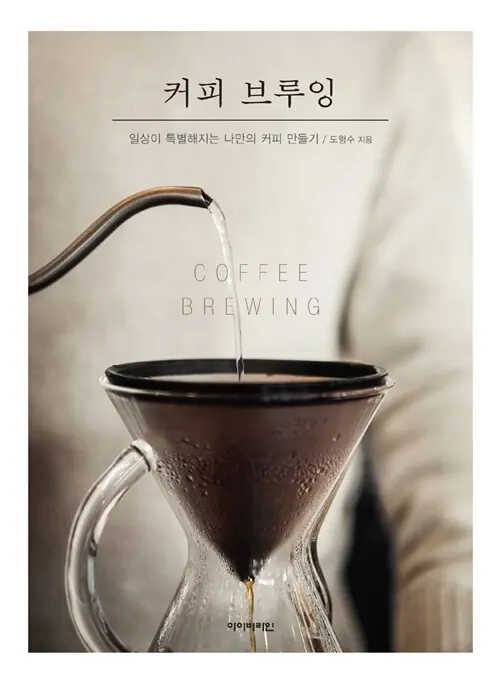
커피 브루잉 simply means Coffee Brewing. 도형수 builds a domestic guide around a more specific idea: before copying a recipe for a piece of equipment, readers should recognize the character of the bean, understand what the equipment does, and decide what kind of cup they prefer. The Kyobo presentation confirms that progression and lists the condition of the coffee, particle size, temperature, and time as central elements.
The extensive description reproduced by Bookstore 12 situates the book within the opening of filter coffee to a broader Korean audience. It attributes the operation of 5brewing coffee to the author since 2012 and presents his proposal as an accessible alternative to hand-drip teaching heavily focused on the form and speed of the stream. This is editorial information, not an independent history of the sector. It does explain why the volume favors comparison and adaptation over a single ritual.
The table of contents has eight sections. The first four prepare the vocabulary; the remaining four survey devices grouped as mild, medium, strong, and various. This classification is not equivalent to a scientific standard. It is a way to navigate twenty-one tools and the sensations of concentration or body that the author’s recipes seek to achieve.
Before the Method: Bean, Equipment, and Taste
After asking what brewing is, the book proposes three preliminary concerns: the bean’s character, understanding the tools, and personal preference. The order matters. Two readers may seek different outcomes from the same coffee; a recipe is not an examination with one correct answer. The tool should be chosen in relation to that intention, not only by popularity.
The next section reduces the problem to four elements verifiable in the contents: bean condition, particle size, water temperature, and extraction time. This simplification makes learning manageable, although it leaves other dimensions implicit, such as ratio, water composition, flow distribution, or filter material. A 2020 scientific review shows precisely that these variables interact. Changing the grind can alter flow rate and contact; changing temperature modifies speed; changing ratio shifts concentration and yield at the same time.
The book is therefore more robust as a framework for comparison than as a table of isolated causes. Recording the recipe, testing, and adjusting toward a preference is consistent with its purpose. Saying that one turn of the grinder by itself “produces” an attribute would be an overly rigid reading.
Nine Routes to a Mild Cup
The Mild Brewing section includes Chemex, a cone, Kalita, Kalita Wave, Kono, Hario V60, Clever, nel, and a drip coffee maker. It brings together manual percolation, a hybrid immersion-and-release device, cloth filtration, and automated brewing. The common denominator is not one mechanism, but the outcome the author organizes under mild intensity.
The distinction is useful. The PLOS ONE model of extraction in porous beds showed that a truncated conical geometry can develop different local fields of velocity and extraction from a cylinder even when outlet concentration looks similar. Clever also changes the order of immersion and drainage; nel retains and transmits materials differently from paper. A shared sensory label does not erase these physical differences.
The book adds a column with brewing rules according to roast level. The contents verify its existence, not specific parameters or universal validity. Adjusting extraction to the coffee’s solubility and development is reasonable, but roast darkness, bean density, and grind distribution cannot be summarized in one box.
From AeroPress and Siphon to Presses
Medium Brewing brings together AeroPress, moka, and siphon. Strong Brewing includes French Press, SoftBrew, Espro Press, Café Solo, Kinto, and Paro Dripper. The map mixes manual pressure, steam-generated pressure, vacuum, immersion, and metal filtration. This grouping lets readers seek a range of strength or texture and then study the procedure specific to each piece of equipment.
A comparison published in Foods analyzed the same coffee brewed with V60, AeroPress, French Press, and Pure Brew. Volatile-compound profiles and sensory evaluation distinguished the methods; paper, metal, geometry, pressure, and turbulence participated in the differences. It was a study of one coffee under controlled recipes, not a general ranking. It reinforces the intuition that the device configures the cup, but prevents “mild” or “strong” from being fixed forever as a device’s essence.
Human intervention also changes between systems. A V60 requires management of water delivery; French Press depends on immersion, agitation, and separation; AeroPress adds pressure and handling; siphon combines heat, movement, and vacuum. Comparing them requires recording recipe and result, not only the commercial name.
Everyday Methods and Access
The final section brings together Iwaki water drip, Hario Mizudashi Pot, Coffee Pin, and Kalita One-Touch Dripper. Their presence broadens the book toward cold preparations and convenience solutions. It also completes the intention stated by the publisher: enabling coffee at home, at work, or wherever the available equipment is not that of a specialized bar.
The figure of twenty-one devices comes from the editorial promotion and matches the contents list. It does not imply twenty-one comparable experiments or equal depth for every recipe. The value of the set is cartographic: it shows that “brewing” encompasses percolation, immersion, vacuum, pressure, cold drip, and simplified devices.
For a beginner, that breadth can free them from seeking one definitive dripper. For an advanced reader, the risk is the opposite: categories based on intensity may conceal how greatly ratio and grinding can move the result within a single method.
Measurement, Preference, and the False Ideal Cup
Although the contents do not present the book as a treatise on refractometry, its emphasis on personal taste aligns with later sensory research. The new 2023 Coffee Brewing Control Chart integrated descriptive and consumer results and found two preference groups with different responses to concentration and yield. It replaces one “ideal” zone with maps of attributes and liking.
That does not invalidate domestic terms such as mild, medium, or strong. It requires the speaker to define what is being described. “Strong” can mean higher concentration, more perceived bitterness, more body, or simply a more intense roast. Measuring TDS helps with the first meaning; tasting and an explicit vocabulary are necessary for the others.
Temperature offers the same lesson. A drip-coffee trial compared 87, 90, and 93 °C while adjusting grind and time to maintain concentration and extraction. With those variables controlled, the sensory profile changed little with temperature. This does not make the thermometer useless: it demonstrates that temperature acts within a system and that two recipes can compensate for it differently.
Reception and Limits
Aladin shows user reviews and a dynamic commercial contents listing; Bookstore 12 reproduces the publisher’s review. These are indications of circulation, not independent criticism or a stable measure of influence. No sufficiently documented professional reception was located to claim that the mild/medium/strong taxonomy was adopted outside the book.
Nor should the promotional claim that 5brewing coffee was Korea’s first café specializing in brewing be presented as a settled historical fact without an independent source. In this dossier it functions only as context attributed to the publisher. The verifiable strength lies in the contents, the breadth of devices, and the insistence on preference and adjustment.
Edition, Date, and Access
Aladin identifies ISBN 9788993461220, 202 pages, and publication on November 3, 2014. Kyobo shows May 29, 2018, but expressly adds “first printing: November 3, 2014.” Gota retains the date of the first printing and does not invent a new edition for the 2018 record.
The listings disagree on dimensions and weight, and none of the evidence consulted establishes the binding unambiguously. The record therefore uses the generic format “print.” No commercial English edition has been verified: Coffee Brewing is a Gota editorial localization. The documented edition remains in Korean and should be read as a guide situated among the tools and market of the mid-2010s, not as a complete catalog of today’s devices.