What kind of book it is
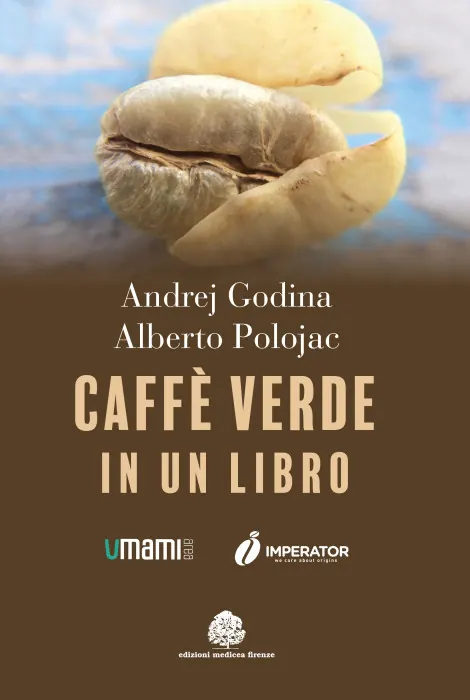
Caffè verde in un libro is a 128-page Italian technical manual that shifts attention from the beverage to the raw material. Andrej Godina and Alberto Polojac conceived it for readers at basic and intermediate levels: professionals at roasters and importers, people studying coffee, and enthusiasts who want to understand what happens before roasting. The Edizioni Medicea presentation describes it as a journey from the plantation to international markets, with green-coffee quality as the connecting thread.
It is neither an agronomy monograph nor an economic treatise. Its purpose is to bring together in one volume the questions an operator encounters when buying, receiving, or evaluating a lot: which plant it came from, how it was harvested and processed, what defects it contains, how it is tested, and under which commercial structures it is traded. That continuity is its main strength. The bean ceases to appear as an anonymous bag arriving at the roaster and becomes the result of biological, agricultural, postharvest, and market decisions.
The introductory scope also imposes a limitation. History, botany, producing countries, classification, cupping, importing, and futures exchanges are complete fields. A book this short can offer a map and an operational vocabulary, not replace regional manuals, current standards, contracts, or specialized scientific literature.
Content and point of view
Public sources do not provide a complete paginated table of contents. To avoid inventing one, Gota's description is limited to the sections that agree between the publisher and the Comunicaffè interview. The journey begins with the plant's origin and history, basic botany, and differences among producing countries. It continues with life on the farm, harvesting, and processing of the fruit. It then moves to quality control: physical defect classification and sensory analysis through cupping. Finally, it introduces importing, price formation, and the exchanges where arabica and robusta references are traded.
Polojac explained that the text brought together material from the basic and intermediate levels of the Specialty Coffee Association's green-coffee modules. That statement clarifies the teaching architecture and audience, but it comes from one of the authors; it is not independent certification that every page reproduces a current curriculum. The training field itself has changed since 2018.
The authors' point of view is professional. Polojac worked in importing, purchasing, and quality control; Godina conducted training and evaluation across the chain. The book looks at coffee through the people who must describe a lot, identify risks, and make a commercial decision. That experience provides useful examples and priorities, although by itself it does not represent the experience of every producer or the regulatory diversity of each origin.
What "quality" means here
In the manual, quality connects physical appearance, the absence or presence of defects, cup behavior, traceability, and commercial suitability. It is a practical definition, not a single chemical property. A lot can be uniform in size and present a sensory defect; another can contain visible irregularities without every one having the same perceptible threshold. Classification helps with sampling and communication, but it does not eliminate the need to sample-roast and taste.
This caution is especially important today. The SCA evaluation system has evolved toward the Coffee Value Assessment, which separates physical, descriptive, affective, and extrinsic dimensions. The change does not make earlier techniques useless: it shows that an aggregate score or a defect table does not exhaust the different ways in which a coffee acquires value for buyers and markets.
Physical standards are also revised. ISO 4149:2025 specifies methods for olfactory and visual examination, foreign matter, and defects in green coffee for technical, commercial, or arbitration purposes. The existence of an international standard does not mean that every country, contract, or segment uses an identical classification. The reader must check which protocol governs the particular transaction and which version is in force.
What green-coffee science adds
The manual is right to place quality before roasting, but the causal relationship is more complex than can be summarized in an introduction. A 2022 review in Food Research International concludes that green-bean composition depends on genetics, environment, cultivation, maturation, processing, and storage. It also notes that knowledge remains fragmented and that studies do not always report conditions comparably. Attributing a cup profile to a country, variety, or isolated method therefore often conceals interactions.
Storage offers a concrete example. An experiment published in Scientific Reports in 2023 compared washed and natural coffee, jute and polymer packaging, three temperatures, and periods up to twelve months. Lots kept at 20 °C aged faster than those held at 10 or -10 °C; in some outcomes, process type had more weight than packaging. This is useful evidence, but it comes from particular coffees and chambers. It does not demonstrate that freezing is always the optimal logistical solution or that packaging material is irrelevant under different humidity, transport, and opening conditions.
Moisture and water activity are not synonyms either. Two beans with similar moisture percentages may have different water availability for reactions or microbial growth. An isolated figure helps control, but it must be interpreted with temperature, relative humidity, time, processing, and instrument precision. The merit of Godina and Polojac's approach is that it directs the reader toward these measurements; the risk would be turning teaching thresholds into absolute guarantees.
Markets, prices, and the "second commodity" claim
The publisher presents coffee as the world's second most traded commodity. It is a common promotional phrase, but its validity depends on what is measured, in which year, and which categories are compared. It should not be used as a statistic without an explicit series, unit, and economic source. Coffee's importance to numerous producing countries does not require that superlative.
The chapters on New York and London are useful for explaining benchmarks, futures, and price formation, but an exchange-traded contract is not the final price received by every producer and does not fully describe a specialty microlot. Differentials, quality, certifications, financial costs, logistics, currencies, buying relationships, and bargaining power change the result. Contract rules and instrument names can also change. The book helps readers recognize the infrastructure; real decisions require current quotations, contracts, and regulation.
The importer's perspective makes it possible to understand controls and risks that often remain outside barista manuals. At the same time, the book does not appear to have been designed as research on value distribution, labor conditions, or inequality in the chain. The phrase "farmer's life" should not be confused with a comprehensive representation of diverse rural economies. Sources created to study income, gender, land tenure, or climate effects are needed for those subjects.
Reception and documented scope
The reception located is mainly professional and commercial. Comunicaffè interviewed Polojac in December 2018 and presented the volume as a response to a training gap in Italian. The coverage provides information on intention, audience, and the writing process, but it is not an independent critical review: it relies heavily on the coauthor's statements. The publisher and stores repeat a similar description.
Bookstore indicators are modest and transparent. IBS shows zero customer reviews, and Libreria Universitaria invites readers to publish the first. The absence of ratings does not prove a lack of professional use, but it prevents claims of broad reader reception or critical consensus. No formal academic review of the volume was located either.
Its importance should be stated precisely: it is an affordable, compact Italian introduction to a subject the authors considered poorly covered in their market. It is valuable for connecting stages and giving language to people entering purchasing or quality control. There is no evidence for calling it a definitive treatise or attributing international normative authority to it.
Edition, discrepancies, and recommended use
Sources agree on title, authors, publisher, 128 pages, and ISBN 9788898015528. IBS dates its sale to October 17, 2018, and describes a bound volume. Libreria Universitaria also records 2018 and a rilegato format. By contrast, the current Edizioni Medicea page titles the product "II edizione aggiornata" and specifies brossura filorefe, a sewn paperback, without showing another ISBN or a clear date for that revision.
Those records do not reveal what changed between printings, when the second edition appeared, or whether the ISBN was reused. The catalog therefore does not create two artificially separate manifestations and uses the neutral format "print." Anyone who needs to cite a specific page or version should inspect the colophon of the copy in hand.
It is a good entry point for roasters, cuppers, quality-control staff, and students who read Italian. It should be accompanied by current standards, contractual documentation, and scientific reviews of the problem being investigated. Read in this way, it fulfills its promise well: it does not explain all of green coffee, but it shows why understanding the cup requires looking at the plant, processing, storage, and market before turning on the roaster.