What can be stated with confidence
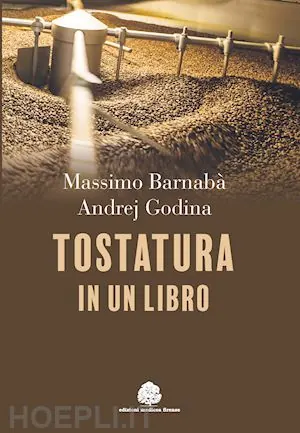
Tostatura in un libro is an Italian technical manual by Massimo Barnabà and Andrej Godina for basic and intermediate levels. Edizioni Medicea presents it as the first Italian manual devoted specifically to the subject and states a practical purpose: to accompany the roaster through the stages of the process and provide theoretical tools for achieving quality with greater control.
The public documentation lists its scope in considerable detail: green coffee, physical and chemical transformations, the roasting curve, cooling, sensory analysis, defects, color measurement, profiles for espresso, filter, and decaffeinated coffee, packaging, and quality control. It also mentions RoR, development time, mass loss, density, a colorimeter, Cropster, and IKAWA Pro. What it does not provide is a complete table of contents. This dossier therefore describes verifiable thematic blocks and does not invent chapters, internal order, or wording from the book.
From green coffee to the curve
Starting with the raw material prevents every difference from being interpreted as an effect of gas or time. Moisture, water activity, density, size, postharvest process, and storage influence the energy required and the precursors available. Measuring density or moisture does not predict flavor by itself, but it can show that two batches did not begin in the same state.
During roasting, the bean receives heat through combinations of convection, conduction, and radiation that depend on equipment design. It loses water and dry matter, expands, becomes porous, and generates gases and volatiles. The recorded curve is a partial representation of that system. RoR expresses the rate of change measured by a probe, not the exact internal temperature of every bean. This distinction is essential when a manual introduces software: recording more data points improves comparison, but it does not automatically correct a slow or poorly positioned probe.
Mass loss provides another aggregate signal. It consists mainly of water at first and, progressively, degradation products and volatiles. Two coffees with the same final percentage may have followed different histories. Color and weight are useful consistency controls; neither replaces sensory evaluation conducted after a comparable resting period.
Aroma and development: what science allows us to say
An independent study of aroma formation under different conditions tracked sixteen compounds and physical properties in a commercial drum roaster and fluidized beds. At a similar final color, high temperature with a short time and low temperature with a long time produced differences. When the bean temperature profile was equivalent, aroma kinetics were similar in the two types of equipment tested.
This supports the manual's interest in curves and chemical changes, but it does not prove that any particular visual curve is optimal. The study controlled specific coffees, equipment, and conditions. Moreover, "aroma" is not a single substance: different compounds form and degrade according to different kinetics, and their concentration does not translate linearly into pleasantness.
The 2020 research on color, time, and flavor brought together eight studies with trained or semitrained panels. Color and duration were associated with sensory changes; darker or longer roasts tended to increase bitterness and reduce acidity, fruitiness, and sweetness. When color was held constant, development time was more informative than time to first crack. Color remained the strongest predictor.
Another experiment compared four development durations in a washed Colombian coffee and a one-kilogram roaster. At a similar color, NMR, GC-MS, and descriptive analysis distinguished the profiles: short developments were fruitier, sweeter, and more acidic; long developments were more roasted, nutty, bitter, and astringent. Restriction to one coffee and one machine prevents those directions from becoming a universal recipe for espresso or filter.
Espresso, filter, and decaffeinated coffee
The publisher states that the book distinguishes roasting for espresso, filter, and decaffeinated coffee. This is reasonable because product goals, solubility, preparation, and raw material change, but the public records do not allow its exact recommendations to be reconstructed. No temperatures, percentages, or curves that are not publicly available are therefore attributed to it.
Nor does the distinction imply that there is a single "espresso roast." An espresso recipe concentrates solids and volatiles differently from filter preparation, but origin, equipment, water, and preference alter the target. In decaffeinated coffee, the prior process can change green-bean moisture, color, and structure. The manual appears useful in reminding readers that the same control is not interpreted identically across all products; the specific decision must be verified with the actual lot and preparation.
Cooling, color, and quality
Roasting does not intellectually end when the drop door opens. Rapid cooling limits the continuation of reactions driven by residual heat; storage and packaging alter the loss of gases and aroma. Color measurement helps compare both whole and ground beans, which may diverge if external and internal development are not uniform. A color number depends on sample preparation and calibration, so the protocol matters as much as the instrument.
Cropster and IKAWA Pro appear as examples of recording and control platforms, not as guarantees of quality. Software preserves data, visualizes differences, and facilitates repetition. It is still necessary to decide what to measure, maintain sensors, and relate curves to cupping. The combination of instrumental control and sensory analysis is one of the strongest aspects of the approach described publicly.
Reception and documentary limits
The Caffè Espresso Italiano presentation recommends the volume to aspiring roasters, professionals, and curious readers and summarizes its topics. It is favorable trade coverage, not a critical review that compares sources or tests results. Feltrinelli and IBS list no reader reviews for the edition. No academic assessment or extensive independent reception has been located.
That absence does not demonstrate a lack of usefulness. It limits what can be claimed about influence and consensus. Its verifiable relevance lies in offering professional vocabulary in Italian and bringing basic and intermediate training together in an accessible volume. The detailed quality of its explanations, bibliography, and exercises could be assessed only from the book itself.
Who may find it useful
It may be a suitable entry point for Italian-speaking roasters, baristas setting up a micro-roastery, and quality-control staff who need to connect measurements with transformations. An expert may use it as a teaching framework or checklist. It does not replace specialized manuals on engineering, aroma chemistry, maintenance, or safety.
Reading should end in local tests: repeat batches, record the environment and thermal state, measure color and mass loss, cup coded samples, and change only a few variables. The book offers categories for organizing that practice; the roaster must verify their applicability.
Edition and a distinct manifestation
Feltrinelli and IBS agree on ISBN 9788898015603, Edizioni Medicea, 2019, 144 pages, and hardcover; Feltrinelli specifies October 2. Librerie.coop confirms the year, Italian language, and binding.
There is also a commercial record with ISBN 9788898015610 and 160 pages. Although it shares the title and authors, a different ISBN may identify another binding, revised printing, or record. Without a colophon or physical comparison, it should not be merged with the 144-page edition. Gota publishes only manifestation 9788898015603 and leaves the other as a discrepancy pending investigation.