What kind of book it is
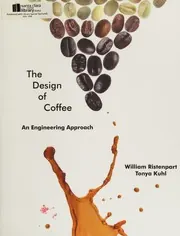
The Design of Coffee: An Engineering Approach is a laboratory manual designed to introduce chemical engineering without beginning with a wall of equations. William Dean Ristenpart and Tonya Kuhl choose an everyday object that can be roasted, ground, filtered, measured, and finally tasted. Coffee does not merely decorate a lesson that has already been written: it provides the complete process through which students perform balances, compare energy use, observe mass transport, and make design decisions.
The catalog description of the copy states the purpose clearly: to offer a nonmathematical introduction to engineering through roasting and brewing experiments. That formulation avoids two misunderstandings. This is not a general guide to origins, service, or international recipes. Nor is it an advanced monograph on coffee chemistry. Its question is how someone learns to analyze a system and justify a modification with data.
Its pedagogical appeal comes from the fact that every measurement retains a perceptible consequence. Missing mass, a coffee maker that consumes more energy, or a filter that retains colloids does not end only in a spreadsheet: it changes the process and, sometimes, the cup. Flavor provides motivation, but it does not replace measurement.
From analysis to a design competition
The table of contents preserved by Internet Archive makes it possible to describe the sequence of the first edition. After an introduction to coffee and engineering, equipment, supplies, and safety, an analytical section begins. The first laboratory asks students to dismantle a drip coffee maker intellectually: to identify parts, inputs, outputs, and function. It is followed by a flow diagram and mass balances, pH and reactions, energy use, mass transfer during brewing, and coffee understood as a colloidal fluid subject to filtration.
The second part moves from explaining to designing. Students conduct trials to optimize strength and extraction, scale a preparation up to one liter, and take part in a blind-tasting competition. The appendices gather general brewing guidelines, units and conversions, data analysis, graphing, and a tasting guide. The 2015 edition listing announces nine experiments; material from later editions adds exercises, so those must not be projected retrospectively onto the first ISBN.
The UC Davis ECM 1 syllabus clarifies how that finale worked. The score combined sensory acceptance and electrical energy: students had to make the best-tasting coffee while using the least energy. It is an optimization problem with competing objectives. Heating more, grinding differently, or extending a process may change the result, but every decision has a cost that must be recorded.
A book born from a course
The work is inseparable from the UC Davis course. The American Society for Engineering Education paper documents the combination of class, laboratory, and project, and presents coffee as a vehicle for showing students in any major what engineers do. The UC Davis Coffee Center maintains that education within a university ecosystem devoted to coffee.
The strongest evidence of reception, then, is not a collection of literary reviews but the manual's continued use. UC Davis Engineering reports that the course grew, the book reached new editions, and the experience contributed to the development of the Coffee Center. Those figures and assessments come from the same institution and the authors; they demonstrate adoption, not an independent pedagogical evaluation.
The ASEE paper offers more critical support because it explains the teaching objectives and course design, but it is not a randomized trial comparing the manual with another method. It is possible to say that the book structured a popular and enduring course. Enrollment or sales alone do not establish that every student learned engineering better, or that coffee is the ideal context for every learner.
The science supporting the approach
The physical core of the manual remains relevant. Brewing coffee is a solid-liquid extraction shaped by mass, temperature, surface area, transport, flow, and time. Separating strength from yield helps distinguish how much material is in the beverage from what fraction of the dry coffee has been extracted. Measuring each variable enables repetition and comparison, although no number can decide by itself whether the cup is enjoyable.
An immersion model published in 2021 developed precisely that relationship. Under the conditions studied, equilibrium dissolved-solids concentration varied approximately inversely with the water-to-coffee ratio, and yield was close to 21%. The study also revealed a practical difficulty: calculating extraction by drying the grounds can underestimate it because of retained liquid and losses during drying. The lesson reinforces the book's method while also showing that a measurement requires an understanding of its biases.
Water adds another layer. The 2014 study of dissolved cations examined how sodium, calcium, and magnesium interact with coffee compounds. Its conclusion was not that a single mineral recipe exists, but that ion identity and concentration matter and that different coffees may require different compromises. A laboratory that records only “water” as an input conceals composition, alkalinity, and variation among water systems.
Filtration is not simply a matter of solid versus liquid either. Coffee contains particles, droplets, and macromolecules that affect turbidity, body, and resistance to flow. Treating it as a colloidal system encourages questions about what passes through paper or metal and what changes when the bed compacts. That perspective is more transferable than memorizing which filter supposedly produces a superior cup.
What later research complicates
The deliberately simple introduction does not represent every brewing regime. In espresso, a 2020 model and experimental series showed that grinding progressively finer does not increase useful extraction indefinitely. If permeability is reduced too far, nonuniform flow and channeling may appear; yield reaches a maximum and then falls. An average particle size or homogeneous-flow model can conceal that behavior.
The full distribution also matters. A study of commercial capsules connected the proportion of fines with permeability, time, and dissolved solids, but did not find that those technical variables alone explained sensory quality. Raw material, roast, composition, and preference do not disappear merely because the process has been carefully measured.
This requires separating three levels that the classroom brings together for teaching purposes. TDS and yield describe part of the beverage. A student panel expresses liking in a particular context. Electrical energy measured during an exercise captures only one part of the environmental cost. Dividing a sensory score by energy is an ingenious way to teach multicriteria optimization; it is neither a professional quality assessment nor a life-cycle analysis.
Bibliographic discrepancies
The principal edition has its own self-publishing history. Amazon and Goodwill Books connect ISBN 9781516894789 with CreateSpace, paperback format, and 2015. Internet Archive transcribes “Ristenpart / Kuhl Publishing” and describes 105 pages of content; retail listings give 112. The digitized images include preliminary matter and do not resolve the collation. Gota preserves the ISBN, year, and format, but omits pages and does not invent a reconciliation.
The research group's page records a 2016 second edition with another ISBN. The 2023 institutional article already discusses a third. Those revisions prove that the manual evolved, not that the 2015 copy automatically contained later exercises. This dossier describes the architecture documented for the first edition and uses later history only to explain its continuity.
Limits and readers
“Nonmathematical” means that the book avoids requiring advanced university training; it does not mean the work is passive. It requires access to electricity, water, coffee, equipment, a scale, time, recordkeeping, and a safe setting for heating and handling materials. Some learning also depends on discussion, supervision, and fellow tasters, conditions that isolated reading at home cannot fully reproduce.
Much of what now forms a comprehensive coffee education also falls outside its scope. The manual is not a social history, an ethical buying guide, an agronomy treatise, or a climate-change review. Taste appears as a design response, but a peer panel does not replace sensory training or represent consumers from different cultures. Sustainability is approached through the process's electricity consumption, not through farming, transport, packaging, equipment durability, or waste.
For students and instructors, it remains an exceptionally concrete proposition: every chapter leads to an observable action and a defensible decision. For baristas and advanced enthusiasts, it works better as a course in experimental thinking than as a recipe book. Its most enduring lesson is simple: before claiming that a cup improved, one must state what changed, what was measured, what remained constant, and what “better” means for the problem at hand.