A manual born from the craft
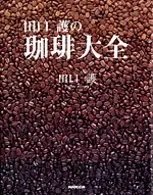
田口護の珈琲大全 is an illustrated professional manual, not an academic encyclopedia despite what the Japanese word taizen, “complete compendium,” might suggest. The publisher NHK出版 presents it as a practical work covering the characteristics of beans, conditions in producing countries, cultivation, roasting, cutting or grinding, and extraction. It also expressly states that professionals can use it as a technical roasting book. That combination defines its scale well: it seeks to cover the whole sequence required to produce a cup, but observes it from the experience of a coffee shop and small roastery.
Mamoru Taguchi developed his work around Cafe Bach in Tokyo. The establishment's own book page summarizes the central thesis with a strong claim: roasting is not a privilege of masters endowed with inexplicable intuition, but a field of logic, conditions, and reproducible relationships. The book attempts to open the craft's black box. For Taguchi, selecting green coffee, sorting it, roasting it, blending it, grinding it, and brewing it are not isolated skills; they form a system in which every decision restricts or expands the next ones.
That commitment to transmission matters as much as the recipes. A business needs to repeat a profile, diagnose a deviation, and teach another person. The volume's historical usefulness lies precisely in formulating a working grammar for a Japanese tradition of coffee roasted on the premises.
Five chapters and a complete chain
The table of contents reproduced by Yodobashi divides the work into five chapters. The first brings together the fundamentals of the bean: the three principal species, cultivation conditions and stages, processing methods, arabica varieties, classification, hand sorting, and differences between new and aged harvests. It is not yet an agricultural treatise; it offers the knowledge a roaster needs in order to read the raw material.
The second introduces the so-called “systematic science of coffee.” It groups beans into four types, connects each group with flavor tendencies, and proposes adjusting roast level to those characteristics. The third expands the thermal work: what a roast level means, how to distinguish good and defective coffee, how green coffee responds, and how to experiment even with a hand-held mesh roaster. It also includes the construction of blends.
The fourth chapter moves to small roasting machines. It classifies machines, explains their structure and operation, compares ways of applying heat, describes an initial procedure, and addresses the moment at which the process should be stopped. It also incorporates tasting as a control. The fifth covers grinding, brewing conditions, paper drip, cloth filter, espresso, and other utensils. The result is not a casual collection of topics: it follows the material order of the work and returns evaluation of the cup to the process that produced it.
The value of thinking in systems
The most fruitful contribution is methodological. If a cup changes, the reader must avoid immediately attributing it to the final pouring gesture. The green lot, defect removal, thermal development, blend, particle size, or coffee-to-water relationship may have changed. Thinking in systems requires conditions to be recorded and results compared, two habits that remain fundamental even when different sensors and vocabularies are used today.
The continuity between roasting and brewing is valuable as well. Some modern manuals isolate a filter recipe from everything that came before it; Taguchi insists that an extraction can express only what selection and roasting have made available. Likewise, blending does not appear as a way to conceal raw materials, but as an operation with flavor goals that must be designed and verified.
His four bean types or associations among origin, roast, and taste should not, however, be turned into universal laws. They are workshop tools: they simplify a broad reality to make it manageable. They work better as hypotheses to test against a particular coffee than as a definitive taxonomy.
Photographs, machines, and embodied learning
The 160-page B5 format allows explanation, photographs, and diagrams to be combined. The NHK出版 listing confirms that length and classifies it as a practical volume. Its material form matters because the operations described cannot be learned through reading alone: recognizing color, expansion, defects, or machine behavior requires repeated observation.
The book can organize that practice, but cannot replace it. A photograph freezes a stage; it does not communicate smell, the rate of change, or the thermal inertia of a real batch. Nor does a description of the endpoint eliminate differences among machines. The promise of escaping intuition does not mean eliminating sensory judgment. It means making conditions explicit, comparing, and turning experience into communicable knowledge.
That distinction guards against an overly literal reading. A beginner will find a map; an experienced roaster will recognize decisions that can be recorded and discussed. Neither will automatically obtain the correct profile for every raw material.
What has changed since 2003
Research on roasting has grown considerably. A 2022 review of roasting and quality brings together relationships among heat transfer, time, temperature, physical changes, chemical composition, and sensory response from literature published well after the book. That research confirms the value of treating roasting as a measurable process, but also shows that a simple rule rarely explains the result by itself. Variety, processing, moisture, density, equipment geometry, and thermal strategy interact.
Evaluation has changed too. Taguchi incorporates tasting as professional control, but later institutional systems have distinguished description, intensity, quality impression, and preference more clearly. In 2024, the SCA adopted components of the Coffee Value Assessment and stated that they replace the 2004 protocol. This change does not make the book's evaluation useless; it prevents it from being presented as the current standard.
The range of green coffee available to Japanese roasters, the language of processing, digital monitoring, and discussion of sustainability are not the same either. The volume describes a particular system from the beginning of the century well, not the whole of contemporary specialty coffee.
Reception and its place in the Japanese tradition
Promotional claims calling it a roasting “bible” should be treated as professional reception, not scientific proof. Even so, its continued availability in the Cafe Bach catalog and the NHK出版 store more than two decades later indicates an unusually long commercial life for a technical manual. Its influence is best understood as craft pedagogy: it provided categories, sequences, and an ideal of reproducibility to readers who wanted to learn small-scale roasting.
Its perspective is necessarily situated. It prioritizes the roaster's discipline, defect control, and an idea of the cup constructed around Taguchi's system. It does not offer a broad social history or a deep analysis of labor and value at origin. Nor does it represent every Japanese current by itself. Calling it “the” Japanese method would erase a diversity that the coffee market itself demonstrates.
How to read it today
It is especially useful for beginning roasters, managers of small coffee shops, trainers, and readers interested in the technical history of Japanese coffee. Each classification should be read as an operational proposal: record the initial condition, apply the method, taste blind when possible, and check whether the relationship holds.
It is not the best single source for current roasting chemistry, contemporary sensory science, or sustainable production. For those questions, it should be accompanied by academic reviews and recent standards. It does preserve a more general lesson: quality is not born in an isolated gesture, and the craft improves when its decisions can be explained, repeated, and corrected.
That lesson justifies its place in a demanding library. 田口護の珈琲大全 does not close coffee knowledge; it shows how a professional community attempted to organize it. Read as a historical system and a bank of hypotheses, it remains more productive than when read as a collection of commandments.