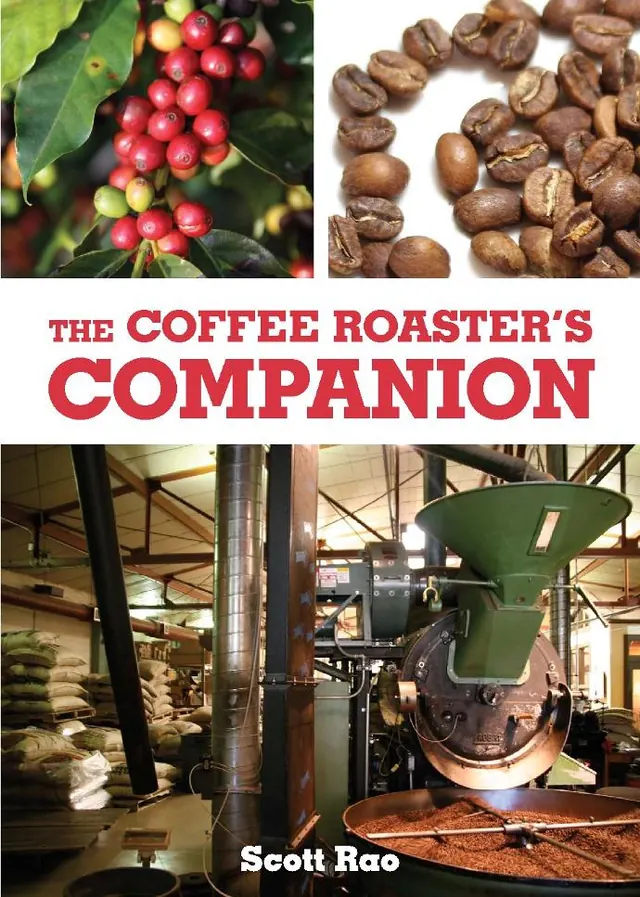
A deliberately brief professional manual
The Coffee Roaster's Companion appeared in 2014 as a practical manual for roasters, not as an engineering treatise or peer-reviewed chemistry book. Scott Rao condenses into ninety pages a way of observing, recording, and correcting batch roasting. The contemporary Daily Coffee News review places it at a time when digital curve logging was spreading but a shared professional vocabulary for interpreting those data was lacking.
Its central gesture is to turn roasting from a succession of intuitions into a repeatable process: define objectives, record temperature and time, observe rate of rise, maintain comparable conditions between batches, and cup systematically. It does not eliminate sensory craft. It tries to give that craft memory and conditions for comparison. The result is accessible to beginners, but it assumes a production roaster and concentrates, according to the introduction and reviews, on light or medium roasts of specialty coffee.
Seventeen chapters, from raw material to equipment
The contents reproduced by Douban make it possible to verify seventeen chapters. The first five explain why coffee is roasted, green coffee composition, processing and storage, physical changes, and roasting chemistry. The sixth is devoted to heat transfer; the seventh, to roaster designs; and the eighth, to the progression of a batch.
The operational section continues with batch planning, “three commandments” of roasting, consistency, and measurement of results. The final chapters cover sample roasting, cupping, the relationship between roasting, brewing, and extraction, storage of roasted coffee, and machinery selection. This structure matters because it avoids beginning with an isolated curve. Before interpreting a data point, the reader must consider raw material, thermal process, instrument, machine, and sensory criterion.
The “commandments” are not reproduced here as textual formulas: reviews summarize them, but a paraphrase can erase conditions and exceptions from the original. It is verifiable, however, that the book turned rate of temperature rise, energy distribution, and development into the axes of a coherent methodology.
Curves, RoR, and the promise of repeatability
RoR, rate of rise, is the change in the temperature reading per unit of time. Rao advocates observing its progression, not only final temperature or total duration. The Coffee Compass highlights among its lessons a preference for continuously declining RoR, sufficient application of energy at the beginning, airflow management, and assessment through cupping.
The idea is powerful because it requires attention to trajectory. Two batches can finish at the same color and have passed through different thermal histories. A curve, however, is not the bean. The probe responds to its own mass, position, contact with coffee and air, and software smoothing. The displayed value is a local signal from the system, not an exact and universal measurement of the internal temperature of every seed. A curve shape is therefore comparable only when equipment, batch, and instrumentation are sufficiently controlled.
Repeatability is not the same as quality either. Precisely repeating a defective profile only reproduces the defect. The book is right to place cupping and measurement together: the curve helps locate a difference; the cup determines whether that difference matters for the product objective.
What science supports and what it does not
Independent research confirms the general importance of time-temperature history. Baggenstoss and colleagues tracked sixteen aromatic compounds in a commercial drum and a fluidized bed. With a matched final color, high-temperature, short-time conditions produced different kinetics and properties from low-temperature, long-time conditions. When the same bean temperature profile was imitated, aroma formation was similar across the two systems studied.
That supports measuring the process, but it does not demonstrate one universal ideal curve. The experiments did not test every machine, origin, batch size, or RoR shape. A later study using eight sensory data sets found that color and time influenced flavor and that, at constant color, development time had more effect than time to first crack. Color was nevertheless a stronger predictor. The prudent conclusion is multivariable: a time ratio or curve without color, coffee, and tasting is not enough.
There is also experimental support for deliberately defective profiles producing differences. A 2018 study compared six profiles labeled normal, light, dark, scorched, baked, and underdeveloped through GC-MS, descriptive analysis, and consumers. The samples occupied different chemical and sensory spaces, and the balanced reference was preferred. But the study used a single arabica origin and profiles defined by a specific panel; professional labels do not thereby become unique chemical diagnoses.
Reception and influence
Early professional reception was intense. The Coffee Compass described it as dense despite its size, balanced between theory and practice, and useful even when readers do not share all its conclusions. Sprudge documented well-attended courses and the expectation that the book would help roasters use Cropster or Artisan data more intelligently.
Daily Coffee News also recorded an important objection: the promotional claim that almost no prior technical literature existed minimized decades of roasting science and engineering. The criticism does not cancel the manual's novelty as an operational synthesis for specialty coffee. It distinguishes two different achievements: Rao did not invent roasting research, but he did help translate technical problems into language that many roasters could apply and discuss.
Later influence is visible in the normalization of terms such as RoR, crash, flick, and development. That diffusion is cultural reception, not causal evidence. A common term does not guarantee that everyone defines it in the same way or that the sensory defect attributed to it has only one cause.
Limits and a current reading
The book concentrates on batch roasters and light or medium specialty coffee. Its recommendations do not cover continuous roasters, fluidized beds, instant coffee, very dark profiles, or every scale in equal detail. An action involving gas or air can produce opposite effects in machines with different architectures. Even within a drum, batch size, power, speed, ambient pressure, and moisture alter the response.
Probes, software, and sensory literature have improved since 2014. Rao later published Coffee Roasting: Best Practices, revising and expanding several ideas. The Companion should be read as the system that established a foundation, not as the latest version of the author's position.
Its most responsible use is experimental: establish a stable baseline, change one variable, repeat, measure color and mass loss, cup blind when possible, and document the context. If the result contradicts the rule, the data should not be forced to protect it. That willingness to compare, more than any specific percentage, is the book's enduring legacy.
Edition consulted
This dossier covers ISBN 9781495118197. BookScouter records it as a 2014 first edition, hardcover, and 90 pages. Sanmin agrees on author, publisher identified as Scott Rao, year, format, and length. Douban confirms these details and provides the contents.
Some secondhand marketplaces attribute 2016 to the same ISBN, probably because of a printing or late metadata, but they do not identify a new textual edition. Given the existence of 2014 sources and reviews contemporary with its launch, Gota retains 2014 and avoids inventing a reprint number. It does not claim that all copies with that ISBN are physically identical beyond what the records make it possible to verify.