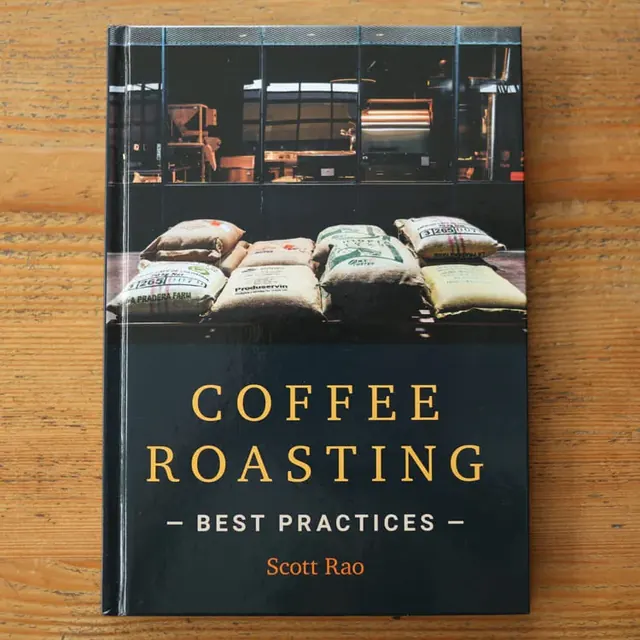
A sequel, not a replacement
Coffee Roasting: Best Practices assumes a reader who already knows the anatomy of a roaster, the vocabulary of curves, and the fundamentals explained in The Coffee Roaster's Companion. Scott Rao presents it as an advanced guide to reducing defects and achieving repeatable results in production. The Roast Rebels record emphasizes that there is little overlap: the first book introduces fundamentals and machine designs; this one concentrates on controlling profiles.
The difference is not merely one of difficulty. The volume moves attention from “what happens during roasting” to “how to prepare the machine and the working day so that the data are comparable.” Burner adjustment, drum speed, airflow, thermal state before charging, probe position, software, and the between-batch protocol are all part of the same problem. A curve cannot be repeated if the system begins each batch with a different amount of energy.
A structure oriented toward production
The detailed Oil Slick Coffee review documents nineteen chapters in a brief book. It specifically identifies “Tuning Your Roaster,” “How Probe Speed and Location Influence Curves,” and “Roasting Software and Automation.” It also describes chapters on approaching a new coffee, basic chemistry, data collection, preparation and consistency, reasonable parameters, reading curves, air, gas, moisture, first crack, post-crack control, sample roasting, storage, and common errors.
That structure explains why the book should not be reduced to “avoid crash and flick.” Before interpreting those patterns, Rao asks readers to construct conditions of measurement: actual power, a manometer, suitable probes, stable warm-up, and a between-batch protocol. He then connects the curves with decisions about gas and air. At the end, he returns the process to color measurement, mass loss, cupping, storage, and quality control.
Not every title in the contents is supported here by a public publisher source, so this dossier describes the sections verified by the review rather than reconstructing a complete table from unauthorized copies.
The probe measures a signal, not the inside of the bean
One of the most useful contributions is its demystification of the “bean temperature” reading. The probe is in intermittent contact with a moving mass and hot air; its diameter, material, position, and response time change the curve. The initial “turning point” is primarily the sensor's thermal response after charging, not the moment when beans that entered at room temperature cool down from the roaster's temperature.
RoR is the derivative of that reading and amplifies noise, delay, and smoothing decisions. Two installations can therefore display different curves for similar processes, or similar curves for internal histories that are not identical. The practical vocabulary of crash, a sharp fall, and flick, a late rise, depends on how the signal is calculated and filtered. The book attempts to work within that limitation through instrumental consistency, not to pretend that it eliminates it.
This caution has an editorial consequence: a visually “perfect” graph does not demonstrate even development or sensory quality. It is a useful fingerprint for comparing the same system. Changing the probe, software, or filtering breaks some of that comparability.
Declining curves, defects, and causality
Rao favors a smoothly declining RoR and proposes gas strategies to avoid falls around first crack and later rises. He attributes flat or cardboard-like flavors to baking and excessively roasty notes to certain rises or late applications of energy. These associations have been enormously influential, but their names are not chemical entities with one definition.
The 2018 study of common defects produced six profiles from the same arabica and analyzed them through GC-MS, a descriptive panel, and consumers. Samples defined as light, dark, scorched, baked, and underdeveloped separated chemically and sensorially, and the reference profile was more balanced and preferred. This demonstrates that deliberately different time-temperature histories can generate coherent signals. It does not demonstrate that every fall in RoR, in any machine, causes exactly the same flavor.
A 2020 study integrating eight roasting studies found that color and time influenced acidity, fruitiness, sweetness, and bitterness; color explained more variation, although development time was also significant. Another experiment with four profiles of one Colombian coffee, approximately matched at Agtron 76, measured sensory analysis, NMR, and DHS-GC-MS. Short developments were fruitier, sweeter, and more acidic; long developments were roastier, nuttier, and more bitter.
The results support the idea that time after first crack can modulate the profile even at similar color. Their limits are clear: one coffee, a one-kilogram Probatino, and four trajectories do not establish optimal percentages for all production. Moreover, “maintaining color” requires changing final temperature when time changes, so the treatment represents a controlled combination rather than an isolated industrial variable.
Gas, air, and thermal state
The book insists that charge temperature does not summarize the energy stored by the machine. Two roasters can display the same value after spending the preceding minutes at different temperatures. The between-batch protocol seeks to stabilize that history. This is a physically reasonable intuition: walls, drum, air, and components exchange heat with the coffee, and their contribution depends on the design.
For the same reason, an airflow instruction does not transfer literally. In some drums, increasing flow can raise convective heat transfer; in others, it introduces cooler air and slows the batch. It also removes smoke and chaff. The guide's practical value lies in asking roasters to characterize their machine's response and repeat the procedure, not in offering a universal control setting.
Later work shows why a single signal is insufficient. A five-kilogram commercial study found that seven profiles changed the dynamics of titratable acidity during roasting, although the maximum around first crack was surprisingly similar among the profiles and origins tested. The article measured simple chemistry, not perceived acidity, and ended near carbonization to observe the entire trajectory. It is useful for questioning overly linear narratives, not for replacing cupping.
Professional reception
Oil Slick Coffee considers the book a useful continuation and especially praises its discussion of probes, telemetry, and software. The Home-Barista thread shows favorable reception among professionals and advanced enthusiasts, alongside doubts about applicability to home roasters and about claims based on the authority of having worked with hundreds of machines.
That mixture is informative. Rao's practical standing explains why his proposals are tested; it does not replace replication, controls, or blind assessment. Reader ratings do not constitute evidence that the method improves every coffee either. They document that it provided tools and an operational language that many found actionable.
Who it serves and how to use it
It is most useful for roasters who are already producing, have data logging, and can control maintenance, warm-up, and the between-batch protocol. A beginner can learn much, but risks pursuing an RoR shape without understanding the machine. On a home roaster with slow sensors or power that is difficult to modulate, some tactics are impossible to reproduce.
A responsible reading turns each “best practice” into a local hypothesis: document the coffee, moisture, density, batch size, environment, thermal state, gas, air, color, mass loss, and rest time; repeat; cup blind; and compare. If a smoother curve does not improve the cup, the discrepancy deserves investigation, not concealment.
Edition and date
AbeBooks records ISBN 9781792327759, 2019, 94 pages, English, hardcover, and the bibliographic label “Independent Publisher.” BookScouter agrees on year, length, and format. Roast Rebels confirms ISBN, language, and 94 pages.
Some European stores give 2020. The known copyright page carries a 2020 copyright in certain copies, while the introduction is dated in California in 2019 and independent catalogs divide their records. Without evidence of textual changes or a new ISBN, Gota uses 2019 as the first documented publication and states the discrepancy. It does not assign an edition or printing number that the sources do not prove.