Section
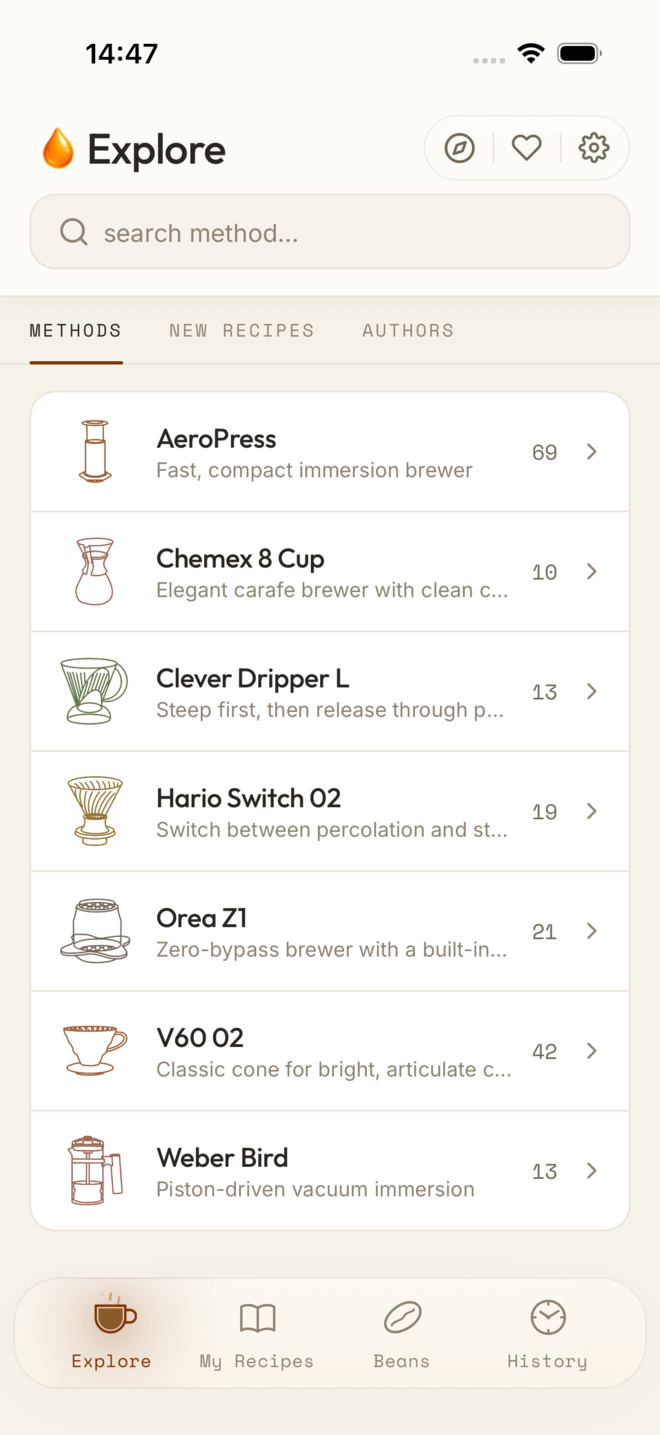
Methods
A brewer is a constraint, not a tool. V60 rewards flow control, French press rewards patience, AeroPress trades volume for grip on every variable. Pick by what each one makes easy to taste — clarity, weight, texture — not by what photographs well on a shelf.
12 Articles
Articles
Filter vs immersion
Every brewing device sits on one side of a single line. Filter brewers (V60, Kalita, Chemex, Origami) move water through the bed. Immersion brewers (French press, Clever, cold brew) let water sit with the grounds and then drain. AeroPress is a hybrid that gives you both, depending on how you use it.
Intro
2 min
V60
Hario's conical brewer is the most copied design in modern coffee, and for good reason: a 60° cone, deep ribs, and one big hole add up to a brewer that doesn't restrict flow at all. The grounds are what hold the water back, not the device. That makes the grind and your pour the only real variables.
Intro
3 min
Kalita Wave
Where the V60 gives you a deep cone and free-flowing exit, the Kalita Wave does the opposite: a flat bed, three small holes, and a corrugated paper that holds itself off the walls. The brewer restricts flow on purpose. The grounds and the device share control.
Intro
1 min
Chemex
The Chemex is mostly known for its hourglass silhouette, but its real signature is the paper. Chemex bonded filters are 20–30% thicker than standard pour-over papers — they trap more oils, more fines, and slow flow noticeably. The brewer is a vessel; the filter does the work.
Intro
1 min
Origami
The Origami dripper is a folded ceramic cone with 20 vertical ridges, designed to fit either a V60 conical filter or a Kalita Wave flat-bottom paper. One brewer, two geometries — that's why competitive baristas keep landing on it.
Intermediate
2 min
AeroPress
The AeroPress is a plastic cylinder, a plunger, and a paper filter — sold as a travel brewer in 2005 and quickly adopted by people who'd never travel with one. Its trick is that it sits across the filter/immersion line. Closed at the bottom by the filter and your stand, it's an immersion brewer. Once you press, water and grounds separate fast. The grind range it accepts is enormous, and the cup is clean but with body.
Intro
2 min
Clever and Switch
Both brewers solve the same problem: what if you could steep like a French press, but drain through a paper filter? The Clever Coffee Dripper has a gravity-triggered valve in the bottom — it stays closed until you place the brewer on a cup, and the cup pushes the valve open. The Hario Switch is a V60 with a manual valve. Same idea, different release mechanism.
Intro
2 min
Cold brew
Cold brew is filter coffee's slowest cousin. You drop coffee and cold (or room-temperature) water into a vessel, leave it for 12–24 hours, and then strain. No heat, no pour, no fuss. Time replaces temperature as the extraction lever.
Intro
3 min
French press
The French press is the cleanest expression of the immersion idea: ground coffee, hot water, a metal mesh, and time. The mesh holds everything bigger than ~150 microns; everything smaller — fines and oils — passes into the cup. That single design choice is what gives the French press its character.
Intro
3 min
Moka pot
Bialetti patented the moka pot in 1933 and the design hasn't changed much since. A bottom chamber holds water, a basket holds coffee, an upper chamber receives the brew. Heat the base on the stove; pressure builds in the bottom chamber as water heats; steam pressure pushes hot water up through the basket and into the upper chamber. It's a stovetop pressure brewer, not espresso — pressure tops out around 1.5 bar, where espresso machines run 9.
Intro
4 min
Japanese iced (flash brew)
The fastest way to a high-quality cold coffee is also the most counter-intuitive: brew a hot V60 directly onto ice. Flash brew — the Japanese kissaten tradition of aisu kōhī, brewed hot and chilled on the way down — replaces part of the brew water with ice in the carafe. The hot brew falls through the bed normally, then chills instantly on contact with ice — locking the volatile aromatics in the cup before they evaporate.
Intermediate
4 min
Siphon
Two glass chambers, a heat source, and a vacuum. Water is driven upward into the coffee by vapour pressure, steeps as a full immersion, then gets pulled back down through a filter when the heat comes off. It is the most theatrical brewer in coffee and the one most often dismissed as theatre — which is a shame, because the cup it makes is genuinely hard to get any other way.
Intermediate
4 min
The whole library, offline
Every recipe here, in your pocket.
All 1022 curated recipes from 130 baristas — filterable by taste, time, and roast, saved offline, with your favorites and tasting notes alongside.
- Works offline — brew anywhere
- Filter by flavor, body, and roast
- Favorites and a tasting log
Free iOS No signup 1022 recipes by 130 baristas