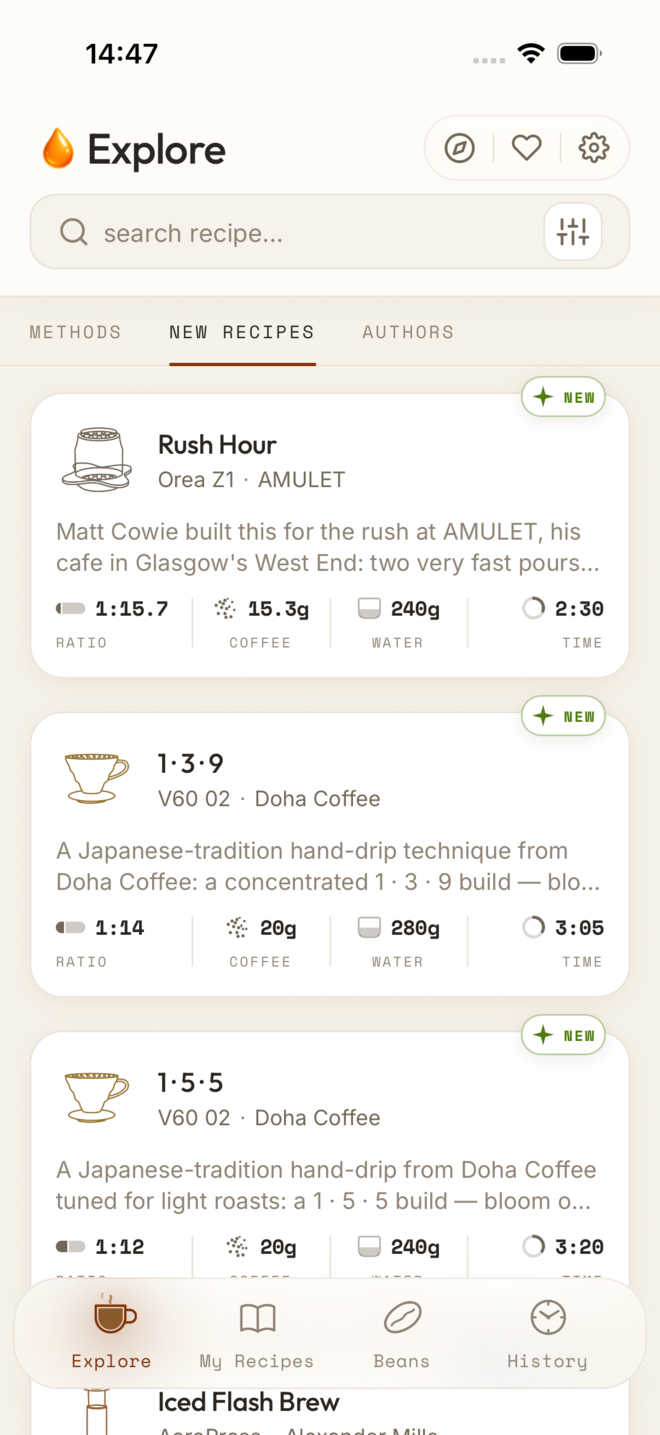
A brewing approach where water passes through the coffee bed continuously and exits as brewed liquid almost immediately. Every pour-over method is percolation: V60, Chemex, Kalita, Origami, Orea, Tricolate. Espresso is also percolation, just under nine bars of pressure.
The opposite is immersion, where the bed sits fully submerged for a defined time before the liquid is separated. Percolation never reaches that equilibrium — water is always fresh against the grounds, which means extraction never plateaus the same way.
How it tastes
Percolated cups read clearer, brighter, more articulated. Because fresh water is constantly meeting the bed, you can pull more nuance — fruit notes, floral aromatics, citric acidity — than immersion lets you hear. Light roasts especially prefer percolation: it's where their high-altitude character actually shows up.
The cost: percolation is technique-sensitive. Pour rate, distribution, agitation, channeling — all of these change what comes out. Two baristas with the same recipe and the same coffee can produce different cups on a V60 if their pours don't match.
What controls a percolation brew
Beyond grind, time, temperature, and ratio, percolation adds two more variables: flow rate (how fast water moves through the bed) and pour pattern (where you direct it on the surface). Recipes are often written as much around these as around the chemistry — Hoffmann's V60, Kasuya's 4:6, Tricolate's slow drawdown. The vocabulary that surrounds pour-over coffee exists because percolation is the form that demands it.